

Ancient sound, modern mystery: Bagpipe harmonics and Sanskrit chanting
By Kris Bowden
You’ve heard it before. The sound of the bagpipe “stirs the blood” or awakens emotions in people. It is an instrument scientifically noted for a profound impact on the human nervous system.
The drones produce a deep hum with overtones that can reach up to 10,000 Hz, with some levels extending beyond human hearing.
When we tune our pipes traditionally, using just intonation, the notes are perfectly in tune with the drones, creating a resonant, “pure” sound layered with harmonics. That layering of sound is what gives it a guttural power that people can feel deeply.
Ideally, that’s what we pipers are all chasing, am I wrong? A locked-in, pure sound working in harmony, surrounding us in a bubble of tone.
“Why are you always tuning?” my wife asks. My answer varies, but it comes down to this: I need to.
I know I’m not alone. When your pipes are optimal, and you’re playing by yourself and living in it, there can be a transcendent, almost spiritual quality.
Some people call it primal. Haunting. Even “unearthly.”
Join me down a rabbit hole for a moment, and I promise to loop back to the pipes.
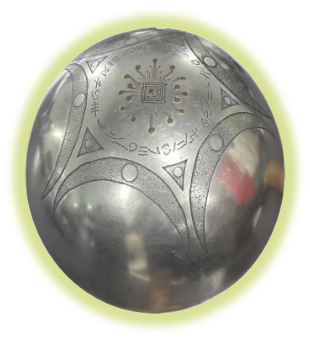
Have you heard of the “Buga Sphere”?
It is an alleged piece of extraterrestrial tech or an artifact that crashed after hitting power lines in Buga, Colombia, in May 2025.

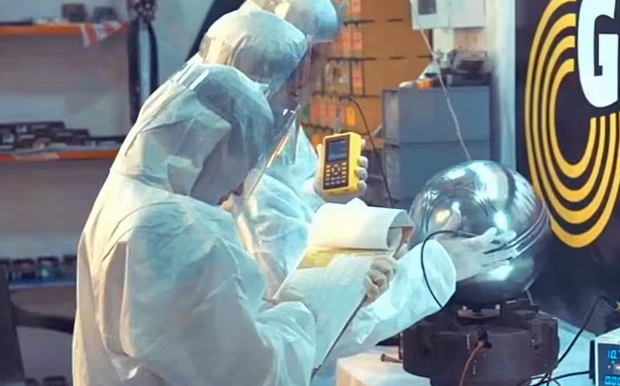
Skeptics could argue that it’s an elaborate art project or hoax, but the scientific data continues to pour in about this unique item, now under analysis in Mexico City. Key institutions involved are the National Autonomous University of Mexico, MIT, the University of Georgia, and the University of San Diego.
X-ray footage by MIT has revealed that the object contains a complex network of sub-spheres, with a fibre-optic-like wiring linking them, and an engraved script on the exterior.
The outside is seamless with no welding marks. The sphere itself is made of aluminum, with an initial Brinell hardness of around 330, which is extremely hard for aluminum. Humans can technically make aluminum to that hardness level, but it’s extremely difficult and beyond today’s industrial standards.
ChatGPT informed me that, in theory, to create a unique lattice structure similar to that found in the Buga Sphere, we would need to add rare-earth elements such as cerium or lithium.
The intricate designs on the sphere are linked to several ancient writing styles. Sanskrit is the closest match; ancient Irish Ogham and Norse runes also have similarities.
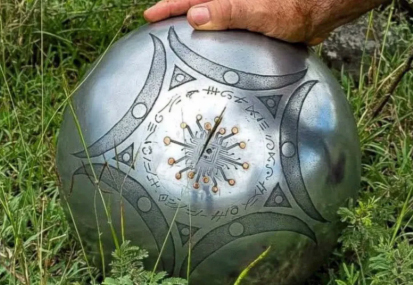
Is this advanced tech or is this ancient tech? The University of Georgia found that there are 31 microscopic holes along the equator of the sphere. Inside, researchers found an unidentified resin they believe serves as an adhesive to anchor the fibre-optic-like threads.
The organic resin dates to approximately 12,560 years ago – the “Younger Dryas” period of Earth that predates human civilization by thousands of years.
Okay, let’s make a wide turn back to music, harmonics, and vibration.
Continued experiments on the Buga Sphere show that it starts activating, specifically vibrating, when exposed to Sanskrit mantras. The sphere’s internal vibrations matched the rhythm of the chanting.
Unlike a pure electronic sine wave, the drones of a Highland bagpipe produce a fundamental frequency and a dense series of overtones. The sphere’s 18 microspheres reportedly oscillate more vigorously when locked onto these complex multi-layered harmonics.
So, finally: bagpipes.
That’s what initially brought me to this fascinating story. The first round of reports released in December 2025 claimed they tested pipes “with comparable results.”
The updated research now refers to the pipes, but says they only suspect that they would generate the same multi-layered harmonics required, not that they have directly tested them.
That means the job is open!
Unlike a pure electronic sine wave, a bagpipe drone produces a fundamental frequency along with a dense series of overtones. The sphere’s 18 microspheres reportedly oscillate more vigorously when locked onto complex multi-layered harmonics, exactly like those the Highland bagpipe creates. I, for one, would love to see and hear a professional-level piobaireachd played for the thing and see how it reacts.
The crossover between the pipes and meditative chanting
While playing the pipes and chanting Sanskrit Bija mantras like Hrim, Shrim, and Krim might seem worlds apart, they share profound physiological and potentially spiritual mechanisms.
- Deep diaphragmatic breathing: filling the lungs from top to bottom.
- The drone: A continuous, unchanging harmonic floor, comparable to repetitive mantras that create a “mental” drone to displace intrusive thoughts and to mask internal noise.
- Physical vibrations: I’ve long said, Vibration matters when seeking an incredible bagpipe. The je ne sais quoi of sheepskin . . . ebony . . . cane reeds . . . whatever little things that can add more vibration, I will do. I’m more at one with my pipes when they’re vibrating, and I can feel the bass drone vibrating along my collarbone and into my chest. When they’re going optimally, it’s a special destination to reach.
Sanskrit is often called “the perfect language of sound” because the vibrations produced by its syllables are intended to stimulate specific energetic centers, called chakras. The goal is to create internal resonance that physically vibrates the skull and chest.
What makes you pick up your pipes?
For some, the camaraderie and good “chunes” are enough. For others, it may very well be something quantifiably deeper. Something mysterious, ancient, and spiritual:
The hair-raising on the back of your neck when you come down on low A after tuning the drones in perfect harmony.
Pipe-Major Stuart Liddell overwhelmed with emotion at the crescendo of Inveraray & District’s “Dream Valley” medley at the Worlds.
So, are the pipes just a bag, a bunch of reeds and hollow sticks, or are they a connection to something we’ve lost and are about to rediscover?
We’re packing some serious heat and possibly even more power than we know.
Kris Bawden is the pipe-major and founder of the MacEoin-Ramsay Pipe Band of Ottawa, and a media personality (Big Kris, “BK”) and producer whose career has spanned multiple cities in the Ontario, including Hamilton, Barrie, Ottawa, and is probably best known for his FM Morning show on K-Rock 105.7 in Kingston. Music credits include The Trews’ “Highway of Heroes” as studio session piper and appeared in the music video. He was presented with a gold record by The Trews in 2014. Outside of his media persona, from 2008 to 2011, he served Canada as a civilian with the “Influence Activity Task Force” in Kandahar, providing terrestrial FM radio programming capability and management to Psy-Op assets for ISAF. He lives in Ottawa.
Be sure to check out Kris Bawden’s Substack newsletter.

“The intricate designs on the sphere are linked to several ancient writing styles. Sanskrit is the closest match; ancient Irish Ogham and Norse runes also have similarities.”
I have studied Sanskrit for over 30 years. Sanskrit is a language, not a script. Today Sanskrit is usually rendered in a script called ‘Deva Nagree’ (‘deva’=divine, ‘nagree’ means city. ie the divine script of the city). I have only briefly studied runes. To be honest, I struggle to find any similarities between Runes and these characters.