

Leading lights pay tribute to the late, great Ian McLellan
The passing of Ian McLellan BEM on December 3, 2025, was a profound loss for the piping and drumming world.
As a pipe-major, his accomplishments and reputation are legendary and historic. As an influencer, he didn’t simply raise the playing standard a pipe band could attain; he catapulted it miles forward. As a gentleman, he respected and admired his competition, and to virtually everyone he spoke to, he didn’t simply make them feel like an acquaintance; you were a friend for life.
There are so many in the piping world who Ian McLellan deeply influenced. We asked several of the greatest for their thoughts at this sad time.
John Wilson
One of the piping and drumming world’s most famous people, the Campbeltown native was a piper and pipe-sergeant in Ian McLellan’s Strathclyde Police for many years, and remained a close friend for the rest of his life.
Ian and I were very close friends for more years than I care to consider, and the piping community and pipe band world have lost a giant in his passing.

Nearby was another piper tuning up, clearly getting ready to play in the March. It was Ian McLellan. He told me that he had coincidentally been drawn to play first in the March event and that that was his first time competing in Oban.
I really connected with his friendly, supportive attitude, and as we walked away to our respective platforms, he said, “Well, here goes. The rookies will have to set the standard.” Ian won the March, and I won the Strathspey & Reel, but I was left with the thought afterwards that some day our paths might cross.
Ian had inherent management and leadership skills that many HR consultants would envy. He was sharply focused; he would readily identify good practice and embrace it. He was trusting and a natural man manager. In addition, he was modest and pragmatic, with a very professional presence. When he spoke, people listened. All of these qualities he channelled into his role as pipe-major of the Strathclyde Police Pipe Band.
His forte as a piper was the March, Strathspey & Reel format. From the outset, he was clearly determined to make the name Strathclyde Police Pipe Band synonymous with a level of excellence in that discipline.
“Attention to detail” was his mantra, and for Ian, that phrase was a straightforward summation as to how to present a March, Strathspey & Reel in an authentic fashion.
“His drive came from his passion for the music and a burning desire to perform to the highest standard consistently. In truth, he was openly uncomfortable at any speculation or references regarding record-breaking wins.” – John Wilson
Practice sessions were where all the detailed preparation was done, because Ian firmly believed that, on competition days, the level of playing on pipes should be limited so that the players would conserve their energy and adrenaline levels for the competition arena. He always reminded us to leave our performance in the arena with the judges, not in the tuning field.
In tuning the band, he passionately adopted the basic approach that if the note intervals in all chanters were accurate, then the drones would be in harmony and remain steady throughout. Over the years, I was privileged to be his “trusty lieutenant” in that process.
Ian wasn’t results-driven. In fact, he always believed that the piping/drumming public would, and should be, the ones to define the band’s place in history. His drive came from his passion for the music and a burning desire to perform to the highest standard consistently. In truth, he was openly uncomfortable at any speculation or references regarding record-breaking wins.
Despite his outstanding record of pipe band championship wins and his elite profile as a solo competitor, teacher, and judge, he remained a very modest and approachable man with a huge passion for our music.
I was privileged and honoured to be his pipe-sergeant during the halcyon days of our World Championship wins. These were experiences I will cherish forever.
Ian, my friend, rest in peace.
My deepest condolences to Karen, Janice and their families.
Richard Parkes
As pipe-major of Field Marshal Montgomery, Richard Parkes at least shares a common status with Ian McLellan as the greatest pipe band leader in history.
Ian McLellan was one of my heroes.
I took on the role of pipe-major of Field Marshal Montgomery in 1981 at a time when the Strathclyde Police had claimed two World Championship titles in just a few short years. I already held Ian in the highest regard as a pipe-major, and I made a point of watching him lead Strathclyde at the major contests whenever I could.
“He spoke little during tuning. He didn’t need to. The hard work had already been done in the weeks and months beforehand, aligning his players to his wavelength, focused entirely on him and the job in front of them.” – Richard Parkes
What stood out to me was the importance of leading by example. Ian’s leadership was subtle, disciplined, and unwavering. On the day of a contest, his players seemed to understand instinctively what he expected. He spoke little during tuning. He didn’t need to. The hard work had already been done in the weeks and months beforehand, aligning his players to his wavelength, focused entirely on him and the job in front of them.
I built my own tuning strategy for FMM based on what I learned from watching Ian. What impressed me most was how he adapted his band’s sound to whatever the weather delivered. On a rainy competition day, you’d hardly see Strathclyde tuning at all before entering the circle. In what seemed unexpected at the time, the pipers kept their instruments out of the rain until a short time before they were due to perform – and yet, without fail, the sound was always there.
That sound became the standard I pursued with FMM. The sound Ian created with the Strathclyde Police raised the bar for the entire pipe band world. His commitment to precision playing and meticulous one-to-one tuning to produce a robust, bright sound in complete unison pushed preparation far beyond the accepted norm at that time. The results speak for themselves – an unprecedented six consecutive World Championship titles from 1981 to 1986, a record that still stands unmatched.
Throughout my years leading FMM, his legacy with the Strathclyde Police remained the mark I measured myself against. When Ian set down the pipes and picked up the judge’s clipboard, I looked forward to the days he was on our panel. His feedback was constructive, fair, and delivered in a way that made you want to rise to the challenge the next time. And when he eventually retired from judging, he became very encouraging to me. When I was getting close to his record of 12 World Championships, Ian told me he thought I could break it. That encouragement, spoken with a sincerity that spoke volumes about his character, meant a lot to me.
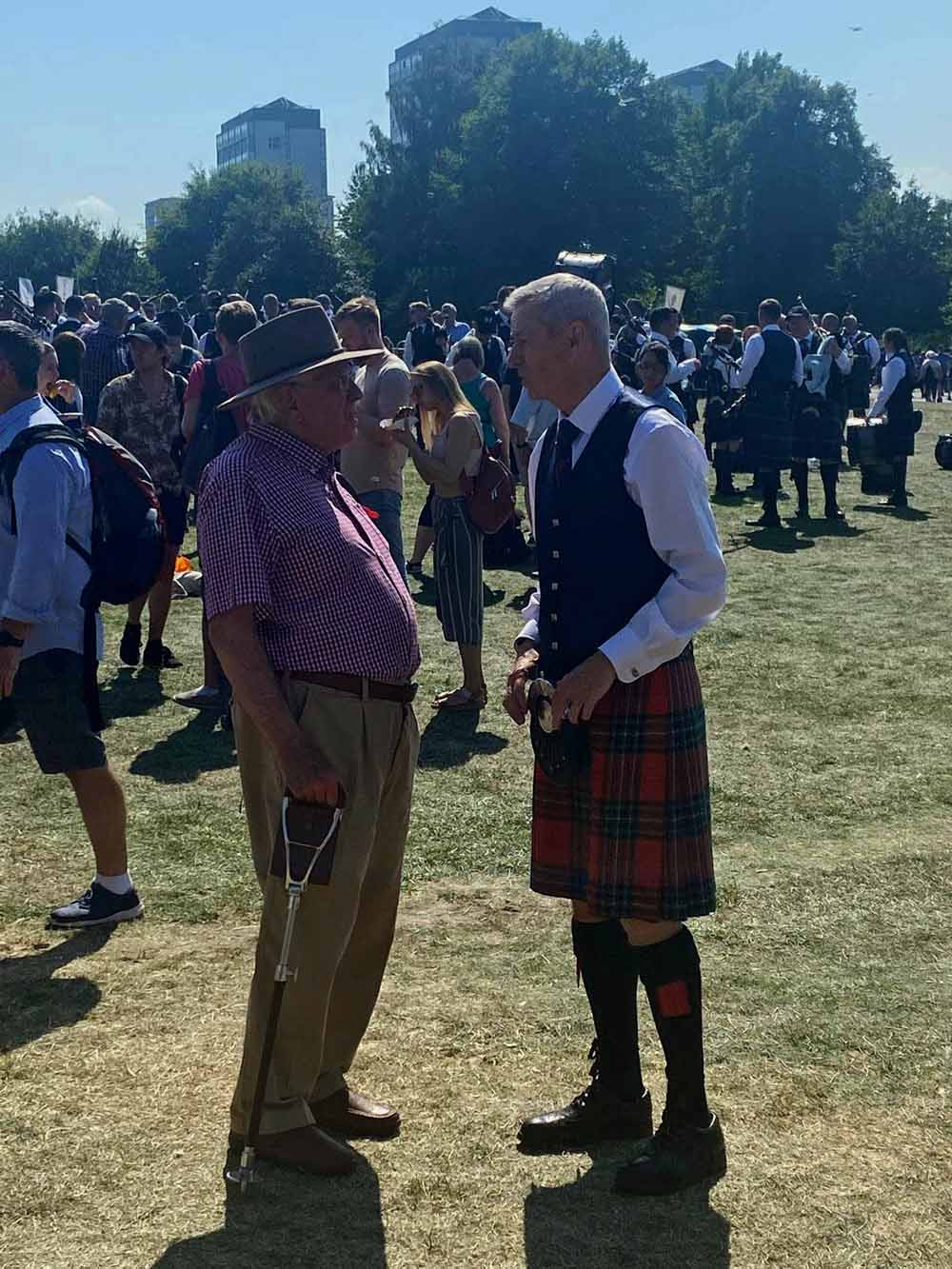
The 2022 Worlds brought a heatwave rarely seen in Glasgow, with the mercury touching 29 degrees as we made our final preparations. We clustered under the gazebos, protecting the pipes from the sun, when I glanced up and spotted Ian approaching – Panama hat, walking stick, and that familiar easy stride. He greeted me with a handshake and a few kind words of encouragement for the results later on that day.
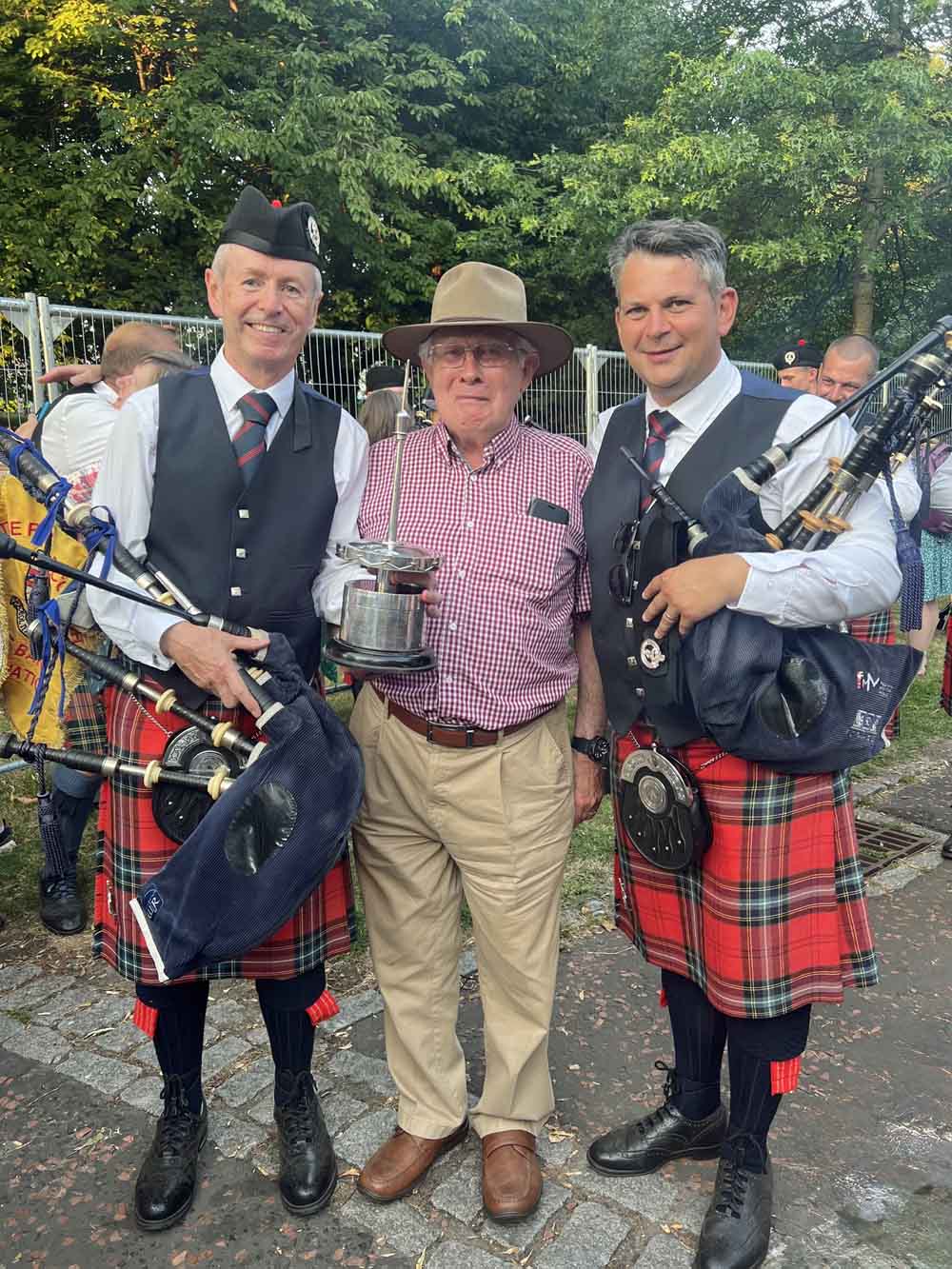
That evening, FMM marched off with its thirteenth World Championship. Ian was among the first to congratulate me. His graciousness was matched only by his humour; the crowd burst into laughter as he pointed at me and yelled, “Give me back my trophy!”
A framed photo of Ian, Matt Wilson, and me from that day hangs in my sitting room. It remains one of the most cherished memories of my time as pipe-major. Now, it carries a quiet sadness, not only because our craft has lost one of its greats, but because I have lost one of my heroes and a friend.
Robert Mathieson
He guided Shotts & Dykehead Caledonia to five World Championship wins and now serves on the RSPBA’s judging panel. Mathieson’s Polkemmet and Shotts bands were in rare company as they actually beat McLellan’s Strathclyde Police on a few occasions.
I remember, as a young, enthusiastic piper in the early 1970s, regularly listening to the piping program on Radio Scotland. It was hosted alternately by George Mcllwham and Lt.-Col. David Murray. For me, the best three featured soloists in those days were Pipe-Major Angus MacDonald, Hector MacFadyen and Ian McLellan. If any of these three guys were on, I would never miss the session.
“He was the maestro at delivering great forward motion in the music without sacrificing the definition in the embellishments.” – Robert Mathieson
I was blown away by an article in which Ian mentioned Hector MacFadyen very favourably for his style of play and technical precision. Ian himself had a very distinctive and powerful style of execution when playing any melody, competition or otherwise. He was the maestro at delivering great forward motion in the music without sacrificing the definition in the embellishments, especially in the marches.
I remember in my early days as pipe-major of Polkemmet. I came off the park thinking it had gone quite well. He heard us play, came over to me, and said, “That was really well played, but you need to get it up the park a bit!”
I was shocked that he would take the time to chat with me as a young newcomer to the pipe-major role and then also offer sage advice as a fellow competitor. Dwelling on notes too long and overstated expression was a pet hate of his.
I don’t think I have ever heard anyone else master or display his dynamic technique in light music to that degree. That same hallmark came through strongly in his pipe corps, with even more contrast in note values and compression to create collective unison in the execution. He was a genius at making sure that the note values governed what went into the rhythmic accompaniment, without any piping compromise, especially in the traditional idioms of his pipe band ensemble.
He was a good friend, teacher, judge, listener and mentor to anyone who played pipes. It’s the end of an era, and he will be sadly missed.
It was an honour to share in his knowledge.
Wilson Brown
The Highland Society of London Gold Medallist played under Ian McLellan for many years.
I joined the Strathclyde Police as a 22-year-old, not expecting to be involved with the police pipe band for a few years. However, when Ian McLellan gets in touch, hands you a stack of tunes, and tells you he needs you for the Worlds in six weeks, you don’t say no.
What followed was five World Pipe Band Championships from 1983 to 1988, along with insights into leadership, motivation, discipline, and an unwavering confidence in both himself and his team.
He demanded respect and instilled confidence even when some of us had doubts. In Ian, you trusted, you knew he had the solutions. A scorcher at Bellahouston? A monsoon at Cowal? No problem. He was able to produce the goods regardless. He didn’t use technology or a scientific approach. He used his ear and management skills to mould a small group of pipers – sometimes as few as 10 – into something special.
“Many hours of discussion, negotiation, experimentation, and, no doubt, compromise went into producing a combination of pipes and drums admired by many.” – Wilson Brown
His friendship and close collaboration with Alex Connell were also admirable, as he fully appreciated the need to develop a strong ensemble effect. Many hours of discussion, negotiation, experimentation, and, no doubt, compromise went into producing a combination of pipes and drums admired by many.
He was a constable in the police rank structure, but to all of us, he was undoubtedly the boss, someone we respected and admired.
I spoke to him briefly at this year’s Masters Solo Piping Competition. Although his health was suffering, it took me back to the 1980s, when I spoke to him with the same reverence I had shown in my early twenties, remembering the formidable force he was as he led one of the most successful pipe bands ever. I was grateful to have been part of that story.
Ross Walker
Walker was pipe-major of Boghall & Bathgate Caledonia for 20 years. Before retiring in 2015, he was a piper in the band that competed, occasionally successfully, against McLellan’s Strathclyde Police. Walker is now an esteemed RSPBA judge.
My brothers and I will always fondly remember Ian. From a chance meeting in Paignton in 1976, where Ian and May pitched their sun-loungers next to a very young Walker clan, through many subsequent years of friendly yet fierce competition, Ian and the band he led were a constant source of inspiration and aspiration . . . and not a little frustration.
“His reach and reputation were more expansive than he probably knew in those days, exemplified by the reaction from the father of a Boghall bandsman after a Boghall championship win in the early 1980s: ‘Were the Polis’ no’ there?!'” – Ross Walker
A formidable competitor, his all-conquering Strathclyde Police set the mark that we all endeavoured to meet and surpass. The few blows we managed to land in competition were very special indeed, given the level of perfection in his music and tone. His reach and reputation were more expansive than he probably knew in those days, exemplified by the reaction from the father of a Boghall bandsman after a Boghall championship win in the early 1980s: “Were the Polis’ no’ there?!”
Like many of the pipe band greats, Ian was always generous with his time, advice and support to me as a fledgling pipe-major. His words of wisdom were like a fine wine: to be enjoyed, carefully considered and long-savoured. His unparalleled achievements and experience at that time gave his advice a unique gravitas that will remain long in the memory.
Terry Lee
He led Simon Fraser University to six World Championship trophies, and for much of his career, competed head-to-head with McLellan’s “Polis.”
It isn’t easy to compile thoughts on someone whom you hold in the highest regard. There are so many attributes that make Ian McLellan, to me, the true definition of a pipe-major. These include drive, talent, passion, leadership, competitive spirit, patience and an even keel.
I remember when I first took over Simon Fraser University, touring around Glasgow to find out where “The Polis” were practicing. There always seemed to be several possible practice venues, and it was all very secretive (or the players weren’t told until late). Practices were closed during Worlds Week. They were a complete police unit who worked together, and practices were daily from 2 pm to 4 pm.
One time, I was finally invited out to a practice, and I was instantly taken with the discipline of the whole group. The only person speaking was Ian, and that was only when necessary. The members knew their role, and it was like a well-oiled machine. After practice, Ian made time to welcome me and asked how we were doing. I took so many things away from that practice. I was blown away.
“I could not believe it when Ian came on our bus afterwards to congratulate the band. He had just won the Worlds, and it was so indicative of his character.” – Terry Lee
In 1985, SFU was unknown but ended up a close second to the Strathclyde Police at the World Championships in Hamilton. I could not believe it when Ian came on our bus afterwards to congratulate the band. He had just won the Worlds, and it was so indicative of his character.
Then, in 1995, when we did manage to take it, it was a full-circle moment when Ian came up to shake my hand as we were playing off the field. I have an old, grainy photograph to prove it! I will never forget that moment.
Fast forward to Ian and me judging together. I enjoyed chats with him at the Worlds over a pint, awaiting the results. Even when Ian retired, he would join in the patter in the judges’ tent.
Such a class human Ian was. Just the best.
Alex Gandy
Ian McLellan’s influence on Alex Gandy was strongly felt in both his solo and pipe band careers.
Ian was the kind of man you wished could live forever.
I never got to hear his band or his playing in person, but it was always very clear to me the impact he had on the band and solo worlds.
I met him during a trip to Scotland in the early 2000s, but got to know him better when I lived in Scotland on and off from 2006 until 2008. Ian was always candid and would tell me what he thought. Thankfully, the good outweighed the bad, though I would never get away without the qualifying comment, “. . . apart from those D-throws.” Ian was firmly on the light D-throw team but would allow heavy throws if they were executed correctly, which I appreciated.
I was always happy to see his name on the adjudicators’ list. Ian was on the panel for a few of my more memorable prizes. He judged a few times when I wasn’t in the prize list. He was always prepared to tell me (or any competitor who asked) what he liked or didn’t like. It never felt personal. He put who he thought was best in first place.
The last time I played for the late Ronnie Lawrie was in 2007. He was judging the Open Jig with Ian at the Argyllshire Gathering. I vividly remember getting onto the boards, greeting them both, and Ronnie finding my tune list only to select all eight parts of “The Cameronian Rant.”
Almost like they had planned it, Ian looked at me without missing a beat, glint in his eyes and said, “And we’ll have it twice through.” I still remember the look on his face when he said it – a little cheeky, but I knew he thought I could manage it.
Things worked in my favour that day, and after about 70 pipers played, I ended up first. My dad was second, and it was the very first time I beat him in a contest. It was a big day for me.
Ian was on the panel when I won my first A-Grade light music event in Scotland, the March at the Inveraray Games, playing “Parker’s Welcome to Perthshire.”
“When I finished playing, I knew it had gone well, but I was more thankful to have finished relatively unscathed. When I looked at the judges’ table before leaving the stage, Ian had his arms out toward me, nodded and winked.” – Alex Gandy
Most recently, I believe the final event he judged was the 2023 MSR at the Glenfiddich. I was as nervous as anybody would be on that stage, but felt good being able to greet the judges: “Pipe-Major . . . Pipe-Major . . . Pipe-Major” – Ian Duncan, Ian McLellan, Jimmy Banks. I played “Brigadier-General Ronald Cheape of Tiroran” (a tune I know he was fond of, which helped me settle in the tuning room), “The Ewe wi’ the Crookit Horn,” and “Duncan MacIntyre RMS Athenia.”
When I finished playing, I knew it had gone well, but I was more thankful to have finished relatively unscathed. When I looked at the judges’ table before leaving the stage, Ian had his arms out toward me, nodded and winked. Again, a look from Ian that I will never forget.
We chatted afterward, and he told me the event was excellent, and the results were close, but that the harmonics from my pipe were what clinched things. Getting a compliment from that man about your bagpipe was the greatest. He was so renowned for sound and his light music playing. Seeing how guys I admired looked at Ian told me everything I needed to know, even as a teen.
Ian always made time for me. More recently, he would comment on pipes or tunes and also ask about my career. He thought I should be piping full-time instead of working for a bank. Some days, I agree with him.
You can get friendly and chat with most judges. But Ian always felt like a friend, even when I was 17. He would always ask about the family and had a very soft spot for my Mum and Grandpa Ronnie. Mum always called him “Pipe-Major,” which I think he also liked. Our entire family loved and appreciated Ian and will miss him greatly.
I’m so grateful for the many opportunities I had to play for him and to get to know Pipe-Major Ian McLellan.
Jack Lee
The most competitively successful Canadian piper in history, Jack Lee was significantly inspired by Ian McLellan, whether as pipe-sergeant of Simon Fraser University or one of the world’s greatest solo pipers.
Ian was a wonderful man, a fantastic pipe-major, and a true role model.
In the early days of SFU, Terry and I spent a lot of time with Ian. We were trying to learn as much as we could about how he did it. How did he get such a great sound from his pipe corps?
“They did it all with working Glasgow Police officers. There were no long-distance or rental players in those days.” – Jack Lee
Ian was incredibly generous with his time and only too happy to help us. His mentorship was instrumental in SFU’s journey. When SFU won its first World Championship in 1995, Ian was one of the first to congratulate Terry – a kind gesture that we greatly appreciated.
One aspect of the great Glasgow/Strathclyde Police success story that doesn’t get enough attention was that they did it all with working Glasgow Police officers. There were no long-distance or rental players in those days.
Ian was a terrific teacher and mentor. Once he retired from the band, he became much more involved in solo judging. I had many chats and visits with Ian in that phase of his career. As always, he was most generous and helpful to soloists like me.
I will miss him and think of him often.
James Wark
One of the stalwart pipers in and contributors to Ian McLellan’s Strathclyde Police. James Wark is a composer of renown; the band played many of Wark’s compositions. He has served on the RSPBA adjudication panel for many years.
I learned a lot from Ian.
He was a humble man who never expected success but just did what he knew was right. I don’t recall him ever giving anyone criticism. If you needed guidance, that’s what you would get.
As a brilliant musician, his instrument tuning was so accurate. Watching and listening to him as he worked on the sound was very revealing.
“He had nothing but respect for our competitors, never saying anything detrimental about them.” – James Wark
Ian supported everyone, regardless of their musical competence. All he wanted was steady sound and good time-keeping to sustain the orchestral effect. If someone had a bad day, they would be encouraged to get over it and get back into form.
I was based at the back of the band, and any new pipers were put beside me to help them fit in without being under pressure. Band practices were full on – the same system he would use for competing. We all got to understand the process, which helped during set-up.
Ian was always open to suggestions for music, and that’s how newly composed pieces, not just by me, were taken up. Also, harmonic ideas were given full consideration.
He had nothing but respect for our competitors, never saying anything detrimental about them.
Ian McLellan was respected by everyone.
Bruce Gandy
I first saw Ian McLellan leading the Glasgow Police Pipe Band as a young man in 1977 at the Canadian National Exhibition Inter-Continental Championships in Toronto.
In those days, the pipe-majors were unmistakably the leaders of their bands, and the Glasgow Police had a presence like no other. As they marched forward into their circle, there was a confidence, almost a command, that impressed all of us.
Even at their practices, you could sense their commitment, and Ian was right at the centre of that feeling. I met him properly in the early 1980s, and from then on, he was both a gentleman and an advisor to me for many years.
“He didn’t care where you were from or what your background was. You either played the pipes or you didn’t, and Ian just wanted to talk piping.” – Bruce Gandy
He was always someone you looked for at competitions, not because he was pipe-major of the Glasgow Police, but because he carried no bias toward anyone. He didn’t care where you were from or what your background was. You either played the pipes or you didn’t, and Ian just wanted to talk piping. That’s something I always admired about him.
We also had many great conversations about golf, the courses we had played, and what we loved about the game. He was as enjoyable to chat with about golf as he was about music.
Ian was a fantastic judge: very fair and someone who stood by what he believed to be right. I respected that when tempos began dropping for some tunes, Ian wouldn’t have it. He believed that if a march lost its forward movement and drive, it lost its very purpose. To this day, when I’m playing or listening to someone else play, I can picture him at the table with that little pen tap he always did. He never tapped downward; it was always an upward bounce. He was listening for the upbeat, for that spring that brings a march to life. When you listened to Ian play, that lift was unmistakable.
He was always generous with advice, too, and incredibly encouraging to my son Alex over the years. Alex respected him immensely. I don’t think he ever called him “Ian”; he always said “Pipe-Major.”
Ian will be deeply missed by so many of us. Whenever I went to play, if I saw he was judging, I never felt overly nervous. His smile and his greeting made you feel like he genuinely wanted you to play your best, and he hoped to be entertained as well.
That smile is what I’ll remember for the rest of my life.
Jim Semple
Jim Semple was a longtime piper with the Strathclyde Police Pipe Band under Ian McLellan
It is with deep respect and gratitude that I pay tribute to Pipe-Major Ian McLellan.
Ian’s leadership of the Strathclyde Police Pipe Band was legendary. Under his guidance, the band achieved remarkable success, driven by his musical genius, his meticulous attention to detail, and the high standards he set for everyone around him.
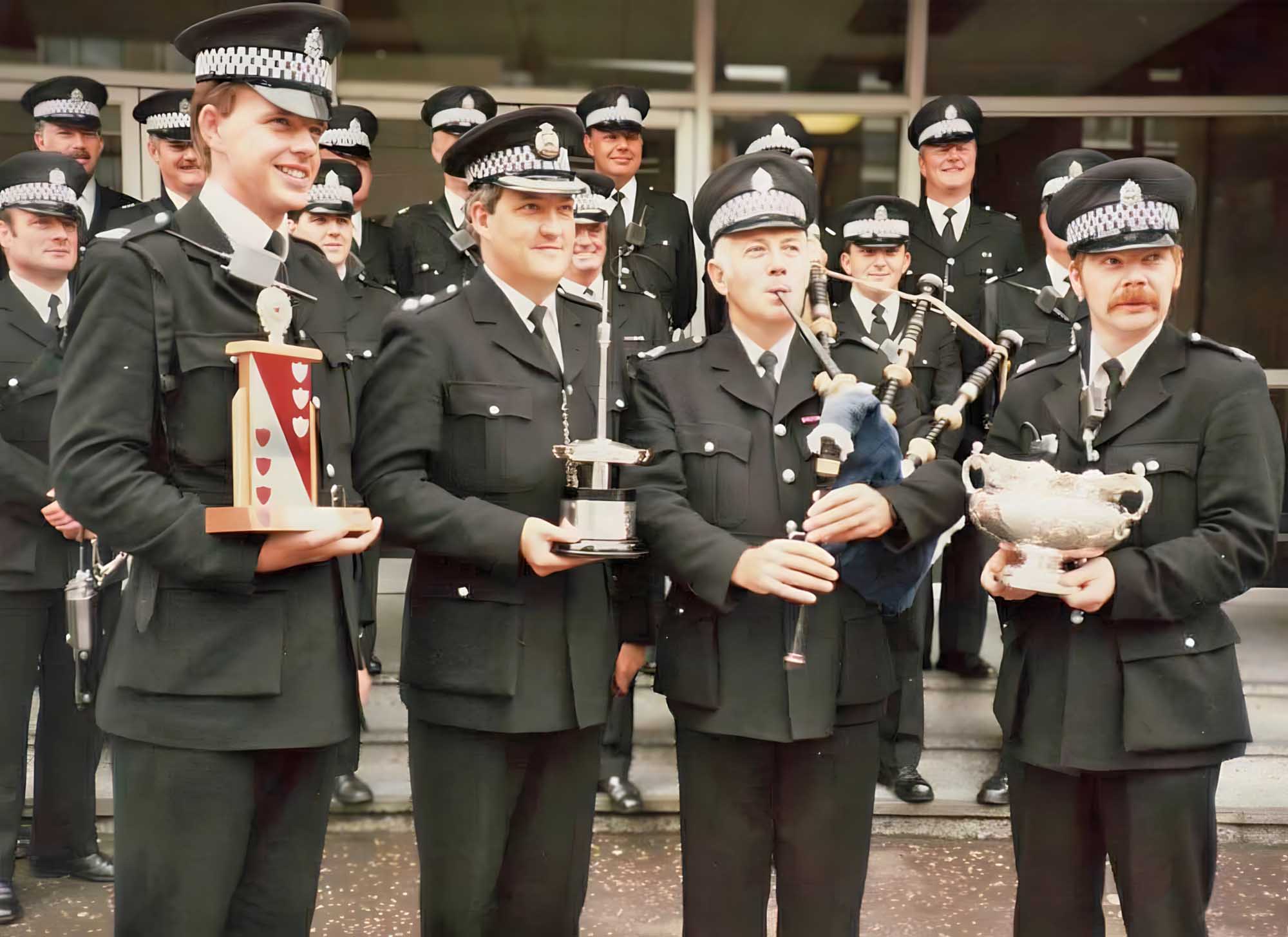
When I transferred from Central Scotland Police, Ian took me under his wing. He worked patiently to bring my playing to the level required by the band, and in doing so showed the generosity of spirit that defined him.
Ian always had time for everyone; nothing was ever too much bother. With just a look or a few words, he could make you realize you had more work to do and inspire you to get it done.
“Band members formed a police family, bound by the standards Ian set and the pride he inspired.” – Jim Semple
As police officers in the band, we carried the discipline to be the best, and Ian embodied that spirit. We represented Strathclyde Police in everything we did, and under his leadership, we travelled all over the world, proud of both the music we played and the values we upheld. Band members formed a police family, bound by the standards Ian set and the pride he inspired.
I owe him so much, and will be forever grateful for his leadership and the opportunities he gave me. I was proud to be part of it, and those memories will live with me forever, as they will with all the other band members who shared that journey.
He was a gentleman, a great teacher, and a mentor who led by example. Above all else, Ian was devoted to his late wife, May, and was a family man first and foremost, dedicated to Janice, Karen, and their families. Our thoughts must be with them now as they deal with the magnitude of their loss.
Ian McLellan’s legacy is one of excellence, mentorship, and humanity. He will be remembered not only for the music he created but for the lives he touched and the standards he inspired.
If you have memories of the great Ian McLellan, you are encouraged to share them using our Comments feature below.

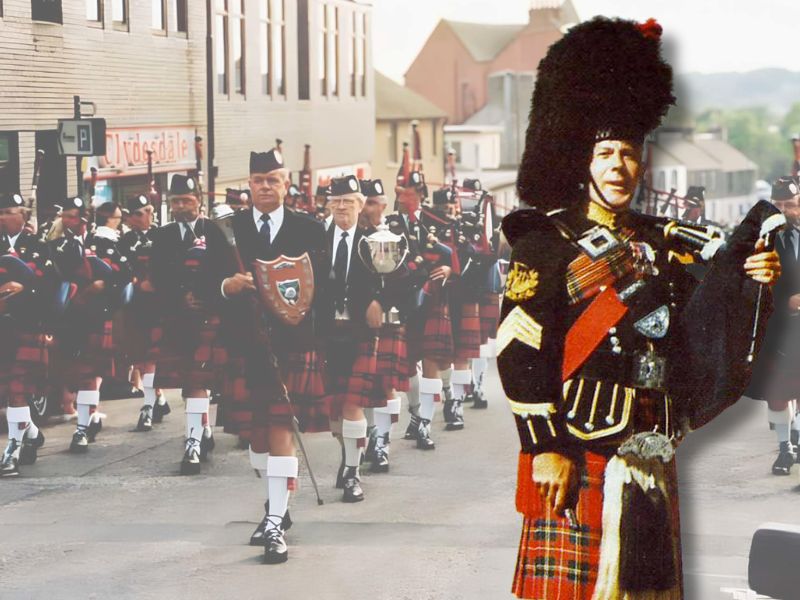
I feel like a minnow commenting here after reading the reflections of so many household names. To me, Ian was a hero who defined what a pipe band should look and sound like. From the other side of the world, our only window into the scene was the Worlds recordings and the albums bands released — and listening to them was an event.
What always struck me was how unmistakably unique Strathclyde sounded: powerful, bright, and supremely confident, supported by a drum corps that delivered exactly what pipers would hope for. Their “Elspeth Campbell” MSR remains one of the most electrifying performances I’ve heard, especially the break into “Pretty Marion,” which felt almost other-worldly. ‘Six in a Row’ is still a masterclass in lift, tone, ensemble, melody, and technical clarity — nearly 40 years on, still utterly relevant.
The standards Ian set paved the way for what we hear today. In the brief chats I was lucky enough to have with him during visits up north, he was exactly as others describe — warm, generous, and encouraging. I vividly remember him attending a pre-Worlds practice, offering kind words to the band, and everyone hanging on every word.
A legend, an authority on our music, and a legacy we should all be grateful for. Rest in peace, Pipe Major.