

A Bridge Too Far? Three leaders discuss why the upgrade from Grade 2 to Grade 1 can be so hard . . . or even fatal – Part 2
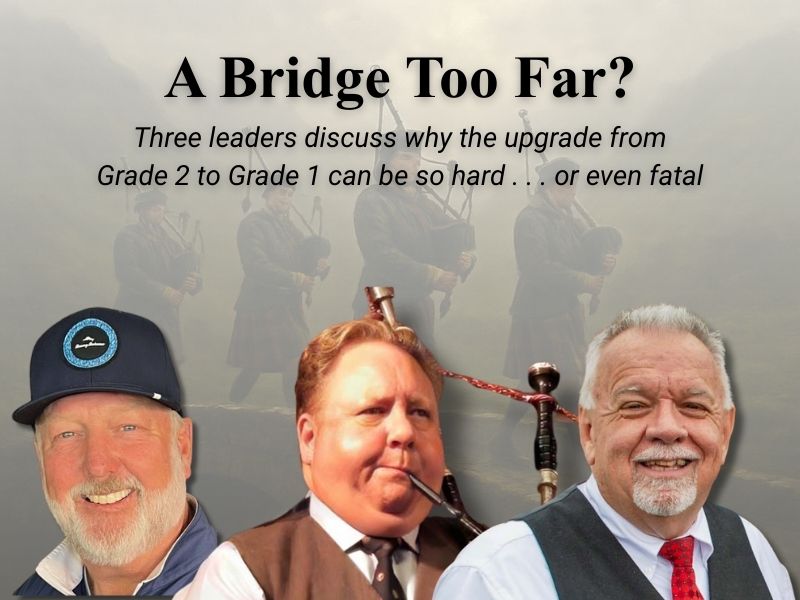
We continue with the second in our three-part panel discussion, featuring John Cairns of Ontario, Scott MacDonald from California, and Scotland’s Kenny MacLeod, on the challenges of making a permanent leap from Grade 2 to Grade 1.
Part 1 laid the groundwork for the topic, the determining factors that make the transition perhaps more complicated than those between other grades.
In Part 2, the panel delves into ways to ensure the band remains viable both when it does not win in Grade 1 and when it returns to Grade 2, by choice or by force, as well as the idea of splitting Grade 1 and Grade 2 to make transitions easier.
Here’s a transcript of Part 2, with minor edits for written clarity.
Part 2
pipes|drums: We’re back with Part 2 of our discussion on making the leap for Grade 2 bands going to Grade 1 and going back to Grade 2. Scott McDonald, making the jump to Grade 1 has been called a “death sentence” recently. How difficult is it for a band to go back to Grade 2 these days after being in Grade 1?

Scott MacDonald: In our case, as a band [the LA Scots], and again, this is my opinion on this, you have to convince your band to do it as well. So not only is it a logical thing, you also have to convince your band as a whole that it’s the right thing. Common sense comes into it. Talent comes into it. You have to be honest with who you are.
And that’s really in our particular case – and I can only speak for us. I felt at the time that it was the only way we could continue the LA Scots as we were and are today. And “death sentence” is kind of funny. But there’s some truth to it because, and I said it earlier in the first part, bands have a couple of years, and then they’re talented players within their drum corps, pipe corps, especially the young ones, start getting a little itchy, and the world is getting smaller. In the past, a lot of the Grade 1 bands in Scotland, Ireland, and so on, and even in Canada, probably wouldn’t think about having an out-of-town player. But Inveraray has out-of-town players, even today. Field Marshal has players from outside their area, and you’re thinking, “Why do they need them?” They have all this talent there.
Kenny and I have had this conversation many times over the phone for years. Why do they need them? They have all the talent in the world in their backyard. But it’s the competitiveness of pipe bands and the urgency to be the best that’s created this handful of bands that are just very, very good.
I’m jealous. I’m not angry about it. It’s amazing. I sit back, and I’m amazed at how it’s come in just the years that we played in Grade 1. It seemed like, “Yeah, we’re going to be in the top 10. We’re so close!” But in reality, we weren’t that close. And that’s the problem. The world just changed a bit.
You get yourself a superstar young player or somebody who feels like . . . and, hey, I don’t blame them. I never had the urge to play in another band. I’ve played in this band. I’ve always been here, in the local band, the family band, whatever you want to call it. And that’s been good enough for me. But band members don’t all think the same way. I don’t. And that’s okay. I don’t get upset when people leave.
A lot of them come back and leave again, and come back, and it’s an open door. But it’s difficult. Bands in Grade 2 get really good right now. The top of Grade 2 is unbelievable. I mean, we got a sixth [at the 2025 European Championships], and I was thrilled. It’s that good. And, so, the lower-grade bands, Grade 3 to Grade 2, Grade 4 to Grade 3, I don’t think it’s as big an issue because they can kind of absorb it. But from Grade 2 to Grade 1: difficult.
pipes|drums: John Cairns, the sense of community that the Peel Regional Police seem to have is entrenched. Does that play into the ability to hold people together for something more than just winning in the grade?

John Cairns: That’s an important point because, like in sports, if your team is not doing well with the players you have, you need to get better players. And it’s difficult to encourage players to join the band when it’s been downgraded, because many people see that as a failing. And as Scott said, creating a plan and having people buy into it is essential for the band to regroup and move forward. But yeah, creating a good sense of community is important because you’re getting people to stay not just for the prize, but also for the people and the organization.
pipes|drums: And Kenny MacLeod, Glasgow Skye seems to be very strongly geared that way. You talked about those small contests that bands used to go to – community contests like Lesmahagow or wherever they might be. Can you talk about the idea of community in Scotland, and whether that still exists or is important for pipe bands these days?

Kenny MacLeod: I always tell the story that when my brother was the pipe-major in about 1980, we used to have this job called the Doune & Dunblane Farmers’ Day. And we literally just went and played at the Farmers’ Day and paraded about the field, and they looked after us, they paid for the bus. But we looked forward to that just as much as we did to going to one of the championships. We were all roughly about the same age, and it was great fun.
Fast forward 25, 30 years. If I were to see my last stint in the Skye, saying, “Right, you guys, we’ve got the chance of playing at the Doune & Dunblane Farmers’ Day.” Well, they’re all working, and they’ve all got things on. They want to compete, fine, but they don’t really want to do some of the wee contests, and for sure they don’t want to do gigs unless it’s really big money. So that part of the pipe band world has been lost a wee bit.
I agree with what Scott said, that you’ve got to know where you are in pipe bands. My second stint as pipe-major of the Skye was in 2011. In 2012, we had a great start to the season. We won the first two majors, then Denny & Dunipace kicked in and won the next three, including the Worlds. But we went to Bridge of Allan, and we won that, and they were second. So, the chat was, “Well, you’ve won three against them, and they’ve won three, so we’ll put you both up.”
“If you’re just going to go up to be the whipping boys, that’s when you are going to lose your good players because they get frustrated and they move on. And then you need players, so you bring in players who aren’t as good, and the band gets a wee bit worse, and then the better players move on, and it spirals after that.” – Kenny MacLeod
But I made it completely clear to the National Council and Music Board reps in the Glasgow branch that we were miles away from the Grade 1 standard. You’ve got to realize where you are in the scene. If you’re just going to go up to be the whipping boys, that’s when you are going to lose your good players because they get frustrated and they move on. And then you need players, so you bring in players who aren’t as good, and the band gets a wee bit worse, and then the better players move on, and it spirals after that.
pipes|drums: Let’s talk about the idea of a Premier grade, or a Grade 1A and Grade 1B, which has been talked about forever. Would it make sense to do that today? You’re still in Grade 1, but you might be Grade 1B, or Grade 1 and then you’re working towards Premier. Kenny, let’s stay with you, since the idea is more realistic in the UK.
Kenny MacLeod: I’m not a fan of that. When you get to Grade 1, you’re a Grade 1 band. I like what they’ve got just now, where it’s a nice, neat, tidy number.
I’m also totally against Grade 1 bands having to qualify. I get it, when you’ve got Grade 3 bands, and there are 30 or 40, you can see when you get to Grade 4 and stuff like that, but when you get to Grade 1 status, you should be taking part in Grade 1.
If you’re the World Champion, you should be able to compete as a World Champion against the rest of the world, the possible World Champions. At the moment, Grade 1, again, just going by Perth [the 2025 European Championships], Manawatu were over; it might have just been them. It was fantastic. I didn’t hear anybody competing, but tuning up, everybody was very good. It’s a very, very good grade just now. I would suggest that they keep it like that, keep it nice and neat and tidy and don’t have any qualifying in it. I would rather have that than a Grade 1A and a Grade 1B.
pipes|drums: Scott, let’s say the LA Scots or whatever band in Grade 2 gets moved up to Grade 1B, would that still create motivation?
Scott MacDonald: I go back and forth on this. There are times when it’s the primary grade because it basically is. I mean, we’ve talked about six, seven bands, eight bands that pretty much everybody knows and agrees are the top bands. And then you’ve got the next group trying to get into that next level.
“Consistency would probably help; no playbook really defines what a Grade 1 band is.” – Scott MacDonald
From year to year, when bands are upgraded, and the next year or two they’re not upgraded, and then they’re downgraded. Consistency would probably help with that, since it’s not consistent, and no playbook really defines what a Grade 1 band is.
I may be getting ahead of myself here, but everybody was a little surprised that Glasgow Skye and a few other bands didn’t get upgraded, because in past years they would have been. But I get it, because not every band is perfect. The pipe corps is better than the drum corps, and the drum corps is better than the pipe corps. Are they top-to-bottom equal? Because the premier bands have amazing drum corps and amazing pipe corps. They’re not in there if they have one weak part.
I go back and forth, but Scotland, the RSPBA, they kind of box themselves in. It’s just not clear what the direction of the upgrading and downgrading is. It’s pretty obvious to the people here, John and Kenny certainly know. We’re all pretty honest about our bands and bands we listen to. We think, That’s a good band, or, That band’s struggling.
For the most part, a little bit of clarity from the leadership would probably help bands and maybe some of the problems in the back end of why are we still in Grade 2 when we should be in Grade 1? Well, we’re not good enough. I don’t know if I said that clearly, but that’s probably my feeling on it.
Right now, we’re a long way away. I’m not sure where we are as a band in this day and age. We’re a long way away from Grade 1, so it’s not even in my thought process.
pipes|drums: John, if you can think back to when the Peel Police were Grade 1 and then moved to Grade 2, would it have been better somehow if you had been moved to Grade 1B or whatever? Would that have changed things for the better for you?
John Cairns: I’m the same as everybody else. I’m not a big fan of the idea of a Premier grade. I always think of this like a sport, and there are teams at the top of the grade, and there are teams at the bottom. You need to have that standard to aspire to, which makes bands at the bottom better. But there needs to be some definition, and like Scott was saying, what constitutes being viable to compete at Grade 1, whether it’s the numbers, whether it’s having a pipe section, drum section, and mid-section all at the standard to move up to Grade 1. I don’t know what the criteria would be, but if that were clearly defined, then that would allow bands at the top of Grade 2 to recognize, Okay, well, we’re almost there, but we need to fix this. We wouldn’t be putting a band up to Grade 1 who was clearly not ready to compete.
But even if you went to a 1B, the transition from the 1B bands to Premier would be the same as it is now. They’re still going to have to struggle to reach that standard. I don’t see any benefit in doing that.
“You’ve been in Grade 2, and chances are you put your kilt on in the morning thinking, ‘We might get a good run here, we could win it. If not, we’ll get a prize.’ And then you’re in Grade 1, putting on your kilt, hoping you’re not going to be last. It’s a hell of a transformation to cope with.” – Kenny MacLeod
pipes|drums: It sounds like all three of you are pretty much on the same page. That said, it’s very different in Canada and the United States, in that there aren’t enough bands at the top level to separate a Grade 1A and 1B. It doesn’t make sense in the other grades, too. Then there’s confusion when they compete in Scotland, as we’ve seen almost every year, whether an “overseas” band is Grade 3A or 3B, with appeals and the rest of it.
Is splitting Grade 1 and/or Grade 2 simply a non-starter, or is there some leeway?
Kenny MacLeod: I really don’t. 1 should be the premier grade, but keep it small, keep it nice and tidy. Keep the standard high. Going from Grade 2 to Grade 1 is hard. You’ve been in Grade 2 and chances are you put your kilt on in the morning thinking, “We might get a good run here, we could win it. If not, we’ll get a prize.” And then you’re in Grade 1, putting on your kilt, hoping you’re not going to be last. It’s a hell of a transformation to cope with.
pipes|drums: What about Grade 2? Grade 2 is also a grade that’s not split. Would that become a way to make sure bands remain viable if and when they move to Grade 1 or back to Grade 2?
Scott MacDonald: I’ve thought a lot about this. It would probably help the RSPBA or the Music Board or whoever is making these decisions that, if they reach out to Canada, the U.S., Australia, New Zealand, Ireland, to have a committee that keeps track of their local bands, a group that is part of the decision-making, listening to bands or judging bands or whatever and keeping track of them.
There is always a band that pops out of nowhere. And then they go, “Where did these guys come from?!” I’ve seen that more in Grade 3A or 3B. In the last couple of years, I’ve stood next to them, thought I was listening to a Grade 2 band, and then found out they were Grade 3A or even 3B. And I’m like, “Wow, how are they playing in 3B?!”
Now, is that a good thing for the world? Probably not. As long as everybody knows they’re on a fair footing when they’re competing, and the only way to correct that is to try to make things equal in Grade 2 and Grade 3A and 3B.
I’m not sure about 2A and 2B, whether there are enough bands. But as long as the bands at the back end of Grade 2 or maybe the top of Grade 3 are properly slotted.
The only way is for the RSPBA to reach out and find out well in advance, because nobody knows what’s happening. They can look at a roster, but a roster doesn’t tell you everything. It’s the playing, the band competing, the band performing, with eyes and ears. It’s the eye test that will tell you: That band’s playing well above its skis there, and they’re going to go over there, they’re going to just romp.
I’ve always tried to be logical with the bands in our association and the lower-grade bands, and we have lots of bands that travel to Scotland, and they say, “Yeah, we’re going to do well.” And I say, “Well, you’d be surprised; Grade 3 is pretty difficult.”
Then again, if they’re not in the right grade and they don’t get the result they think they deserve, two or three, four or five guys in their band quit because they thought they were going to get a prize. And then they come back and say, “We got last” or “We weren’t close.” The problem is they don’t know what the expectation level is unless somebody tells them.
If the world were perfect, there would be eyes and ears all over the place saying, “Yeah, that band’s probably on the verge of going to Grade 1,” or, “That band should be maybe not doing so well.” And probably it would be a little fair. I don’t know how that would be executed, but that would be in the right direction.
pipes|drums: Adam Holdaway, the pipe-major of the Commonwealth Pipes & Drums from Massachusetts, which encountered this issue, wrote an interesting proposal to examine standards and grading around the world. Something like a World Standards Council for pipe bands. John, would that make sense to help alleviate the pressures?
John Cairns: Absolutely. You see here [in Ontario], many times a band will be promoted to the next grade because they’ve won, but they haven’t factored in the grade’s standard. They may have been the best, with the number of times they qualified. But the six years I was with Peel in Grade 1, we were winning in North American Championship at Maxville and winning Grade 1 here in [Ontario].
“If you remove the top four bands in Grade 2 and put them up to Grade 1 – no disrespect meant to the other bands, but those bands now become the top standard of that grade. If we’re going to close the gap, we should work hard to improve the standard of bands at Grade 2 so the gap is smaller than it is right now.” – John Cairns
But we only qualified once [at the World Championships] because the standard of Grade 1 here in Ontario was not – I wouldn’t want to say “world class” – but at the same standard as Grade 1 overseas. So, bands must be given a chance to reduce that gap.
Seeing Glasgow Skye stay in Grade 2 is terrific because that’s going to elevate the standard of Grade 2 even higher. If you remove the top four bands in Grade 2 and put them up to Grade 1 –no disrespect meant to the other bands, but those bands now become the top standard of that grade. If we’re going to close the gap, we should work hard to improve the standard of bands at Grade 2 so the gap is smaller than it is right now.
pipes|drums: Why don’t we wrap up this part and come back to talk about those standards and the fact that the RSPBA didn’t upgrade any bands from Grade 2, and also that thought process.
What are your thoughts? Take advantage of our Comments feature below to express your opinions and observations.
Stay tuned for Part 3 of our panel discussion on moving from Grade 2 to Grade 1 and back, coming soon.




NO COMMENTS YET