

Artificial Intelligence in competitive piping and drumming: a panel discussion – Part 2
We continue with Part 2 of our panel discussion on potential applications of artificial intelligence in competitive piping and drumming.
AI might be used more in our world than we realize, and we can expect much more in the near and far future. We can’t say whether it will be accepted by competitors and associations.
Our panel of accomplished pipers, who are also computer technology professionals:
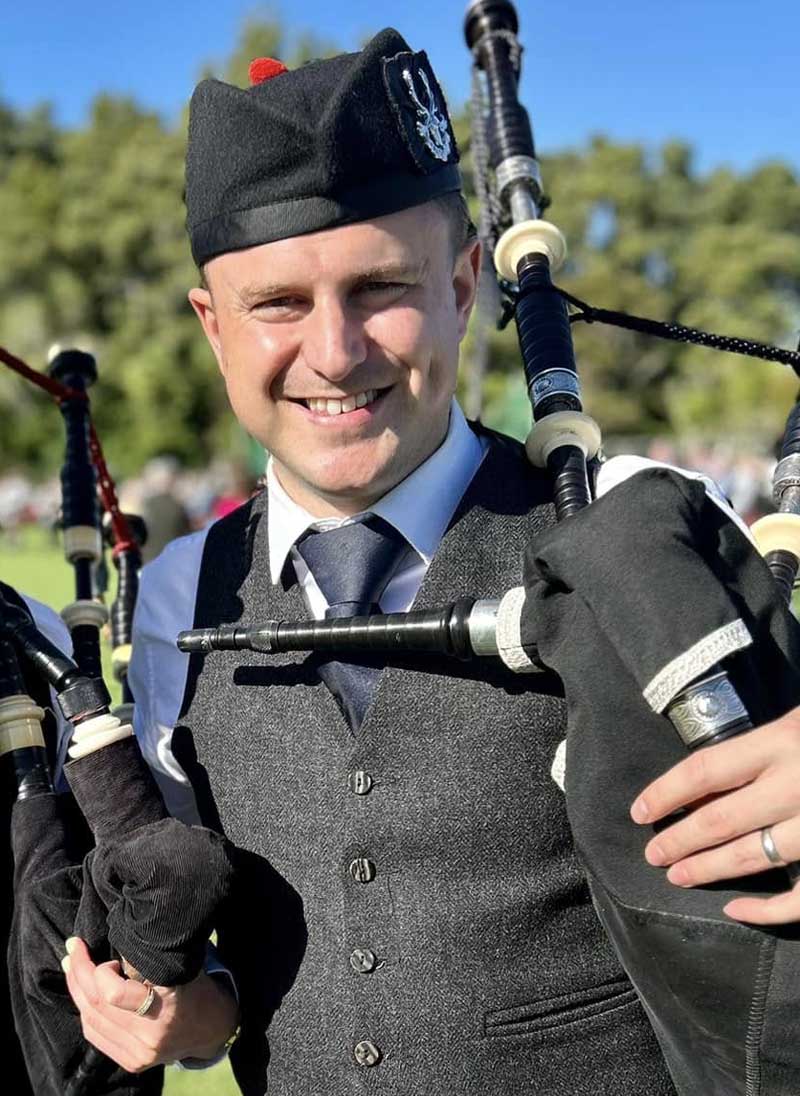
Matt Faser is the pipe-major of the Grade 1 Hawthorn Pipe Band of Melbourne, Australia, and a judge on the Australian circuit. Professionally, he is the general manager of engineering and consultancy apps for government-based projects in Australia. Last year, he launched Musolink, an app for pipers and drummers to track and elevate their practice routines.

Twenty-four-year-old Colin Johnstone from Aurora, Ontario, is a Professional-grade solo piper on the Ontario scene. He’s played with top-grade bands and works as a cybersecurity researcher with the Canadian Imperial Bank of Commerce in downtown Toronto.

Only 22, Brodie Watson-Massey of Edinburgh is a fast-rising star on the Scottish solo piping scene. He recently won the 2025 Scots Guards Knockout Competition, and routinely features in A-Grade prize lists. As he finishes his university degree, he’s working in data science with Scottish Enterprise.
In addition to Part 1 of our panel, pipes|drums has been discussing AI for more than a year.
- Revolutionizing adjudication of piping and drumming contests: leveraging AI for judging efficiency
- The Future of Competitions: harnessing artificial intelligence for objective judging
As always, readers and viewers are invited to use our Comments tool at the end of this article to express their thoughts and opinions.
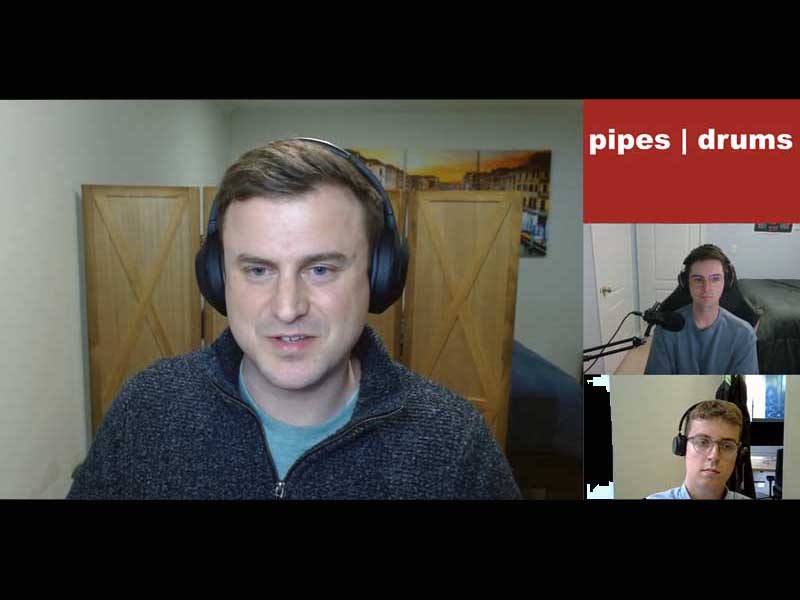
Here’s Part 2 of our AI discussion panel:
Here’s a transcript of Part 2, with minor edits for clarity.
pipes|drums: We’re back with Part 2 of our panel discussion on artificial intelligence and the possibilities that might exist now and in the future. Once again, we’ve got Matt Fraser, pipe-major of the Melbourne, Australia-based Hawthorne.
Colin Johnston is a top-level solo piper based in Aurora, Ontario. Brodie Watson-Massie is also a top-level solo player based in Edinburgh who is playing with Inveraray & District.
All three of them are experts in data, software, artificial intelligence, and other related fields. Thanks again for taking the time. Maybe Colin, let’s pick up on what you’ve written about judging.
Judging piping, drumming, and pipe bands is intrinsically mostly subjective, with very few objective things like tuning, tone, and precision. Because of that subjective nature, it’s fraught with controversy. Could AI solve some of those controversies through a judging application?
Colin Johnstone: I don’t know if it could exactly solve the problems, but like you mentioned, because of how subjective it is, everyone kind of has their own standards or understanding of what a good performance is. And if we tried to use AI to solve for that, it’s going to follow everything else that it’s seen. So, it will have its own subjective biases because it’s been trained on human data.
“If anything is ambiguous for AI, it leads to many unintended things.” – Colin Johnstone
The first step that I think we really need to do is actually create some type of foundational framework around it: Okay, these are the steps that you need to create a good performance that we can clearly evaluate and that are set in stone that everyone understands. That way, you could use an AI to augment some of the judging that is being done because it is clearly outlined and laid out. If anything is ambiguous for AI, it leads to many unintended things.
pipes|drums: What about you, Matt? What’s your response to that?
Matt Fraser: I think I agree. I think the fundamental issue is getting everyone to agree what that one standard is. And I think that, you know, what is a good pipe band performance to me might be different to what it is to you. And that’s not necessarily incorrect. People have different preferences. You know, I like the color blue. Other people don’t. And neither of us are wrong or right about that.
And I think the same can be true of music. So, it’s actually valid less. Different people will listen to different things and prefer one or the other. Having said that, there are certain things that are much more objective, right? So the drones, if the drones are out of tune, they’re out of tune. Or if there’s a mistake, there’s a mistake. And so where I see AI coming in is helping identify that stuff. And again, as we said in the previous segment, freeing the judge’s mind up to to focus on that stuff that’s more human.
pipes|drums: Brodie, are you on the same page?
Brodie Watson-Massey: Kind of. I think that it’s always subjective. If you were going to use a data-driven tool to support judging, not replace support, I think that’s key. If you used it to replace judging, I think that would be a pretty unwise decision. That’s a whole separate matter. If you were to use it to support judging and have it rank like tuning, mistakes, intro, stops and pipe bands – all these kinds of fundamental things that are expected of a good performance. Different judges might weight them differently. So, how do you measure that?
“The judging associations have to go through that process of saying what they place value on and different judges have different preferences.” – Brodie Watson-Massey
I think that the judging associations have to go through that process of saying what they place value on and different judges have different preferences, of course. So, I don’t think it’s quite that easy. Don’t think that, I actually don’t think that a solution would be the easiest thing to deal with that, to be honest. I think we’re a wee bit down the line from that. But it is possible. Yeah. I don’t know that really answers any of those questions, but just being controversial.
pipes|drums: No, every time you guys comment, new things to come to mind, one of which is the idea of AI drawing upon what’s “successful,” which could potentially create a blandness to the music, if it were used for music creation, at least to my non-scientific computer scientific mind. If a band wants to use a discord to a certain effect, AI might decide that that’s not a good thing to do in judging. But if it’s intentional and effective, then it actually serves to suppress the art form, the evolution of the art. Anyway, interesting theoretical thinking. Getting back to judging, do we like the controversy? I mean, after every competition, it’s like, “So-and-so should have won, and No, I think I should have won. My band was better than your band.” Do we actually court that and like that? Would we as a result risk getting rid of the fun of upset?
Matt Fraser: It sounds bad when you frame it in terms of liking the “controversy,” but I think to say that we like talking about what each of us like in music and what we think is better and what’s not as good, we like that, right? We like the art of listening to this stuff and enjoying it and talking about it as a group. It’s a very social activity. The subjective nature of it leads to some people differing in their opinion. That’s part of us. I just think it sounds bad if you frame it up in terms of it’s the controversy that we enjoy.
pipes|drums: That’s really well put. “Controversy” may have been an ill-chosen word. The subjective nature of it going into the debate, let’s say, about what was good and what’s bad, adds to the evolution of the music. But if competitors don’t want AI to be used for their benefit, for a competitive edge, how do you think associations might police that? If the rules say you can’t use artificial intelligence, and a band or soloist surreptitiously is in their basement practicing or in a band hall implementing some things, do you think an association could police those rules?
Colin Johnstone: I don’t know personally how they would have any idea it was even being used, to be honest, with music and live performance like that would be really hard to detect. And in terms of policing it, I feel like it’s just the same as if we were restricting the use of tuners, for example. That’s a tool that’s come out that didn’t exist in the past that gives you an advantage. If we just outright ban it, then it’s deterring good performance. I don’t think any form of policing would be a good thing, in general.
pipes|drums: I’m old enough to remember when tutors came on the scene and there were accusations of cheating – ”That’s not real competition.” There was an evolutionary process with that. But to my knowledge, associations never considered banning tuners, maybe for that exact reason you talked about, Colin. How are you going to enforce such a ban and not let it evolve on its own?
Brodie Watson-Massey: If players don’t want it, they’ll express that. And I think that you can’t have one player being judged by it and not another. It has to be standard across the board. That goes without saying. But we have boards, organizations, which help with monitoring and managing these things. It would have to be some sort of integration with those.
“I wouldn’t recommend banning the use of AI to get ready for a competition. There’s a discussion about whether or not it should be used in the actual judging circle.” – Matt Fraser
pipes|drums: Matt, same page?
Matt Fraser: I think so. If people don’t want to be judged by AI, that’s totally fair, and then we shouldn’t do it. In terms of determining if people have used AI in their performances, that would be very difficult, assuming they’re out there performing and there’s no active help during the performance. It’s really hard to know. Would you also ban bands from playing sections of other bands’ medleys or from outsourcing their music writing? Those things aren’t all that different. You get into lots of grey area. I wouldn’t recommend banning the use of AI to get ready for a competition. There’s a discussion about whether or not it should be used in the actual judging circle.
pipes|drums: Once again, fascinating insights. Let’s wind down this second and last part of our incredibly illuminating discussion. Ultimately, here’s the question: Do you think using artificial intelligence in competition is inevitable? Matt, continue your thoughts.
Matt Fraser: I think it’s inevitable that people will use AI to help them get ready for competitions. I think for me, the jury’s out on whether or not we’ll end up actually using it to help adjudicate competitions. I think that will evolve.
pipes|drums: Colin?
Colin Johnstone: I do think it’s inevitable, and I don’t think we’ll ever truly use it to adjudicate a contest fully. But having it as a tool that a judge can use to write out their score sheets is very possible and feasible, and will make the judging experience monumentally better.
pipes|drums: Brodie, last thoughts to you.
Brodie Watson-Massey: I’m on the same page with Matt there. I think that, as the technology develops, people will find ways to use it more and more to help them with things, perhaps maybe outwith competing. In terms of the competition sphere and that side of things, like Matt says, it’s difficult to know exactly how these things will develop. With the way things are just now, it’s probably not, but you never really know. The jury’s out on that one.
pipes|drums: Well said. It’s been a terrific discussion, really interesting. Even if viewers and readers might not like the idea of artificial intelligence, it’s still worth discussing the possibilities. It’s good just to toss ideas around and really appreciate the time you guys took. Matt, it’s late in Melbourne. It’s as late there as it is early here in Toronto. And Brodie, we’ll let you continue your workday in Edinburgh.
Thanks very much. We’ll be watching this closely, and we hope to revisit it in the way AI is moving. Maybe in six months, we’ll look at where we are.
Stay tuned to pipes|drums for more on artificial intelligence and other new technologies as they emerge.

Fantastic Discussion. While the talk of how AI can be used, I must say that the question about “do we like controversy” is interesting. I don’t think anyone truly likes controversy, but the controversy we’re talking about, agreeing about this band’s playing, medley, or placing makes the discussion valuable. Yes, we may argue in the tent about why this is right or wrong or he/she should have won, but that discussion in itself, sends the piper home, hopefully questioning why others agree or disagree with your opinion, and this leads to some evolution of the instrument and music itself. Great discussion. I must say though, that if there were an AI that could be the reader in a piobaireachd contest, that would be great, AND, allow panels to have three people musically judging instead of two and a reader, and smaller games may save money, not needing to ‘hire” that reader on Games day.