

Opinion: The pipe band world needs good leaders, but the situation can be helped
Editor’s note: pipes|drums welcomes all fair perspectives and opinions. Sharing information and constructive dialogue is at the heart of the publication. As in all fair democracies, free speech and the free exchange of ideas are central to progress. Our competitive art can move forward only by asking questions, listening to answers, respecting opinions, and trading ideas.
Please let us know if you have an opinion that you would like to express fairly in an editorial. We are always pleased to hear from our readers.
For those who prefer watching to reading, here’s a video of our opinion piece. There’s a slightly longer text version below.
If you’ve held steady paid work, you’ve probably heard the saying, “People don’t quit their job, they quit their manager.” Although that’s not always the reason, there’s a lot of truth to it.
It’s also applicable to pipe bands.
The vast majority of pipers and drummers leave a band not because of the music, or the results, or the schedule. They leave because the pipe-major, leading-drummer or midsection lead is a poor manager of people.
Pipe bands are generally a music meritocracy: the best players are the leaders. That certainly can help with musical performance, but leadership skills are more often than not ignored, and without skillful leaders, performance eventually suffers.
To be sure, some of these folks might be naturally astute and self-aware leaders, or, after several years, self-educate themselves to be better leaders. But chances are, they’re not well equipped and never will be.
We all know the many stories of that gifted piper or drummer who’s the pipe-major or leading-drummer, but assumes bellowing and barking at band members is the route to success. They’re the ones who last a few years in a band, then move to another, and then another. Perhaps you’ve experienced that directly.
It’s interesting that pipe bands don’t generally look for “man managers,” a term the late great Ian McLellan liked to use. In 1993, he identified man management as the most important skill a pipe band leader could possess. Players who can tune instruments and provide musical creativity and prowess are easier to find than those with people-management skills.
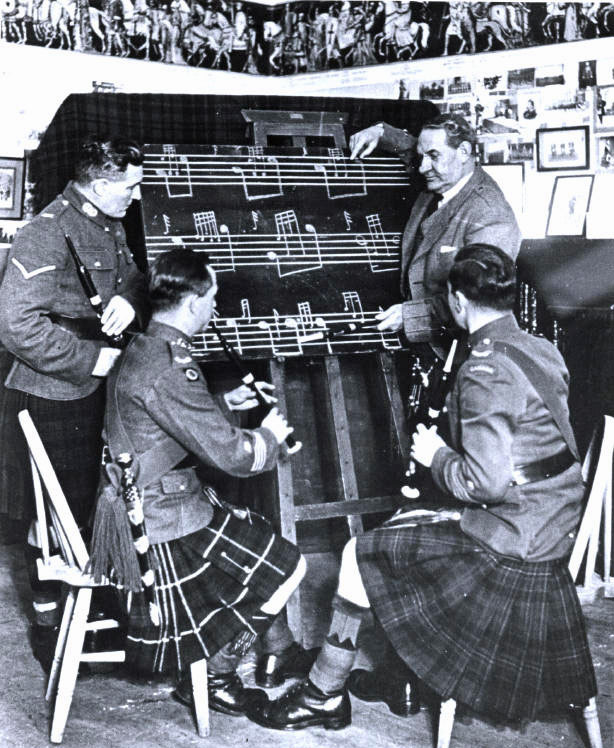
Considering that pipe bands were pretty much invented by the military and the police, where ranks are determined by leadership skills, with plenty of leadership training (see the British Army’s renowned Pipe-Majors’ Course), it’s ironic that that ethic never filtered to civilian bands.
Frequently, the opposite is true: leaders intentionally hoard information and techniques, rather than groom and nurture a successor. Like that horrible work colleague who is the only one who knows how to do something and refuses to share their knowledge, pipe band leaders are often threatened by someone else stepping into their role. Just as a company eventually suffers, so too will a pipe band.
Pipe bands most often fail not because they don’t win prizes, but because they lack effective leadership.
No one would assume a pipe band would offer management training, but associations certainly could (and with it also help themselves).
Organized leadership workshops would help existing leaders and might result in more pipers and drummers considering leadership roles by preparing them with the know-how to help them in the role:
Communication
- Listening to and respecting constructive opinions.
- Giving constructive, actionable feedback.
- Setting clear expectations and goals for the corps and for each player.
- Transparency and honesty.
- Praise individuals as a group; provide constructive criticism and solutions privately.
Emotional Intelligence
- Empathy and understanding others’ perspectives.
- Self-awareness (knowing your own triggers and strengths).
- Regulating emotions under pressure.
- Reading non-verbal cues.
Coaching & Development
- Mentoring, supporting and growing skills.
- Delegating effectively – the section or band does not begin and end with you.
- Identifying each player’s strengths and weaknesses.
- Motivating individuals and the group.
- Encourage advancement within the band when opportunities arise.
- Don’t encourage, but accept and support joining another band in a leadership role when none is likely within.
- Understand clearly why they decided to move on.
- Thank players for their contributions to the band, no matter what.
Relationship & Culture Building
- Build trust and psychological safety.
- Foster collaboration.
- Conflict resolution and mediation.
- Appreciation and recognition of individual and group achievements.
We recognize that this might seem like way too much to expect. Pipe banding, after all, is still a hobby, but there are parallels to work. Most pipers and drummers leave a band because the leader or leaders are poor people managers.
Pipe bands most often fail not because they don’t win prizes, but because they lack effective leadership.
But without at least some management coaching, we can’t expect every pipe-major or leading-drummer to succeed in their role, no matter how good a player they are.
That’s our opinion. What’s yours?
Please use our Comments feature below to express your thoughts.

This article gets to the heart of the issue — and I agree with it entirely. Where the real leverage lies, in my view, is when leadership development begins.
Leadership starts as an identity — a being thing — long before it becomes a doing thing. If we wait until someone is already a pipe-major or leading-drummer to address people leadership, we’re already too late.
Embedding a simple two-hour workshop at youth camp level — focused on self-awareness, communication, feedback, emotional regulation and inclusion — would lay a foundation that players, tutors and future leaders can build on over time. It also creates a shared language that supports retention, psychological safety and healthier gender dynamics.
This is a long game. But if we want sustainable bands and leaders who can both play well and lead well, youth programmes are the place to start.
Excellent 👍
I would note Wake and District’s social media posts on similar lines.
I have just stepped back from a band secretary role, and declined to stand for chairman as the committee is completely ungovernable and are not willing to take advice on board, only when it suits them.
Strangely, I am the only one with professional management experience and training.
All pipe bands would welcome ready-made, exemplary leaders. However, it is worth asking whether that expectation is realistic, or whether it has expanded alongside increasingly formalised training and workplace frameworks. While such initiatives have value, no amount of leadership training can manufacture a natural leader or remove every rough edge. Personality and leadership style are largely set.
Leaders are most effective when supported by a strong offsider who can share responsibility and provide counsel.
Band members also have a role to play: participation comes with an understanding that maintaining standards can be challenging and, at times, emotionally demanding for everyone involved. Leadership is not solely about providing motivation; it is a shared responsibility. Leaders can set direction and provide support, but sustained drive must come from the band as a whole. Without that collective commitment, progress becomes difficult for anyone to achieve alone.
Leadership style are not set at all. A wealth of literature from Hersey, Blanchard, Vroom, Goleman, Bass, Avolio, Yukl, and Antonakis all show otherwise.
To your point around members, the teamship model should suit the pipe band world very effectively.
I absolutely agree that leadership isn’t confined to a particular personality type, nor to the idea that only a few people are “natural leaders.” In fact, much of the research suggests that what we’ve historically labelled as natural leadership often reflects traditional, dominant styles — and those are increasingly shown to be less effective over time.
What we’re really aiming for is authentic leadership, and that begins with self-awareness: understanding our own communication and personality styles, recognising how these differ from others, and learning how to adapt accordingly. Effective leadership is situational and contextual — it’s also a conscious choice of style in response to what the moment, the people, and the purpose require. That the ‘doing’ of leadership built on the ‘being’ of leadership first.
Being skills are developed from the inside out and are rarely learned simply by watching traditional role models.
In that sense, distributed leadership is particularly well suited to pipe bands. Leadership is shared, the load is carried by many, and strengths are utilised across the group — but while still retaining one or two ultimate decision-makers. Those individuals hold accountability rather than carrying the burden alone. This is quite different from a purely democratic model, where consensus becomes the goal and everyone literally goes around in a circle 🙂
Pipe bands most often fail in my experience, through lack of players, not lack of leadership.
Its not the first time a great leader was standing in an empty room, which renders his/her leadership pointless
A great leader is highly unlikely to end up in a room on their own, the greater likelihood is they are not such a great leader after all and need to look inwards, then take action.
Im afraid to say you are absolutely wrong and seriously ill informed. Come over to Northern Ireland.
Many great leaders through the decades, who gave their all for their hobby, and remained loyal to one band and one band only, unfortunately suffered the peaks and troughs of membership through those years. This did not ever diminish their leadership abilities.
And we are currently in the most serious trough in a generation in terms of numbers of pipers and drummers joining bands, and in terms of bands folding for good. This is not the fault of great leaders, it’s a sign of the times.
The opinion piece was not intended to infer that leadership is the ONLY reason for members leaving a band. Obviously, just like a job, demands and priorities change, so pipers and drummers decide to move on. But pipers/drummers are often put into leadership roles because they are the best players in the group, rather than the best leaders. Some help through basic coaching might go a long way. Thanks for reading.
Northern Ireland has possibly the greatest density of pipers and bands anywhere outside of Scotland with deep piping and drumming roots?
If bands can not keep numbers up there, then something is wrong, and any good leader will look within themselves.
Other bands sit in “piping deserts”, including my own, and have proven that good leadership can drive very successful recruitment from people who have no connection to our world before.
Leadership is not a concept constrained by geography or subject. Great leaders always pull people together.
Many of the pipe band greats with many trophies are discussed quietly at the bar as being dam awful leaders.
One aspect of leadership that isn’t called out specifically here is this: what are the goals, or the mission, of the group being led?
Is it a highly competitive band looking to place in multiple arenas, to challenge themselves to attain ever greater accolades?
Or is the band a formational group, with the aim of bettering their playing, both as individuals and as a collective?
Perhaps somewhere in between? Once a band coalesces around a common goal and has a shared vision of who they are and how they want to represent themselves, then their P/M can lead more effectively. I’d wager that a military style Grade 1 band comprised of mostly professional pipers and drummers would need less of a developmental style leader, and can stand the pressure of higher expectations of technique and speed than most bands. Conversely, a local mixed-grade unit that seeks to compete for an upgrade from 4 to 3 while having some fun together learning new tunes may be better served by a leader who allows for some active learning on practice chanter, some clearly defined technique goals, and some tempered urging to improve as individuals in between band rehearsals – things that the competitive Grade 1 P/M can safely assume are not necessary tools in their leadership style.
Leadership programs I’ve attended seem to focus on identifying a leadership style that will help the organization achieve their stated goals. Perhaps an underlying issue with pipe band leadership is that bands don’t take the time to discuss and decide what the goals are for their band. In the absence of that direction, a leader can lead, but you may not get where you (individually or as a band) want to go.
Very much agree here, I’ve been trying unsuccessfully to get my band leadership to have just that discussion as a group.
They are increasingly focused on rising the grades and more and more players who should be capable are dropping out.