

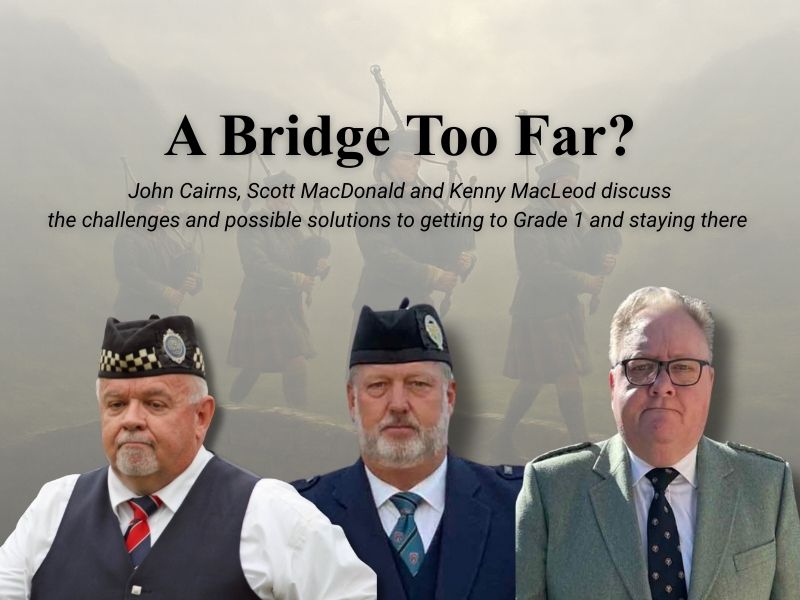
A Bridge Too Far? Part 3 – John Cairns, Scott MacDonald and Kenny MacLeod on the difficulty going from Grade 2 to Grade 1
The third and final part of our discussion with John Cairns of Ontario, Scott MacDonald of California, and Scotland’s Kenny MacLeod concludes with ideas on how associations could help to make the transition successful or even possible.
They all agree on one crucial issue.
Part 1 laid the groundwork for the topic, the determining factors that make the transition perhaps more complicated than those between other grades.
In Part 2, the panel delved into ways to ensure the band remains viable both when it does not win in Grade 1 and when it returns to Grade 2, by choice or by force, as well as the idea of splitting Grade 1 and Grade 2 to make the transition easier.
Here’s a transcript of Part 3, with minor edits for written clarity.
Part 3
pipes|drums: We’re back for Part 3 of our fascinating discussion on Grade 2 bands going to Grade 1 and possibly back, and the issues around that in modern pipe band times. Scott MacDonald, it was interesting. The RSPBA did not upgrade any Grade 2 bands this year. One might have thought that Uddingston and Glasgow Skye, and maybe others, even you can talk about City of Dunedin or Ulster Scottish, they were not moved up to Grade 2. Why do you think that they did that?

Scott MacDonald: Previously, I talked about consistency, and maybe they’re looking at the bigger picture and the quality of bands, and maybe the decision was made that they don’t want to put some of these bands in jeopardy of having the struggles at some of the previous bands, like the LA Scots and others that have experienced. So, that I can see why they would have done that. Would any of those bands, in my personal opinion, be a top-eight [Grade 1] band? Probably not. Would they in a couple of years? Possibly. But then they become on the time clock. I know Dunedin jumped up and down a couple of times. And again, it just depends on the talent you have in your band at the time as well.
Ulster has made a big jump in the last couple of years, and they’re impressive. That they can make that jump? St. Thomas Alumni? I can speak for the Americans here. They have taken it up a notch from what we did in Grade 1. They’re now knocking on the door. There’s a window.
They have a lot of out-of-town players as well in there. And I know [St. Thomas Amumni Pipe-Major] Jamie [Gattinger], he played in the LA Scots at one time. But the pressure is on because they got the people in there. So, the RSPBA probably did the right thing. I have no problem with it. You know me – I could be selfish and say, Get rid of them, because that takes care of three, four bands, and then that’s better for us to get a placing. That’s not what it’s about.
We really need to clarify and clean up where bands are truly, where they are in their talent level. And that would probably help when you run a band, to keep the expectations tempered and realistic.
I don’t have any problem with the RSPBA doing that. But then again, next year, if they go back and then move up four bands just because, then that’s the uncertainty that causes trouble.
pipes|drums: John Cairns. Same page or other thoughts?
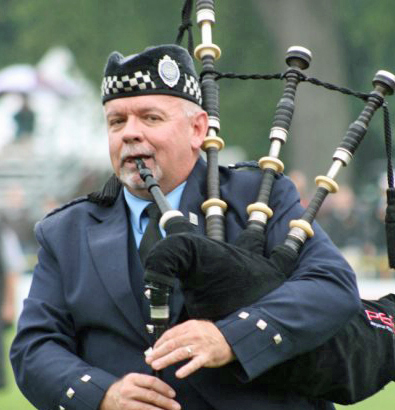
John Cairns: Yeah, absolutely. It’s important that the band not be promoted to Grade 1 until they’re ready to play at that grade level. As Kenny mentioned, I look at some of the bands: one from the United States that was promoted to Grade 1 by its association, but the RSPBA didn’t promote them. They were stuck: Do we do we come over and play in Grade 2, or do we come over because they’re a Grade 1 in their association? It’s important that the RSPBA looks at the big picture, like Scott was saying, to make sure that the bands at the top of the grade are in fact ready to make that jump.
pipes|drums: And Kenny, your close affinity with Glasgow Skye in the past. Did the RSPBA do the right thing?

Kenny MacLeod: I don’t know what to say. Talking to the guys in the Skye band, quite a lot of the young guys were a bit gutted. Let’s face it, we’re all doing it to play at the highest level we can play at. So, a lot of the young guys wanted to be Grade 1 and test themselves against the top bands. Some of the older heads in the band had been through it before. They know the situation, so they were quite happy.
As I say, it’s a big, big change from when you’re to a contest on the bus in a real high, can’t wait to get there, good chance of a prize, possibly winning it, to being, as I say, trying to avoid being last. Just looking at the Skye and Uddingston, and Ulster and Dunedin, and Royal Burgh of Annan. Annan’s a band that won the Worlds [Grade 2] in 2023 – a really up-and-coming, good band.
They all appear to me as if they’re just about ready for the Grade 1 thing. They’ve got good young players, good pipe corps, good drum corps, and at some point they will all move, but when it’ll be, I don’t know.
pipes|drums: It’s been a great discussion over these two parts, and now in the third part. Given all that we’ve discussed, what do you think associations might be able to do to help Grade 2 bands move up – or any band in any grade, for that matter, to be successful in the next grade? Is there more that they could do?
“It comes back to making sure that they don’t promote a band to a grade just because they happen to win that for the previous year, because if the standard is not comparable to what it is overseas, then they’re basically setting them up to fail if they do go over to play at the higher grade. That in itself would help greatly.” – John Cairns
John Cairns: Great question. Like I said earlier, it comes back to making sure that they don’t promote a band to a grade just because they happen to win that for the previous year, because if the standard is not comparable to what it is overseas, then they’re basically setting them up to fail if they do go over to play at the higher grade. That in itself would help greatly.
pipes|drums: Kenny, what do you think? The is there something the RSPBA could do to look after that kind of promotion, making that bridge?
Kenny MacLeod: As we’ve said earlier, clarifying the rules so that you know what you’ve got to do to get promoted – like in football, if you win the league and you win the playoffs, you move up to the league above. It’s very vague at the moment. I remember in 2013 there was a band, Buchan, with a good friend of mine, Scott Oliphant, the pipe-major, they won the Worlds and three majors, second in the fifth major, and didn’t get promoted. Then about two years later, when they hadn’t really won anything, they promoted them.
“It’s very vague at the moment. I remember in 2013 . . . Buchan won the Worlds and three majors, second in the fifth major, and didn’t get promoted. Then about two years later, when they hadn’t really won anything, they promoted them.” – Kenny MacLeod
It would be better if there were some clarity. In Brittany, you’ve got to be at the top for a couple of years before you get promoted. And the way down, if you’ve been at the bottom of the grade above for a couple of years, then you get moved back down again. So, bands know when they’re going to the second championship, what they’ve got to do, that they’ve got to get better if they want to move up or down. Something like that would help a bit.
pipes|drums: Scott, over to you to talk about the Western United States and your area. What do you think?
Scott MacDonald: What [the Western United States Pipe Band Association] has done here is a good thing. I’m not sure all associations do this, but given how we have structured our bylaws, with players from lower-grade bands, we have two or three pipers and a couple of drummers who can play up with us in Scotland, as long as it’s above the grade. And that has helped us a lot.
It gives them experience because they have their own bands, and they take that experience back with them. One, they get a taste of the top in Grade 2. And again, it’s a win-win for [the WUSPBA] and for the LA Scots. It’s good for the talent that’s in our neighbourhood. There are more who have come and joined the band for the trip to Scotland from lower-grade bands because we want to encourage those bands, because that’s the only way they’re getting taught.
“I don’t think associations around the world are looking at drumming. Drumming is a really big problem. You’re not going to have a great band without a very good lead-drummer. You’re not going to be in any contest without a drum corps. I don’t think there is a lot of emphasis on drumming.” – Scott MacDonald
But the biggest issue globally is, I don’t think associations around the world are looking at drumming. I hate to say it as a piper, but drumming is a really big problem. You’re not going to have a great band without a very good lead-drummer. You’re not going to be in any contest without a drum corps. I don’t think there is a lot of emphasis on drumming.
I don’t know if it’s from the lead-drummers or people not teaching, but there’s a shortage, and I’m not sure how to correct it. Our lead-drummer today lives in Scotland. That tells you that right there. It’s difficult.
Associations are going to have to take a look at that to keep the standard up. And that’s a problem everywhere. Again, the super bands, or the premier bands, have to have the drum corps, the pipe corps, and the midsection to be top-level. All those bands have them. We used to have a really good drum corps, and the pipe corps was maybe down a bit. Then we had a better pipe corps, and then the drum corps was down a bit. We could never get it right at times. When we did get it right, we got our eleventh at the Worlds. Still not cracking that top 10. Do we want to be there? Hopefully, when my successor takes over the band, they will be able to do that with the LA Scots.
And we do have some high school bands in the area that are doing a really good job of teaching. And quality people teaching those kids. There is some hope down the road. Is it going to be tomorrow? No. But once the expectations are set right, there will be a future. As of now, we have to rely on out-of-town players, for the most part.
pipes|drums: The drumming issue is one we’ve tackled to some extent recently with Scott Armit’s interesting piece. It’s a very good point. It’s been a terrific discussion. We appreciate you stepping up to discuss this sensitive topic. But the more we discuss things, the more solutions we can find.
Our thanks to John Cairns, Scott MacDonald and Kenny MacLeod for contributing their well-informed thoughts to this critical discussion.
Stay tuned for more from pipes|drums..

NO COMMENTS YET