

Review: Matt MacIsaac unboxes, assesses and demonstrates the Electrified Chanter Stock by the Dunc Electric Bagpipe Company
Electrified Chanter Stock
Dunc Electric Bagpipe Company
USD$550 (approximately GBP£410 /CAD$740)
Available directly from Dunc Electric Bagpipe Company, Los Angeles
Reviewed by Matt MacIsaac
For those who prefer text, here’s Matt MacIsaac’s even more comprehensive review of the Electirfid Chanter Stock.
 I explored the new Electrified Chanter Stock from Dunc Electric, a device designed, unlike a standard microphone, to amplify only the Highland bagpipe chanter and not unwanted peripheral sounds.
Despite the obvious sound characteristics of the loud and intense Highland pipe chanter, it can be challenging to balance the sound “out front.” That is to say, from the front of house, which will determine what an audience hears. This can be, and usually is, quite different from what it sounds like to musicians on stage. For a musician to hear him- or herself clearly, which is absolutely critical to the performance, he or she must use a monitoring system. In simple terms, a monitor amplifies what the musician wants to hear. Sometimes it’s everything; many times, it’s a selection of instruments at varying levels, which isn’t necessarily a balanced sound that reflects the ensemble or group.
A musician’s job is to perform to the best of their ability in front of tens, hundreds, or thousands of people, and being able to hear themselves is essential to producing the best possible performance. To the audience, if the performer cannot hear themself, the sound from a particular instrument will be unbalanced and dominant.
The trouble starts when other loud instruments, such as drums, electric guitars, keyboards, vocals, or even accordions, vie to be heard. Their various sounds and frequencies are picked up by the microphones on stage, then fed through the monitors and the front-of-house system. It can get very muddy and messy, or worse, the dreaded feedback screech.
How does one get around this? The acoustic guitar is a good example of an instrument that frequently relies on a pickup, specifically a piezoelectric one. A piezo pickup works by converting mechanical stress (pressure, strain, acceleration, or vibration) into an electric charge and voltage, which are then converted into sound waves.
The benefit is that the piezo pickup doesn’t pick up outside sounds, at least not noticeably. It responds to direct input or contact, like a plucked guitar string. A microphone, on the other hand, vibrates in response to sound waves travelling through the air. It’s incredibly sensitive and therefore picks up everything around it. Some microphones are more focused than others, and will respond to the narrower field in front of them, but when surrounding sounds are loud enough on stage with other instruments, there is certain to be at least some or even a lot of bleed.
The drawback of piezo pickups is that, since they don’t work by “listening” to the air, they can’t really pick up the broader spectrum of frequencies created by instrument materials, shape, or space, which gives it character. An acoustic guitar is especially affected by this. Listen to a recording of a mic’d acoustic vs a straight pickup, and you’ll hear the difference.
The pickup is thinner and buzzier-sounding, and lacks the colour and warmth of the full sound. However, the fundamental frequencies are usually sufficient to accurately convey the instrument’s sound through the sound system; it still sounds like an acoustic guitar and gets the job done.
First impressions
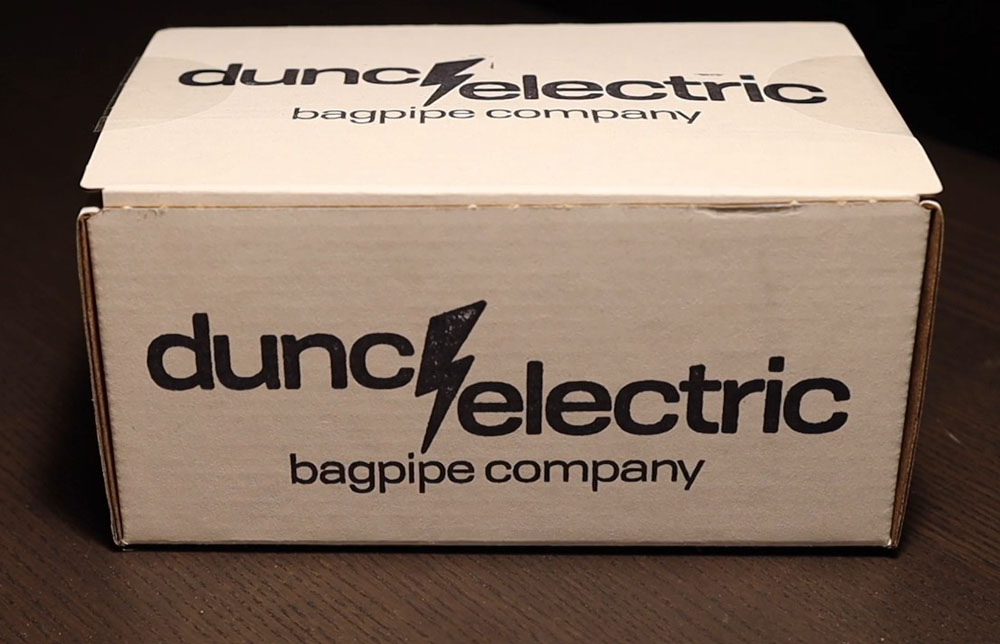
The Electrified Chanter Stock’s packaging strikes me as well thought-out and environmentally friendly. Instead of Styrofoam, the unit is wrapped in a good amount of stiff, black packing paper that holds its shape well. Inside the branded box are some stickers, which, as a 45-year-old adult and gearhead, I still appreciate and actually get excited about.
There’s also a card for the Rufus Harley Foundation. I’ve known about Rufus Harley for a long time, but I have to say I didn’t know much about him, other than that he was an African American from the East Coast of the US who played his own brand of jazz on the bagpipes. I looked for the Rufus Harley Foundation online, but there doesn’t seem to be a dedicated website. Harley passed away some years ago, and his connection to Dunc Electric is not obvious. He was certainly a fascinating character who lived and breathed playing the pipes.
 The unit itself comes in a soft drawstring pouch, an extra bit of protection for the stock and, more importantly, for other objects with which it might be stored. The chanter stock is made from Polypenco, but the pickup box is metal and will scratch softer materials like wood or plastic. It’s a nice touch and is consistent with good-quality audio packaging standards.
The stock has a deep tie-in groove. Very deep. In fact, I wondered if it was too deep for a synthetic bag. I tied mine on with a hose clamp, though, and it was air-tight.
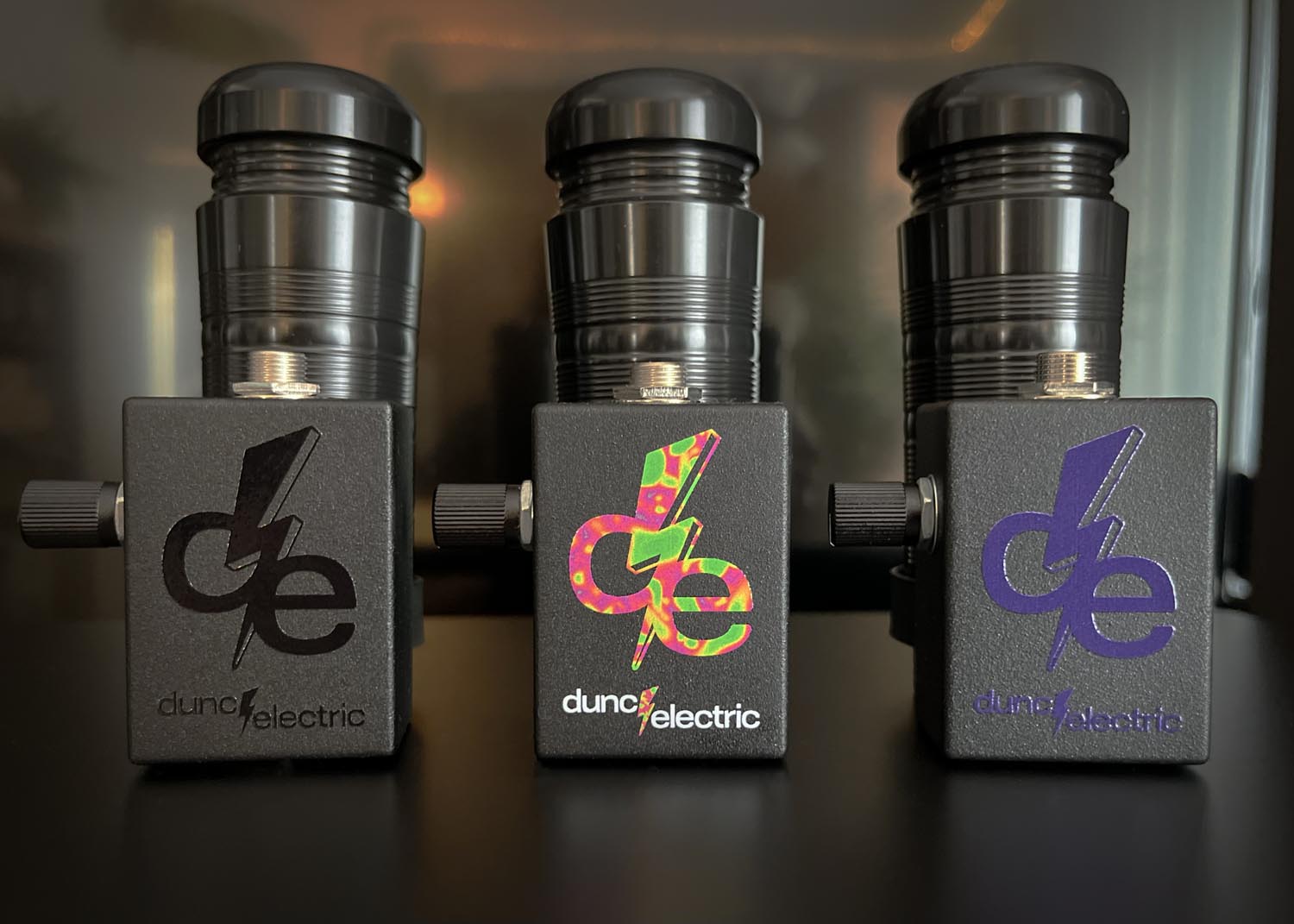
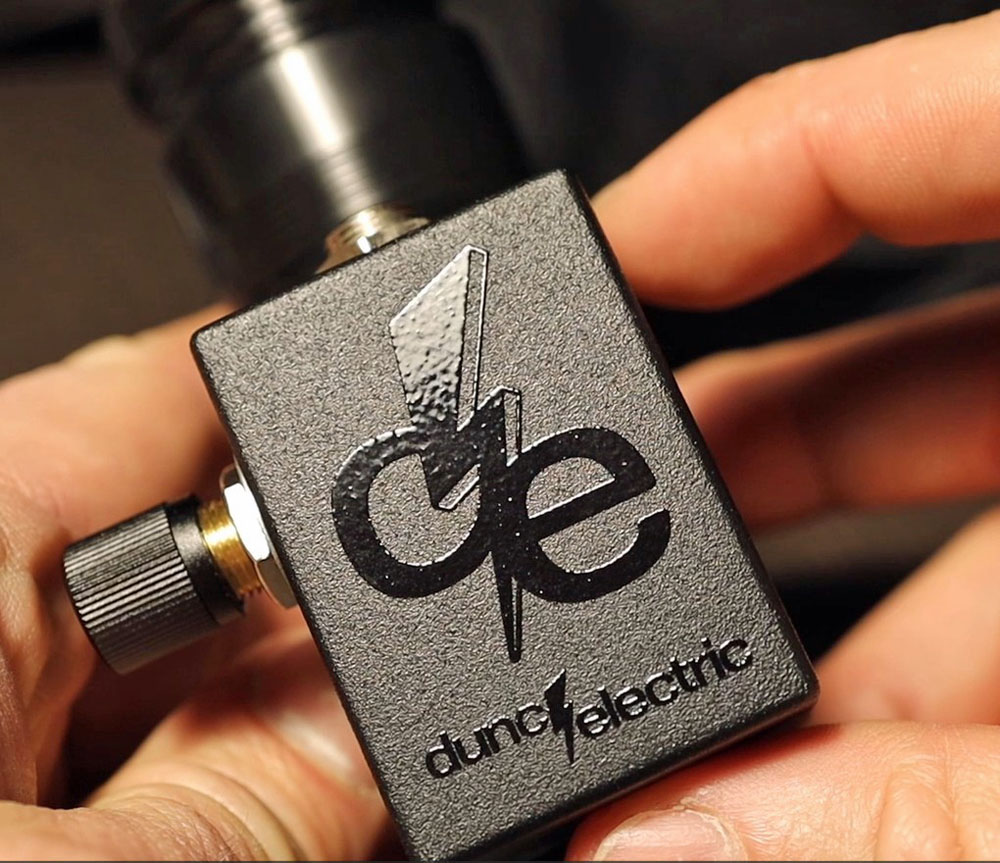
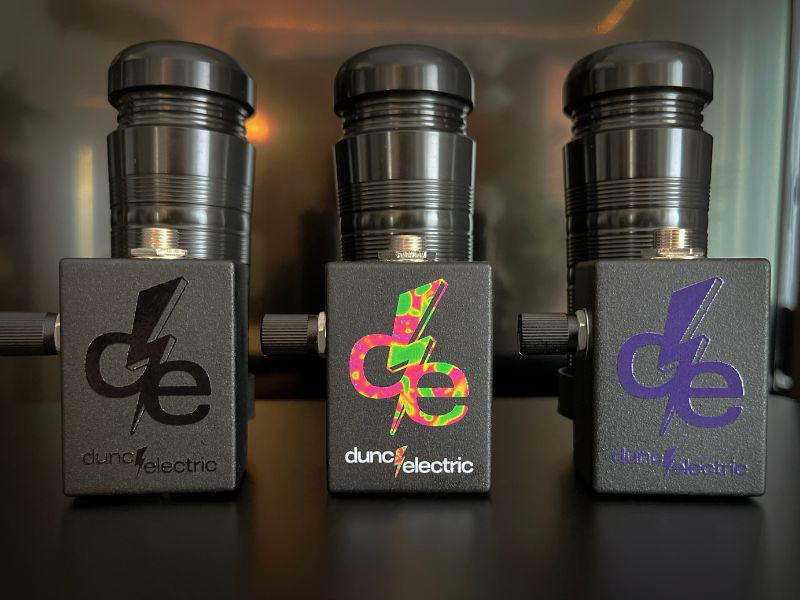
It’s a fairly simple piece of equipment. It’s a regular combed chanter stock made by McCallum Bagpipes with a small, black, 2″ square box displaying the DE logo in gloss black, which is attached securely to the front. This has a 1/4″ output on the top for an instrument cable and a small output knob on the right side to adjust the level. It feels very sturdy and well-made. I wiggled the clamp and output box pretty firmly and couldn’t sense any movement.
“The biggest advantage of a pickup system is that we can plug the chanter into effects pedals, loop boards, and even tuners without unwanted signals in the signal chain, and still hear it as we play.”
Inside the bore, you can see the piezo pickup face: a small rectangular brass plate that sits at reed level inside the front of the stock. The input jack points straight up from the top of the output box, which seemed odd at first, but I quickly realized the cable can be routed up the neck and through the bag cover, rather than hanging down in front of or beside your hands. That being said, I just let the cable hang for this video. I’ve had several microphone setups that had downward-facing cables, and it was a pain.
 The biggest advantage of a pickup system is that we can plug the chanter into effects pedals, loop boards, and even tuners without unwanted signals in the signal chain, and still hear it as we play. Having these sounds come back through a stage monitor would only result in feedback, as the sound is picked up again by a microphone. Delay, reverb, phasers, and overdriven amps are all fun effects to try with a pipe chanter.
One natural characteristic of effects pedals is that not all effects respond the same way to different instruments, and how effects typically respond to input depends a lot on the “attack,” or beginning of a note. Interestingly, the attack and decay (end) of a played note really affect the overall sound and character of an instrument, so if you remove the first and last half-second of a played note on different instruments, it can actually be hard to tell what instrument it is.
Since the pipe chanter lacks controllable dynamics and produces a continuous sound, some effects are lost. Guitar effects are made for, well, guitars, and the pluck (attack) is half of what the effects are responding to. Maybe I’m making that statistic up, but it seems right. When the pluck, bow, strike, etc., is taken away, like on the pipe chanter, the effect then becomes vague or barely discernible.
Testing
I plugged the 1/4″ instrument cable into the chanter box and the other into my audio interface, which is connected to my laptop, which is running Logic Pro, Apple’s industry-standard pro audio workstation software. It took some boosting to get the chanter signal to a usable level; being a passive pickup, with no battery or power source, this was to be expected.
 The chanter sound was also predictably thin, but it was there. It sounded like a chanter, and I smiled at the thought of how marvellous this older technology still is. I believe one of the first piezo pickups dates to the 1920s, and they are now ubiquitous on amplified instruments.
I played around with the EQ for a bit until the sound had more depth and less harshness, which is important.
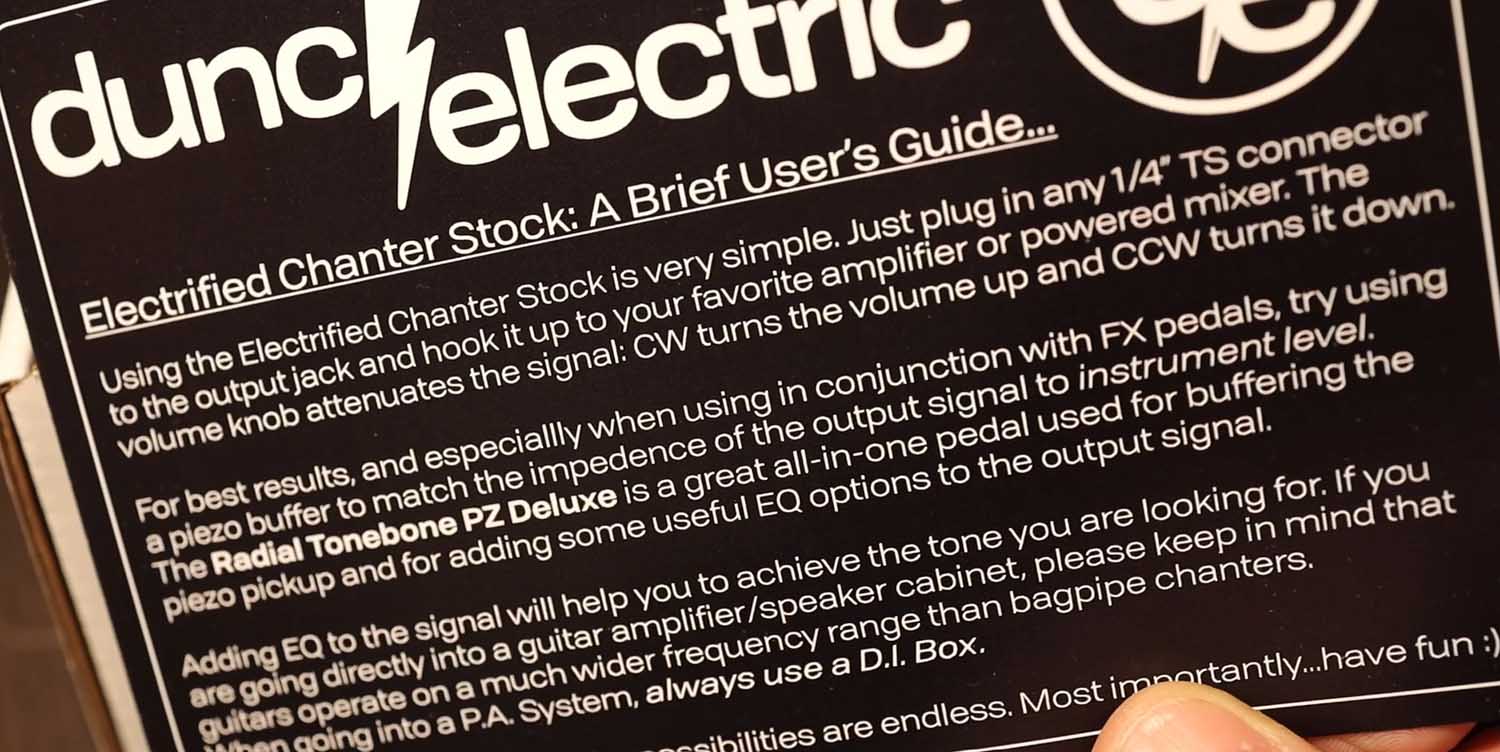
You will need some technical knowledge and experience to make it sound the way you want if you’re not working with a sound engineer. On their website, DuncElectric mentions that you will need to EQ the sound to your preference and that a preamp is required. This means adjusting frequencies up or down to boost or diminish specific areas on the sonic spectrum. For the pipe chanter, 4-6K or 4000-6000 Hz can be quite harsh. Anything below Low G (~415 Hz @ Concert Bb) will result in finger noise or other bumps on the instrument, as the chanter doesn’t make any musical notes below that, but I did make some interesting sounds with those thumps by boosting those low frequencies and then tapping on the output box that gave almost a tuned percussion kind of sound. Coupled with reverb, it made for an interesting beat.
You will also need basic audio equipment to convert this signal into an audible, usable signal. A pre-amp is essential; it takes the passive signal (there are no batteries or power source in this unit) coming from the chanter stock and boosts it to a level that can be amplified. Some guitar amplifiers can do this, but the output may be too low without a pre-amp.
Keep in mind that if you’re playing this through an amp, it will put significant air pressure on your eardrums, so earplugs are essential. The Highland pipes are already too loud for human ears, and boosting the sound level to the point where you can hear your chanter through an amp will be dangerous without proper ear protection.
To record with this, you’ll need an audio interface with good preamps. I used an older MOTU 4Pre as an interface, but with the stock gain knob turned up fully and the channel turned up fully, it was just loud enough. Plugging into my loop/effects board first, then into the MOTU proved to be a much stronger signal. I had fun experimenting with octave shifting, delay (echoing the notes being played), reverb, phasers, overdriven amp modellers and some lo-fi vinyl sounds.
Dunc Electric lists the unit at USD$545 (about GBP£410 or CAD$740), so it’s hard to say whether this is worth the money, but it is certainly worth considering if the above benefits are useful to you as a performer. As a piece of audio equipment, it is well-made and delivers its intended purpose.
Matt MacIsaac is one of the world’s top competition and performance Highland pipers. Among his solo prizes are the Silver Medal at the 1998 Argyllshire Gathering, the B-Grade Strathspey & Reel at the Northern Meeting, the 2019 North American Championship, the Piobaireachd Society Gold Medal (Canada) in 2019, the 2022 Alasdair Gillies Memorial Recital-Challenge, and the 2024 Gordon Duncan Memorial Challenge. A multi-instrumentalist, he tours frequently with the great Cape Breton fiddler Natalie MacMaster, and played with several Celtic folk groups over the years. Since 2019, he has been the Director of the Piping & Drumming Program at St. Andrew’s College in Aurora, Ontario, a position he will leave in August 2026 to return to his native Nova Scotia.
Did You Know?pipes|drums carefully assigns reviews to experts who have no connection to the maker, author or artist.
We never tell the maker who is reviewing their product.
pipes|drums is completely independent and nonprofit, with no interest in any product, event, association, competitor, judge or artist.
Respectful of reviewers’ time and work, we always offer them monetary compensation.
We don’t sell anything other than advertising and subscriptions; all proceeds are plowed back into the publication or donated to worthy nonprofit piping/drumming causes, organizations and pipe bands.
You can trust every review to provide the fairest, most unbiased, credible, and informative assessment possible.




NO COMMENTS YET