

Artificial Intelligence in competitive piping and drumming: a panel discussion – Part 1
Artificial intelligence technology is affecting virtually every element of life, and, whether we ask for it or not, piping and drumming will not be excluded.
In fact, AI is already being used. We just might not know it.
Just as electronic tuning technology and synthetic material were utilized in the 1970s and ’80s, pipers, drummers, pipe bands, judges, and associations will look to AI for the promise that new applications could help us to be more efficient.
Inevitably, there will be allegations that using AI is “cheating,” just as some were incredulous that electronic tuners, synthetic reeds and bags, and Kevlar drum “skins” were an unfair threat to our traditions.
- Revolutionizing adjudication of piping and drumming contests: leveraging AI for judging efficiency
- The Future of Competitions: harnessing artificial intelligence for objective judging
Perhaps AI will be a step too far. If the will of their members dictates, associations may enact rules against using AI for competitive advantage. But, how would such rules be enforced? And if one association has anti-AI rules in place and another doesn’t, how will that work?
Will composers and arrangers be needed when AI can kick out an awesome jig in seconds?
Will we need human judges when AI might completely objectively determine which bands or soloists deserved the prizes without bias?
Might association administrators eventually be replaced by AI software that automatically creates equitable orders of play, administers membership dues, and takes perfect meeting notes?
Will that banger medley arranged and orchestrated by AI be deemed “fair”?
Undoubtedly, the piping and drumming world is heading into uncharted waters.
We’re not a publication that shies from taboos. We believe everything should be discussed, all questions are fair, and we can best deal with change by trying to get ahead of it.
So, we assembled a panel of accomplished players who are also computer technology professionals.
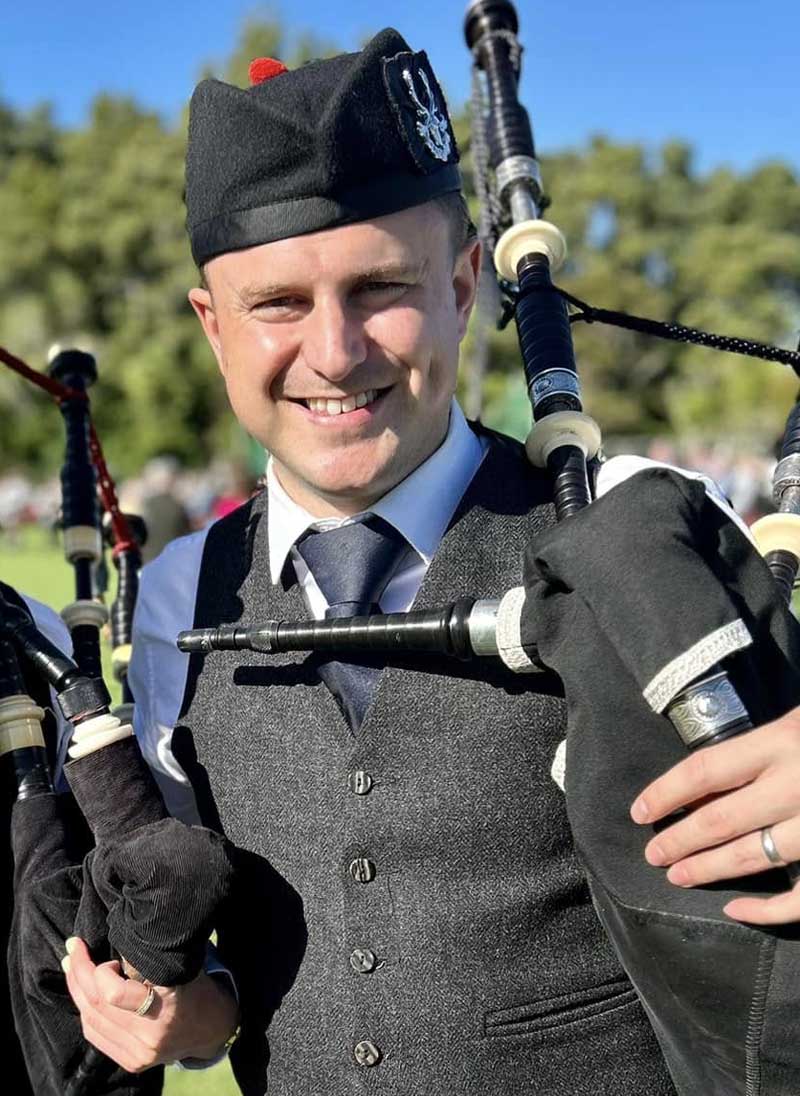
Matt Faser is the pipe-major of the Grade 1 Hawthorn Pipe Band of Melbourne, Australia, and a judge on the Australian circuit. Professionally, he is the general manager of engineering and consultancy apps for government-based projects in Australia. Last year, he launched Musolink, an app for pipers and drummers to track and elevate their practice routines.

Twenty-four-year-old Colin Johnstone from Aurora, Ontario, is a Professional-grade solo piper on the Ontario scene. He’s played with top-grade bands and works as a cybersecurity researcher with the Canadian Imperial Bank of Commerce in downtown Toronto.

Only 22, Brodie Watson-Massey of Edinburgh is a fast-rising star on the Scottish solo piping scene. He recently won the 2025 Scots Guards Knockout Competition, and routinely features in A-Grade prize lists. As he finishes his university degree, he’s working in data science with Scottish Enterprise.
As always, readers and viewers are invited to use our Comments tool at the end of this article to express their thoughts and opinions.
Here’s Part 1 of our AI discussion panel:
Here’s a transcript of the discussion, with minor edits for clarity.
pipes|drums: We’re always interested in talking about things new and we’ve talked a little bit in the past about artificial intelligence and artificial intelligence, AI, is everywhere these days. It’s come on really quickly. And that probably means it’s going to affect piping and drumming to some extent in the future. Whether we like it or not, different things will be tried and who knows what they might be.
The best way to get out in front of it is to talk about it. So, we put together a great panel. We take a worldwide panel through the miracle of technology. We’ve got Matt Fraser, the pipe-major of Melbourne, Australia-based Hawthorne, Grade 1 band, doing great things. Matt is also the general manager of engineering and consultancy apps for government-based projects in Australia. And he also has launched MusoLink not too long ago, which actually uses artificial intelligence to some extent and is doing some great things. It’s an app for pipers and drummers, which people should really look into.
Colin Johnston is a professional-level solo piper based in Aurora, Ontario. He’s also a cybersecurity analyst – actually, a researcher now – for the Canadian Imperial Bank of Commerce. He’s written two articles for pipes|drums on artificial intelligence, which are really interesting stuff. I encourage you to look back at those or read them for the first time if you haven’t yet.
Brodie Watson Massey is an up-and-coming superstar on the solo piping stage based in Edinburgh, Scotland. He’s still in university, but he’s also working for Scottish Enterprise and data science and as he finishes his degree at university.
Thanks very much, guys, for taking the time today. We really appreciate it. This is going to be a great conversation, which we’ll do in a couple of parts.
As a technology professional and a player of one of the most tradition-minded instruments there is. Are you excited by the possibilities of artificial intelligence in piping and drumming?
Matt Fraser: Yeah, I’m very excited. I see it as a tool, not a replacement. But there are lots of elements of what we do that, if replaced by AI, would let us focus on the more creative or the more artistic elements. And I think that can only be a positive for our movement.
pipes|drums: Colin, you have written a little bit about judging and other applications, potential applications for AI. Where are you at right now after a few months since you’ve written those articles?
“I truly think AI can be utilized in a lot of the administration work that piping organizations do, even the way that contests are run.” – Colin Johnstone
Colin Johnstone: Yes, definitely agree with everything Matt said earlier. It’s definitely a very exciting tool. A lot of people don’t fully understand it, which is, think, a big part of the problem, especially when dealing with such a traditional instrument. I know that, in the past, I’ve written about judging itself, but I truly think AI can be utilized in a lot of the administrative work that piping organizations do, even the way that contests are run.
It can help out with so many of those tiny things. The big thing I was talking about in my article was writing score sheets, assisting the judge to write score sheets. It doesn’t have to fully replace what the judge itself is writing, but if you think from a time standpoint, how much time is actually used writing out the score sheet, putting down your thoughts on paper, there has to be a more efficient way to do something like this, especially when we really should be paying attention to what’s in front of us and listening to the music.
pipes|drums: And Brodie, what are your thoughts? You’re still right in the thick of things at university, but what do you see as the youngest member of our group?
Brodie Watson-Massey: I agree with what Matt and Colin said. I think that we do have to be somewhat cautious, but I think that as the technology develops more and more, hopefully it will become easier to implement, and the issues that we’re worried about now won’t be an issue anymore.
pipes|drums: And, think about the music itself, arrangements, ensemble, pipe bands, mainly, and thinking of putting things together, using AI potentially for that purpose. is that a potential fit? You know, and if not, where are the best potential fits? Colin talked about judging. Brodie, you’re playing with Inveraray & District. Do you see it as a good fit in musical arrangement or should that be completely non-artificial-human?
Brodie Watson-Massey: I think AI pulls from things that already exist. So, if you want something to be original, if you want something different, I think that you have to have that human element in there. Certainly, with the way things are just now. In terms of the band, all bands I would say, I think that the way that we do things now challenges people and people like that challenge.
“I wouldn’t want to become reliant on AI to do those kinds of jobs. I would want to do it myself. But I think that there is scope for it to potentially help in the future.” – Brodie Watson-Massey
If it were me personally, I wouldn’t want to become reliant on AI to do those kinds of jobs. I would want to do it myself. But I think that there is scope for it to potentially help in the future. The issue is probably the lack of data that’s comprehensive and gives genuine insight into how good music works in terms of piping and drumming, and supports it with that. But as that becomes more readily available in the future, perhaps we will see it more.
pipes|drums: Matt, with Hawthorn, you’re also in the thick of it as pipe-major of one of the world’s top pipe bands. You’ve actually implemented AI to some extent with MusoLink. Do you see that as a fit? Maybe you’re already using it in Hawthorn?
Matt Fraser: For me, the creative process of experimenting with musical ideas, coming up with medleys, and so on is one of the things I enjoy the most about what we do. And I don’t really want to give that up, even if AI can help. Having said that, there are certain things that might be able to help with. I like to ensure that we don’t play tunes overplayed or played recently by another grade one band. And I’m always paranoid that I might miss something like that.
I can quite often just easily check these days and just say, you know, has a grade one band played X in the last five years. So, it can assist, but I think for the creative elements personally, I wouldn’t want to give those up. I like to use AI to do the things I don’t want to do. And so one example I had is when I’ve judged a few piobaireachd competitions. What I’ve found is, when you’re judging by yourself, if you’re judging a tune you’re not that familiar with, a lot of your mental cycles are spent reading the music to make sure the player didn’t go off the tune, which means you’re not paying as much attention to the music. And so that’s an example where I think AI could help the judge keep track of the music and ensure the player didn’t go off it. Then the judge would be free to focus on interpretation and things that a human is more suited to.
pipes|drums: Never thought of that – second-guessing yourself, if you could have a quick check using AI, it could be very handy.
Matt Fraser: Yeah, and I know I’ve been annoyed in the past when people have got prizes even though they’ve gone off tunes and then I’ve got prizes when I’ve gone off tunes. So, I think everyone would probably be happier if that was that element was taken out of the mix. That’s one example of how I can see AI having a really positive impact.
“Artificial Intelligence will definitely be utilized in some sense. To what extent, I’m not 100 % sure.” – Colin Johnstone
pipes|drums: Back to the idea of arranging, say, medleys or composing even, I know that, the bank of information out there, I think that Brodie talked about, for AI to draw upon is limited, but to get to a point where it’s not, and that it could be well informed to create, in theory, a medley that is brilliantly structured. Is it inevitable, Colin, that people will implement AI to their competitive advantage?
Colin Johnstone: I think it will definitely be utilized in some sense. To what extent, I’m not 100 % sure. Because like everyone’s already said, it really should be a human creating it at end of the line. We might have some suggestions, like Matt already recommended about what’s already being played. And if we have that data all laid out, like if we had an index of every tune existed, who was playing it,
You could easily say, “Okay, I want a new medley, spit it out!” And it could just give you tunes and you could be, “Hey, I like that. Hey, I don’t like that.” And it’s creating something that didn’t exist before. Could be good, could be bad, but it’s something to work with, right?
pipes|drums: Yeah, it’s sort of the writing process, like the written word process almost, where you might start with an AI-generated piece and then make it your own. So, kind of the equivalent.
Colin Johnstone: Yes, and it might create, might spawn an idea that you never would have had before that.
pipes|drums: Brodie, what do you think of that? Let’s say you apply it to the solo scene and you’re looking for content that isn’t normally played, that might give you an edge, or that suits your playing. Do you think there’s a potential there?
Brodie Watson-Massey: Maybe not as things stand just now though I would say I wouldn’t want to use it to pick the tunes I play as the way things are just now, but I could see, touching on what Colin said, using it to find tunes with that kind of synergy that you don’t often find without actually going through that trial and error process of just playing like hundreds of tune – so, that time-saving side of things, the efficiency.
We see that in AI now, things like coding and debugging code would take hours and hours. You’d be searching, and then you’d find it to be the easiest thing ever that you’ve just missed. You can just put it into AI, and it tells you straight away. So, little things like that, I think, could potentially be applied to piping in future.
For me, the big issue is the lack of data of good enough quality to help us in the way that we want it to. You could develop an AI system to put that into, but it’d be pretty expensive and time-consuming. I don’t know if that would really be the best use of the resources of piping and drumming organizations around the world, but it would be a really good challenge and could potentially have a lot of really good benefits.
“For some lower-grade bands who already outsourced their drum score writing, it might be a bit of an assist where they can get something that’s pretty good, that’s better than they might have been able to do themselves. ” – Matt Fraser
pipes|drums: It occurs to me right now that with pipe bands, we’ve run some things recently on ensemble and drumming, scoring to pipe tunes and what’s conducive to ensemble or vice versa, drum scores and then adapting pipe music to go with it. Is that a potential, Matt, for improving or identifying the best drum score for pipe music, and vice versa?
Matt Fraser: To the points that the others have made, assuming it was possible today to do that, it’s likely that you might get kind of derivative type material because it’s based on everything else that’s been. Having said that, for some lower-grade bands who already outsourced their drum score writing, it might be a bit of an assist where they can get something that’s pretty good, that’s better than they might have been able to do themselves.
Another thought that occurred to me often when you’re putting together a medley, you find yourself in a situation where you’ve got a section of a medley and then a gap and then another section, and you’re looking for tunes that fit a certain criteria. It’s like I need a jig that’s in D, and it’s like a fun bridging tune, but doesn’t sound like a closer. And so that sort of thing, it might be able to help with as well, where it can give some suggestions, but you still are the human in the loop that makes the kind of final call about what you like, because there’s a personal element putting your voice into some of this stuff as well, right?
pipes|drums: Excellent points. Really insightful. Well, look, let’s close out part one here and come back and talk about maybe some more on judging and the potential to make objective some of the subjective nature of our art form.
Stay tuned to pipes|drums for Part 2 of our panel discussion on artificial intelligence.





NO COMMENTS YET