

Part 2 of “45 years of Bagpipe Notation Software: a conversation with pioneers Rick Mohr and Rob MacNeil”
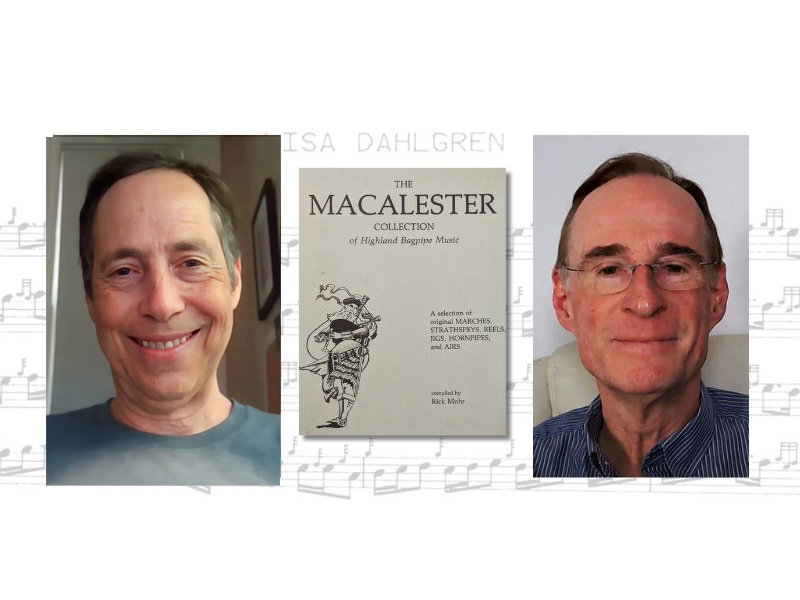
We continue with the second half of our conversation with Rick Mohr, the inventor of the first notation program exclusively for Highland pipe music, and Rob MacNeil, creator of Bagpipe Music Writer, the first commercially available notation application for pipers.
In Part 1, Mohr discussed creating his program using the BASIC programming language in 1980 while attending Macalester College in St. Paul, Minnesota. With it, he produced The Macalester Collection, the first pipe music book in history to be typeset using computer technology. Before then, music “engraving” was literally that: labourious and expensive, handmade engraving of music manuscripts on sheets of silver.
In the 45 years since that first application, digital music notation has become standard, used by virtually every competing pipe band and composers/arrangers on earth to produce polished versions of their music.
Part 2 of our conversation:
Thanks again to Rick Mohr and Rob MacNeil, pioneers of music notation technology for pipers and drummers.
Here’s a transcript of the second half of our discussion with Rick Mohr and Rob MacNeil, with minor edits for written clarity.
Part 2
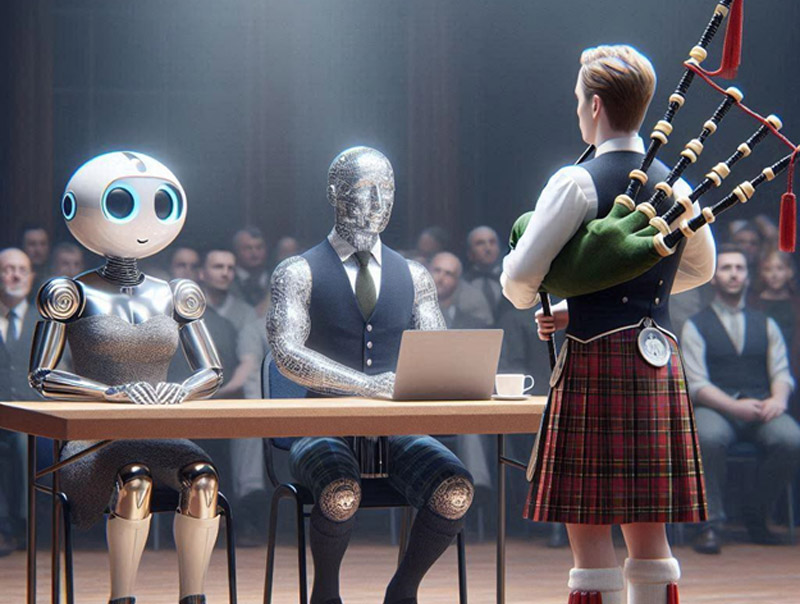
pipes|drums: So, here we are in 2025, 45 years later. We’ve got stuff like artificial intelligence, which has been around for a while, but it’s coming on fast. Do you see AI having an impact on notation? It may already have. Are you following that?
Rick Mohr: I haven’t seen any evidence of that. Indeed, AI has been producing music. I don’t know if you’ve played with these song generators, but they’re stunningly good. Know, somebody would need to. AI comes up with things for the mass market much more quickly than for little niche situations, but somebody could take all the pipe recordings that ever existed, feed them to train a model, and have it start composing tunes. But who would want to do that?
pipes|drums: Well, who would want to make a bagpipe notation application 45 years ago?
Rick Mohr: Yeah, what I mean is it’s great when humans write tunes.
pipes|drums: Rob, what do you think of those AI implications? You may be using it already.
Rob MacNeil: Well, not yet, but there’s an app that recognizes the chanter-played tunes and almost gets them right there. Now, it’s drawing from a database of various tunes in BMW format.
And yet, as long as the tunes are in that database, it recognizes them correctly. I tried to stump it, but I really couldn’t. When I tried to play tunes that weren’t in there, of course, it tried to find the nearest tune. It’s ironic how similar patterns appear in many tunes. You look it up, and it’s pretty good, but it’s not AI-based yet.
Rick Mohr: When you write a new tune and you’re all excited about it, you have to plug it in there and find out that, no, it’s already been written.
Rob MacNeil: Yeah, it’s the composer’s nightmare. Does my tune sound like something else? So, this sort of Shazam for bagpipe music is a great tool for composers.
pipes|drums: It reminds us of Matt Fraser, who was just on a panel we did on AI. He talked about being able to use AI to run a draft medley, for example, to see if similarities exist elsewhere. Interesting. It could help leaders of pipe bands quite a bit. So, it’ll be interesting where things go.
Rob MacNeil: Where I see AI going is in essentially helping the player develop their technique and musicality, as well as being able to assess a performance and give some feedback. Because one of the things that I learned pretty early on in the early published version of Bagpipe Music Writer was that the playing module was the most critical aspect, almost superseding printing, and that was one of the afterthoughts I put in almost in the last minute before putting out the production package there and, so, thinking about how AI can be a benefit to the individual player about giving them assessment.
It’s not the same level as a teacher’s, but providing some feedback will be very important and could be a great challenge for any PhD student to crack.
pipes|drums: And not only that, it sounds like you for the competitive piping scene and tailor-made for judging. You know, if you wanted to complement humans’ judgment and the subjective side of it, with the objective side of correctness, that sounds like an interesting application if the will of competing pipers and drummers wants it.
Thank you for your pioneering work. Forty-five years ago, Rick Mohr developed the first bagpipe notation software; what has happened since is incredible. It’s great to see someone, even in 1980, just doing it just because. Rob can harness that and take it to the next level with Bagpipe Music Writer.
We appreciate that you have both made massive contributions to the piping world. And here’s to the future with more great stuff. So, thanks again.


NO COMMENTS YET