

Matt MacIsaac on his new collection, the composing process, and some advice for creators
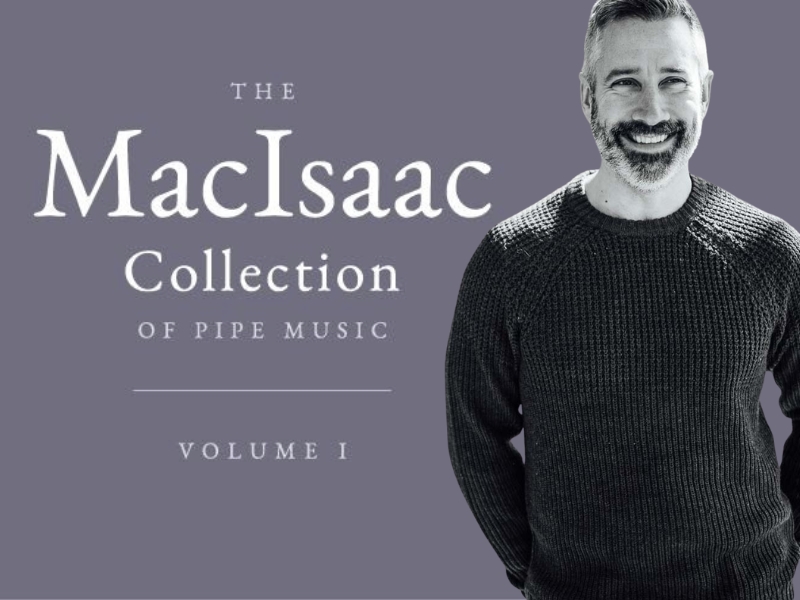
 The MacIsaac Collection of Pipe Music – Volume 1 by famed piper and multi-instrumentalist Matt MacIsaac of Nova Scotia has been in the making for a long time. More than 30 years, actually.
He’s been composing since his early teens, and for much of that time, he’s created and arranged pipe music at a prodigiously prolific rate.
Already well reviewed in pipes|drums by Highland Society of London Gold Medallist Brodie Watson-Massey, The MacIsaac Collection of Pipe Music comprises 71 compositions and is available directly from MacIsaac in print and PDF formats.
The perfect-bound print version is meticulously designed and typeset in wide horizontal orientation on high-quality paper stock, with clear objectives in mind: clarity, accessibility, readability and convenience.
After several years running the piping and drumming program at St. Andrews College in Aurora, Ontario, he’s back in his native Nova Scotia, living, creating, and recording in the small town of Chester, with the scenic, no-doubt-inspirational Atlantic just yards from his front door.
The publication of The MacIsaac Collection – Volume 1 was an ideal time to check in with him, not only about the book, but also about his composing process. It’s food for thought for any creative piper or pipe band drummer hoping to try their hand at composing, or ready to take a different approach to making original music.
Keep watching (and learning) until the final few minutes!
A transcript of our discussion, with minor edits for written clarity:

pipes|drums: We’re here with Matt MacIsaac coming to us from Nova Scotia, his home and native land in Canada. Matt has just released The MacIsaac Collection of Pipe Music – Volume 1. It’s a really impressive collection. We’re happy that Matt is here to talk about it, composing, and all kinds of things. Thanks a lot, Matt.
Matt MacIsaac: Thanks for having me.
pipes|drums: Congratulations on the new collection. It’s a lot of work. How long has it been in the works?
Matt MacIsaac: Thanks. Well, I suppose since I started writing tunes when I was 11. But really, over the last two years, I finally sat down and compiled enough music for a collection this size. There are 71 tunes in it. It’s 100 pages. I’ve been writing since I was young.
The earliest tune in that book is a hornpipe called “Lynn Sutherland” that I wrote when I was 14. Then I’ve got a couple of other tunes in there that I wrote years and years and years ago. But really, I started putting in a concerted effort about two years ago, in the spring, to sit down every morning. I said, Okay, I have these tunes in my head; they’ve been there forever. People have been asking about putting some of my transcriptions from performances or arrangements or whatever together. I finally sat down every morning and wrote down what I already knew, but then I started creating every morning and trying to build the habit, which isn’t always a lightning bolt. Sometimes the lightning bolts come, but a lot of the time they don’t, and it’s just about building the habit first. The last couple of years, for sure. Then this year I just dropped it out of the blue, out of the sky. That’s how that came about.
pipes|drums: Songwriters often take the same approach. They treat songwriting as part of their daily routine, sitting down to compose and create new music. Do you sit down and say, “Today I’m going to write a reel,” or, “Tomorrow I’m going to write whatever”? Do you have a schedule of genres, or do you twiddle around and see what comes out?
Matt MacIsaac: It’s easy to sit down and go, “Okay, I need this,” or “I need that,” and try to write it. But that’s when it doesn’t work. You hold on too tightly to something, and you end up squeezing life out of it. What I do is maybe close my eyes, have a coffee, be outside maybe, and it was nice in the spring, and I would think about a couple of notes. I’d pick three notes, then start writing with them and see what I could make. Sometimes I would get four bars or seven bars in or something, or I’d get a whole tune out, and I’d think, Actually, this works better as a jig, and then I would start again.
“There are so many distractions these days, and it’s easy not to want to do it or feel like you can’t do it or this sucks, or this tune is no good or whatever. But the important part is to make it and do it and keep hashing away at it. Because it’s really a numbers game.”
And to your point about songwriters making a habit of it, that’s the case for songwriters, melody writers, authors. I’ve read so much in the last couple of years about the habit of creativity. It sounds like an oxymoron, but your brain needs to be in that doing-and-creating mode, whether it wants to or not.

Béla Fleck, a banjo player from the United States, has about 19 Grammys, and he’s one of the most incredible musicians in the world. I remember him saying people don’t see the drawers of garbage he’s written; they only see what makes it onto the stage, into the book, or whatever it might be. That really struck a chord with me, to speak, that it’s very much just doing the thing and then refining it and treating it like a craft rather than divine intervention or some sort of lightning bolt or inspiration.
pipes|drums: There must have been, personally for you, a lot of editing. If you’re composing upwards of a tune or more a day, there must have been a lot of so-called “crap” that hit the cutting room floor.
Matt MacIsaac: Of course. I had hundreds of tunes. I whittled it down to 100, then back to 71 at the end, when I finally settled on it. There are a couple of tunes that are going to go in Volume 2, but yeah, there was a lot of editing, and there was a lot of picking up crumpled pieces of paper that I thought were trash yesterday and going, “You know what? I can save this, or I can do something with this.” Some stuff ends up on the floor, and that’s fine. That’s where those notes belong.
But after a significant amount of editing, after everything was done, I tried to find all the gracenotes and all the little technical things and the typesetting and all the publishing and all the design and all the work was done by me. It was very much a labour of love, and “labour” is the operative word. It was much more work than I expected.
pipes|drums: There is a PDF version that people can purchase, but there’s also the printed version. It’s a high-quality production. What made you decide to invest in that kind of print quality?
Matt MacIsaac: Thanks. I’m really happy it turned out the way I wanted: something physical, something tactile, something tangible you can hold, put in your living room, on your coffee table, or on your bookshelf, sitting with all your other books. I miss the old landscape, short-and-wide book. I like that the music spreads out over the page and isn’t confined to portrait orientation.
“I miss those days when something was crafted, not that it’s not happening anymore, but it’s happening less. I just wanted to make sure that this was an option for people.”
I wanted something that looked good and was a physical product. I love PDFs, I love technology, I love the convenience of digital. I wanted that to be available for people. But I also wanted that feeling of being able to flip around and find that book, dog-ear the page and then be able to flip through and have it right in front of you and carry to the next room or whatever you wanted to do, have the full size in front of you. You don’t have to zoom in or whatever.
I miss those days when something was crafted, not that it’s not happening anymore, but it’s happening less. I just wanted to make sure that this was an option for people.
pipes|drums: Seventy-one compositions and arrangements, including, very interestingly, an arrangement of “The Little Cascade,” which we won’t go into, but it’s really impressive. Can you name a few of your favourites?
Matt MacIsaac: There are many. It’s strange to pick a favourite among your own compositions. But there’s one jig called “Donald R.” that I wrote for my grandfather, Donald R. MacKay. He was a native Gaelic speaker in Cape Breton, and he gave me my first set of pipes. He was the only grandfather on my mom’s side who I ever knew. I wrote that for him. It’s a jig in G-major. And then there’s a reel called “Ninny’s Reel.” Ninny is a nickname of a friend of mine. It’s a little reel in A-minor. Those are two of my standout tunes.

pipes|drums: You talked about your process of composing, but do you think composing is something that can be learned, or is it something that pipers and drummers are instinctively drawn to?
Matt MacIsaac: Anything can be learned, but to what degree? That depends on the individual. It’s how much time they put into it, That comes back to what I said about it being a habit, and doing it a lot and just trying it. Many people are maybe afraid to try composing. They ask, How do I write a tune? Or, What’s the best way to write a tune? Or, What should I do, and what should I not do?
There are little things you can do here and there to speed up the initial process, maybe, but it really comes down to doing it all the time. You’re going to have influences that come out of your playing. You’re going to have not necessarily… derivatives- the wrong word, or maybe it’s the right word. I don’t know. But we only have nine notes, and we have a very kind of narrow-ish definition of what a pipe tune is, whether it’s a jig or a reel or a march or hornpipe or a slow air, and then piobaireachd maybe. After that, it gets a lot wider, but also less familiar to pipers.
“Everyone should try composing. Everyone should try to write something down, and maybe it’ll be another tune you already know. But that’s okay. That happens to all of us.”
We have a limited range; we have a limited toolbox. But we still find ourselves unsure of where to start. Whether you can teach that or not . . . there are multiple ways of teaching someone how to compose a tune. We already see all sorts of patterns in pipe tunes, with ending phrases and A and B phrases. It’s a good place to start. But some will be better at it than others, just like anything else. I would say, though, that everyone should try it. Everyone should try to write something down, and maybe it’ll be another tune you already know. But that’s okay. That happens to all of us. Right, this exists already. You crumple it up, and you start again.
It’s a good question whether it’s inherently built into somebody at birth, or whether it’s nature and nurture. To me, it’s very much a nurture situation: we are exposed to a lot of music in our lives, and that naturally comes out in our compositions.
I don’t know if that answers your question. It’s complicated.
pipes|drums: We could go on for a long time. It’s interesting. It occurs to me, “Lynn Sutherland,” the tune you mentioned earlier that you composed when you were 14, is very original. You weren’t very familiar with what others had done in pipe music, but you stumbled on something really original. That’s pretty impressive if that was one of your first compositions.
Matt MacIsaac: Thanks. Could be blind luck, too!
pipes|drums: You’ve talked about hundreds of tunes that have been on the cutting room floor. That suggests Volume 2, as does the collection’s title, Volume 1. Will we have to wait another 30 years for Volume 2?
Matt MacIsaac: Not at all. That’s the opposite problem now that I’ve released Volume 1. I’m thinking, Okay, how long do I wait before Volume 2 comes out? It’s not ready yet, but I’ve started it, and I’ve got probably 10 or 20 that are lined up. I find myself thinking about what colour the cover will be: It’d be nice if it were blue! Yeah, there’s definitely a Volume 2 coming, and maybe Volume 3 eventually, too. It’s a fun process.
pipes|drums: Well, congratulations on The MacIsaac Collection of Pipe Music Volume 1. We’ll look forward to digging into it more and to what else comes out of the Matt MacIsaac vault of arrangements and compositions. Thanks a lot, Matt, and all the best with the new collection.
Matt MacIsaac: Thanks. Appreciate it.





NO COMMENTS YET