

45 years of Bagpipe Notation Software: a conversation with pioneers Rick Mohr and Rob MacNeil – Part 1
When they turn the pages of Highland bagpipe history, there are sure to be breakthroughs such as the addition of a second tenor drone, the evolution of competitions; the MacCrimmons, Angus MacKay, G.S. McLennan, Willie Ross, Donald MacLeod and Gordon Duncan; and the impact of synthetic materials.
But a deserved addition to that the list should be music notation software for Highland pipers.

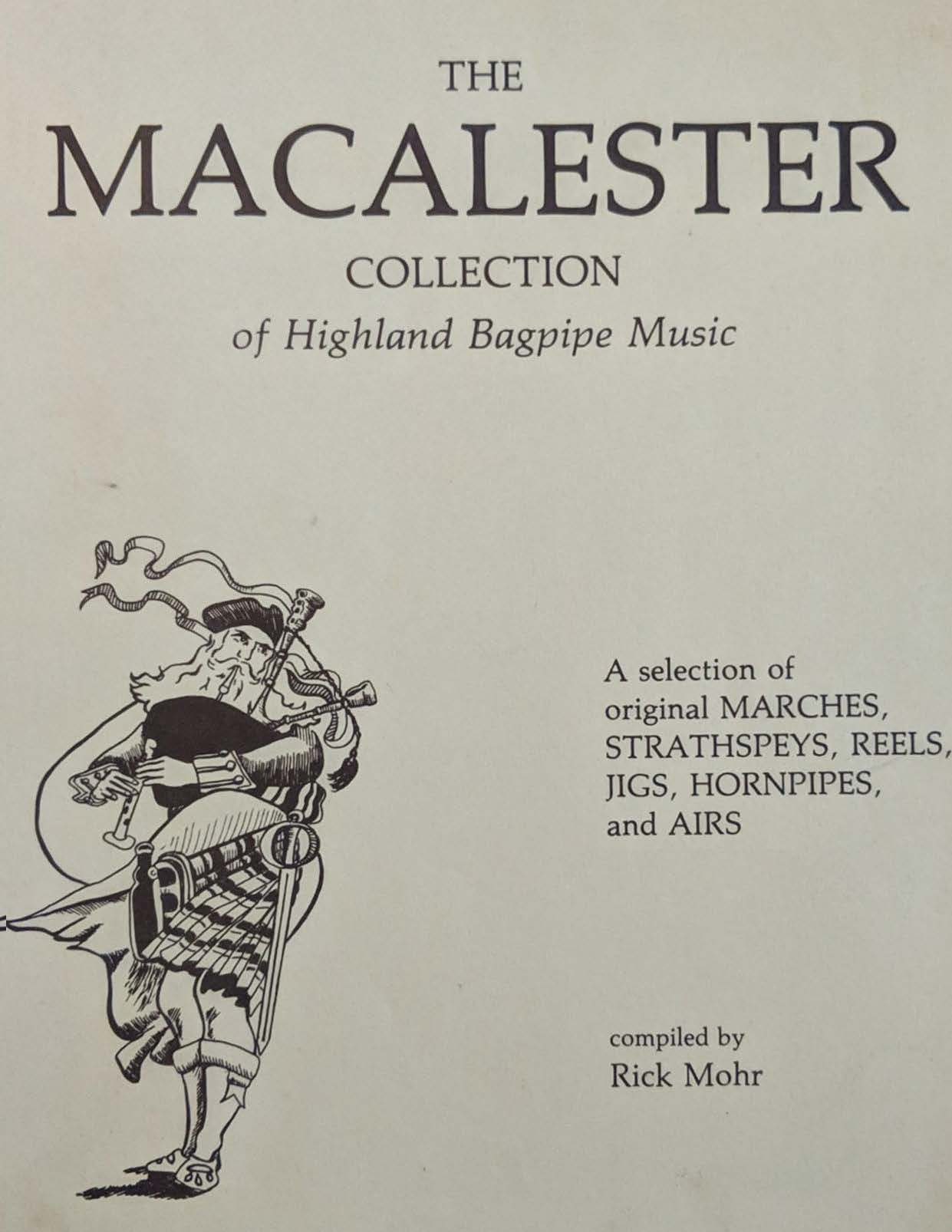
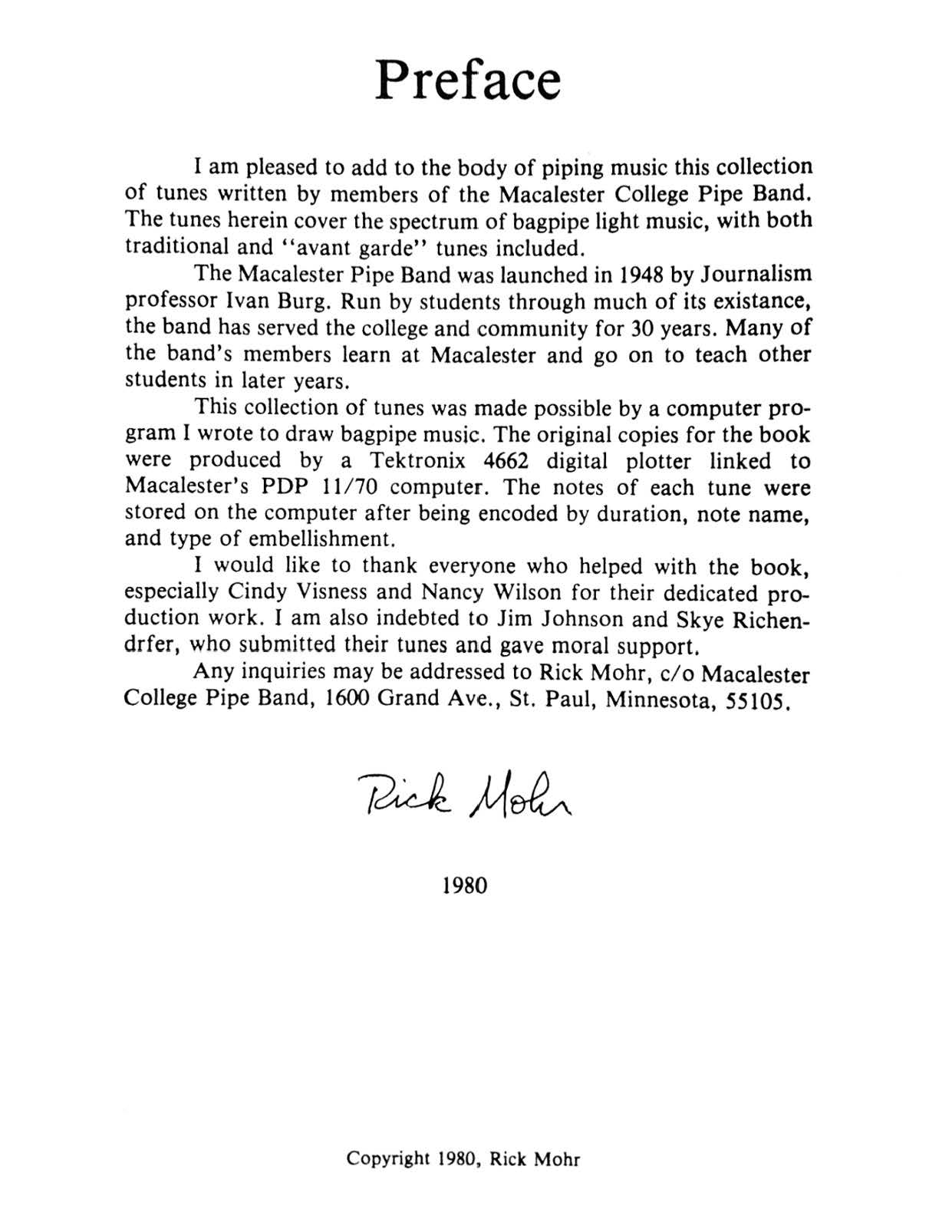
The first software code for bagpipe music “engraving” was created in 1980 by Macalester College student and piper Rick Mohr in St. Paul, Minnesota.
Necessity being the proverbial mother of invention, Mohr was searching for a way to publish a collection of pipe music by members of the Macalester College Pipe Band. At that pivotal time, when the world was on the brink of embracing personal computing, the only means to create professional-looking notation was by the traditional method of painstaking and expensive hand engraving (literally) on silver plates – well beyond the hope and means of Mohr and his fellow Macalester students, Skye Richendrfer and Jim Johnson.

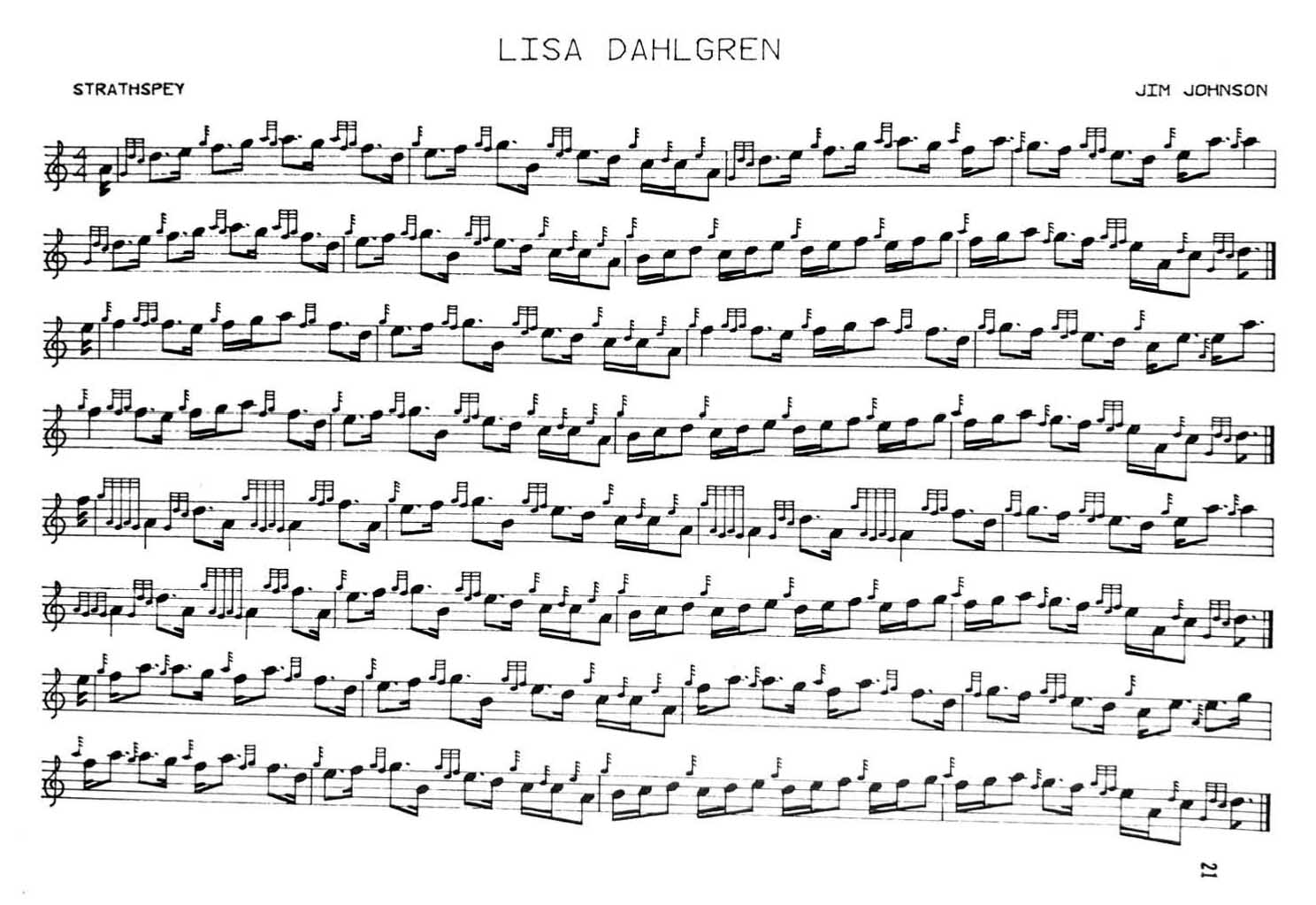
The industrious Mohr applied his limited knowledge of the BASIC computer programming language and, quite extraordinarily, developed an application that didn’t simply produce legible notation, but professional-quality scores that were elegant and, perhaps best of all, editable.
They created The Macalester Collection of Highland Bagpipe Music, the first book of pipe music completed using computer technology.
With no objective other than publishing the collection, which didn’t gain much attention, Mohr’s code lay dormant and eventually was lost. He moved on to other things.
But Vancouver’s Rob MacNeil took note. Richendrfer and Johnson became members of the Simon Fraser University Pipe Band, with which MacNeil also played (he remains president of the SFU Pipe Band organization). With the code lost, the ever-industrious and canny MacNeil was inspired to create his own application around 1984, and the first iteration of Bagpipe Music Writer was developed.
Over the next few years, he enhanced it to work with the first PostScript printers and Linotronic typesetting machines and, importantly, to publish his first collection of music in November 1990.
Since being made commercially available on September 3, 1993, when the first unit was sold at the Caledonian Club of San Francisco Highland Games in Santa Rosa, “BMW” has become the gold standard for pipe music notation.
Today, virtually no pipe band or pipe music/pipe band drum score composer or arranger doesn’t use notation software.
And it all started in 1980 with Rick Mohr in St. Paul.
Forty-five years on, we connected with Mohr and MacNeil to discuss their contributions to piping history, making the lives of pipers and drummers everywhere easier and more fulfilling.
Here’s Part 1 of our conversation:
Stay tuned for Part 2 of “45 years of Bagpipe Notation Software: a conversation with pioneers Rick Mohr and Rob MacNeil.”
Here’s the text of Part of our discussion with Rick Mohr and Rob MacNeil, with minor edits for clarity.
Part 1
pipes|drums: We’re excited to discuss bagpipe music notation today with two of the pioneers. Rick Mohr from Philadelphia and Rob MacNeil, who is familiar to many people, are coming to us from Vancouver.
We wanted to mark the 45 years since the first bagpipe music notation application, which was created in the nascent days of software development. It was also done at Macalester College in St. Paul, Minnesota, where Rick Mohr attended. He’s a 1980 graduate of Macalester. He created the first notation software application on his own, which resulted in the Macalester College Collection of Music, which came out about a year later and is fantastic. It’s a collector’s item but may be reprinted one day. So, thanks again, guys.
Looking forward to the chat and marking this important occasion.
It has been 45 years since you created the first engraving software application for Highland Bagpipe Music at Macalester College. Rick, tell us how it came about.
Rick Mohr: We had a bunch of books of music, like the Scots Guards Collection and all the classics. But at that time, any music publishing was done by engraving a metal plate with these metal tools. And there’s a great video, if you search online, to show how it’s done. They have this claw that makes the staff, and they have stamps that stamp out a note head or a rest, and they draw the beams by hand. It’s so impressive.
Anyway, there were no personal computers or desktop printers, but the college had an early mini computer with terminals that could show text characters, one graphics terminal that could draw a line, and a pen plotter that could draw lines. I had played around with those.
I don’t remember, but I was looking at some music one day. At the time, Macalester had a student-run pipe band where I learned to play the pipes. And Jim Johnson, a very inspiring guy, and Skye Richendrfer joined a year after me. And he was also inspiring. And both of them had written a bunch of tunes, and I had written a few. And having these tunes in a book would be great. How can we do that? And I was looking at a notated tune and thought that’s really just lines and circles. You can draw a line on the plotter; a circle is just a series of tiny lines. And So, I just started playing around with it to see. And I quickly saw that it would be possible if you kept at it. You know, a pen plotter; it has a horizontal arm and a vertical arm on that. So, it can go to any position on a piece of paper. It also had a Rapidograph, a pen architects use with thread on it. And there was the same thread on the pen plotter. You could put a high-quality pen in there and draw a high-quality thing. So, I just started in on it, which was very exciting. It was exciting that, okay, if I keep at this, we can publish these tunes.
pipes|drums: At the time at Macalester, did they have a computer science program? Did you have access to a lot of the latest and greatest technology?
Rick Mohr: Well, some forward-thinking person had gotten this mini computer and these terminals, but there was no computer science course. I had learned basic in high school, one year in California and the basic programming language. And you know, a lot of computer work is done that way. A lot of people learn on their own by playing around. Rob is nodding because he did the same thing. There are people around to ask questions. You try something out. It doesn’t work. You keep trying. You move along.
pipes|drums: Yeah, interesting. You know, Rob, when did you first see what Rick Mohr had come up with, which was an inspiration, I believe, for bagpipe music, your application Bagpipe Music Writer?
Rob MacNeil: Yes, it was Sky Richendrfer that first year that he was in the SFU Pipe Band with me, he gave me a copy of that collection, and I was floored seeing it and wanting to understand how Rick Mohr did it. Fortunately, Rick Mohr documented that in the foreword of the book. I have always been interested in computers, microcomputers, and developing those things. When the IBM PC came out in 1981, I wanted one of those, saved money for a year, and eventually bought one. Like Rick Mohr, there was an interest in music, and just wanting to do something that used the computer to produce music.
pipes|drums: At the time, did you think it was a breakthrough for both of you? Were you conscious of doing something that was really on the leading edge?
Rick Mohr: I had no thought like that. I was 22, and my world was pretty small, and it was just a cool project and a way to make this publication. I took it to Jack Ironside in Seattle [owner of the Scottish Shopper, a prevalent piping and drumming supplies dealer in Seattle] and told him that we wanted to sell it for, I don’t know, five or 10 dollars, I can’t remember. And he said, What’s the wholesale price?!
And you know, it sat around there and did not sell very well. I have received various inquiries over the years. I haven’t had a chance to play through the tunes yet, but I’m interested in that program.
pipes|drums: So, you saw it as something that could take off? Did you work on a licensing deal with Rick, or were you just going to start from scratch with your application?
Rob MacNeil: It was starting from scratch. I didn’t know Rick Mohr at the time. Still, I knew Skye and had come to know Jim Johnson very well when he came up to do his residency at the University of Washington State, so I was producing this mainly to produce music for the SFU Pipe Band.
pipes|drums: What about the times? There’s bagpipe music, and it seems that the other instruments, symphonies or something, and there must have been other notation software out there at the time. Are you aware of other applications that have been developed for notation?
Rick Mohr: Looking back, there were projects at various universities to do music notation. We had a big leg up because there’s just a lot of complexity in music that isn’t present in bagpipe music. You know, there will be four bars per line, and it won’t be any chords, sharps, flats, or big long slurs or crescendo marks. I mean, not multiple parts. Those people were working on it, but it wasn’t available to regular folks. It was on expensive university computers.
pipes|drums: What about when you see how far where we are it’s a standard with software applications for bagpipe notation? Rob, certainly, bagpipe music writers set the standard and still hold the standard in many ways. But did you ever imagine it would be where it is today, where every band on earth uses notation software?
Rob MacNeil: I never did, and I have to credit Rick Mohr as the father of the computer-engraving bank pipe music program. So, what he started in this sort of revolution, affecting almost every playing piper, now reads off-sheet music printed from computer programs.
Rick Mohr: But you know, it’s one thing to do an idea at the beginning, and it’s quite another thing to make a full-blown application that can handle many, many different users and all of their crazy needs. I was reading your frequently asked questions, Rob, and it’s like, yeah, there are a million details you never thought of that are a pain you get to. Okay, I’ll fix that for that person. Okay, I’ll fix that for that person. So, you get a big load of credit for that,
Rob MacNeil: Thank you. Another element, Andrew, is that the time frame that Rick Mohr was able to do that in is incredible. Knowing the path for what I was doing in developing it, it wasn’t until mid-84, after I had had the computer for more than a year and a half, that I finally gave [SFU Pipe-Major Terry Lee] a sheet of music of “Old Adam.” He looked at it and wondered if he had done this. I said, “Yes.” Can you print more of this? “Sure!” But to know that Rick Mohr was able to do that in such a short amount of time while also doing all his university courses and producing the book is an incredible achievement.
Rick Mohr: Thanks. To give people a little idea of one of the problems Rob and I had to solve, think of four notes beamed together, four eighth notes beamed together with an angled beam. The notes may not be regularly spaced for various embellishments in front of them. They may be at different heights. But you’ve got to draw those stems so they hit the beam. Don’t fall short. Don’t go too far. So, there’s some significant math in there to make it always work.
pipes|drums: As we were talking just before we started, it reminded me of the sort of piping equivalent of what you hear about the Apollo space moon missions and being run on the computer, the equivalent of a small calculator today and the kind of efficiency of code and unbelievable work. So, I fully credit you guys for harnessing really early technology.
Stay tuned to pipes|drums for Part 2 of our exclusive conversation with Rick Mohr and Rob MacNeil, pioneers of bagpipe music notation software, coming soon.




As Pipe Major of the RHCPB (Richmond Hill Centennial Pipe Band) I had all our pipers, and some of drummers purchase BMW in the early 1990s.
I used it every week at our band practices for almost 30 years.
Sadly, the band is no longer, as we like so many other bands, lost members to retirement and age.
Thank you Rick and Rob for this amazing tool.
Thank you for recognizing this program and the people behind it.
Retired Piper, Paul McKenzie