

Friendship of champions: Kerr McQuillan & Chris Coates prove personal chemistry can be an edge – Part 1
When we asked 2025 World Solo Drumming Champion Kerr McQuillan if he might be willing to connect to take us through his straight-firsts Hornpipe & Jig performance that helped to carry him to the title, his first response was, “Sounds good. I’d be up for that.”
His immediate next thought was to suggest (actually, more like insisting) that we include Chris Coates, his accompanying piper and fellow Peoples Ford Boghall & Bathgate Caledonia member, saying, “Chris was instrumental in the arrangements.”
It was one of those refreshing eureka moments, discovering something so immediately obvious but also so brilliant, since “solo” drumming events are only solo insofar as the competitor is the only one playing a drum.
The truth is, these events are duets in which the piping can be critical to the drummer’s success – far more than we had realized before talking with McQuillan and Coates in what turned out to be one of the most illuminating conversations we’ve had.

Kerr McQuillan is familiar to pipe band enthusiasts and needs little introduction, so we’ll keep it short: Leading-Drummer of Peoples Ford Boghall & Bathgate Caledonia; winner of the 2023 World Solo Drumming at age 19; winner of multiple major solo drumming events since he was little; and one of the nicest guys you’ll meet in piping and drumming.
Less known is that McQuillan is a piper – not simply a drummer who can scratch out an awkward “Scotland the Brave,” but someone who could probably play in the pipe section of any Grade 1 band on earth. (Fun fact: he was the piper for five drummers at a solo competition this year.)
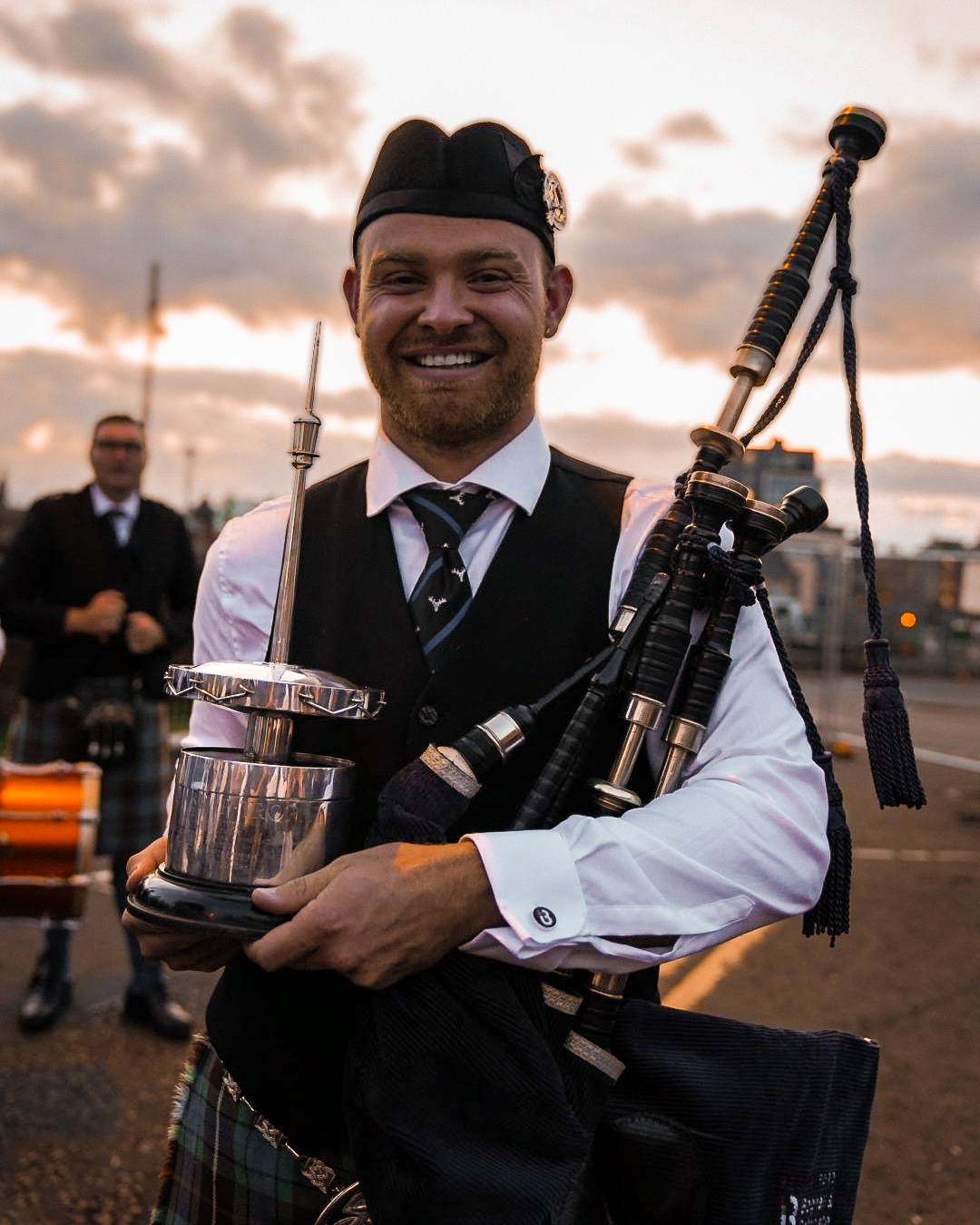
Chris Coates isn’t quite as famous, so we’ll fill you in. Originally from Lochgilphead in Argyllshire, he was taught by Rod Buchanan, Stuart Liddell and Iain Macfadyen, and attended the Plockton Music School for traditional music in the Highlands before going on to study Aero-Mechanical Engineering at the University of Strathclyde in Glasgow. Formerly the pipe-sergeant of Uddingston, and has been with Peoples Ford Boghall & Bathgate Caledonia since 2023. He is an engineer for sustainable investment manager Downing LLP, developing new renewable energy projects in the UK and Nordic regions.
Not only is Chris Coates an obvious brainiac, but this piper can flat-out play. And, like Kerr McQuillan, he appears to be a world-class good guy.
So, what we expected to be an informative conversation on the technicalities of a snare drumming performance became an extraordinary dialogue about the power of friendship to impact music positively.
As they prefaced and then went through the video of their publicly available and shareable Hornpipe & Jig performance, we learned that it was as much about sympatico inter-personal understanding as it was about two mutually talented musicians gaining an invaluable extra edge as two friends doing their thing.
We hope you enjoy Part 1 of our conversation with Kerr McQuillan and Chris Coates.
Here’s a transcript of Part 1, with minor editing for written clarity:
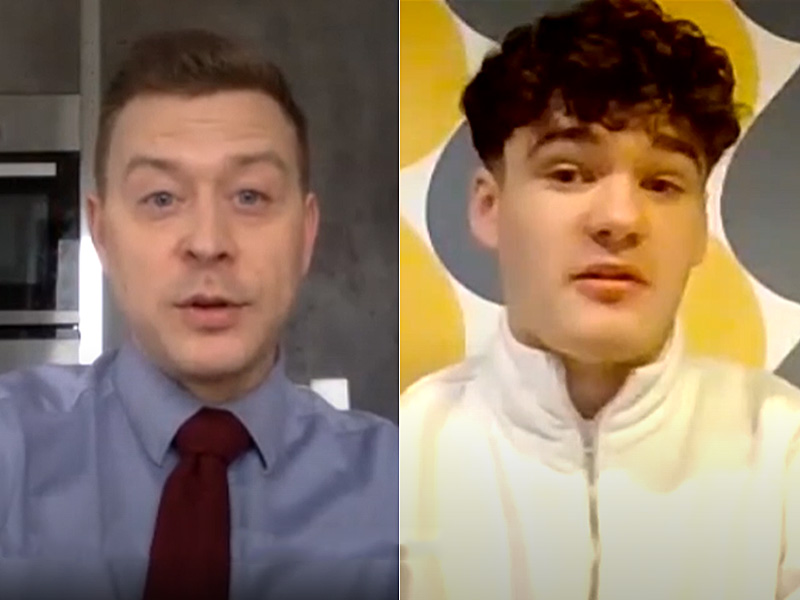
pipes|drums: We’re pleased to have 2025 World Solo Drumming Champion Kerr McQuillan with us, along with – special treat – piper Chris Coates, both from Peoples Ford Boghall & Bathgate Caledonia. Thanks, guys. We appreciate you taking the time to talk about the World Solo Drumming Championship and your great victory, Kerr, and certainly you, too, Chris. Pipers know how hard that is. Congratulations, guys.
Kerr, what was your preparation leading up to the event?
Kerr McQuillan: Preparation was pretty relaxed going into the competition. Chris and I have worked quite a lot beforehand and competed at the World Solos before as well. We knew what we were trying to do going into it.
From a personal point of view, I’ve got a number of practice pillars that I’ll focus on, whether that’s technicality, musicality, playing with the piper, composition, fitness and dexterity, that type of thing as well. I’ve got quite a strict kind of syllabus that goes off of seven weeks prior to the competition that allows me and Chris to be relaxed going in because we know exactly what we’re doing when we’re meeting up when we’re playing together, so yeah, it was just the usual for us and nothing out of the ordinary.
pipes|drums: You mentioned physical fitness. Obviously, both pipes and drums are very physical instruments. But what kind of fitness routine do you go through?
Kerr McQuillan: It’s a blend between making sure that your hands are in the best place possible. Whether it’s doing hand stretches – I’ve got kind of hand grips and balls that I keep in the car – and stuff like that. When I’m either going to a band practice or whatever, you’re just constantly keeping your fingers moving, as well as doing lots of different exercises to a metronome and pushing the speed as best as you can. Because all that goes hand in hand, whether you’re playing a March, Strathspey & Reel or a Hornpipe & Jig or exercises, it all goes to the same thing and should hopefully improve your general play.
pipes|drums: Chris, you mentioned before we started rolling here that you and Kerr got together eight times for eight straight days before the big event.
Chris Coates: Yeah, this year was particularly interesting because I think it’s the first year we prepared. In 2023, I was still at university. I was working. This is the first year we’ve both been employed full-time. In 2023, Kerr probably had more time on his hands to prepare for this than now. We were juggling it around the job, band, and teaching commitments.
It was actually, funnily enough, the first time we did pretty much every night of the week leading up to it. And I think we were two to three nights a week, about two, three weeks before it. Saying that, as Kerr said, it was the most relaxed I think we’ve been going into any competition. The week leading up to it, I was going around to his house – he only stays five minutes up the road, but I was going up to his for about half an hour at a time. The nights before, we were spending most of our time eating together, chewing the fat, just having a good time and enjoying each other’s company.
By that point, we’ve tapered off and we very much felt in the zone with it, and it’s just going through the motions. Even though it was an intense buildup in terms of commitment, it was definitely the most relaxed we’ve been as a pair.
“Chris and I sit down months and months in advance and are like, Right, what are we trying to create here? And for us, it’s generally about engagement for the audience. What can people relate to? What can people understand? What can people enjoy?” – Kerr McQuillan
pipes|drums: And before we actually get into the recording of the Hornpipe & Jig performance itself, Kerr, talk a little about tune selection. It’s two hornpipes, two jigs. “Joe McGann’s Fiddle,” “Zito the Bubbleman” by Gordon Duncan, “Last Tango in Harris,” an R.S. MacDonald composition, and “Ray Anderson,” a lesser-known tune by Duncan Johnstone. So, Kerr, what’s your thought process when picking out compositions to perform?
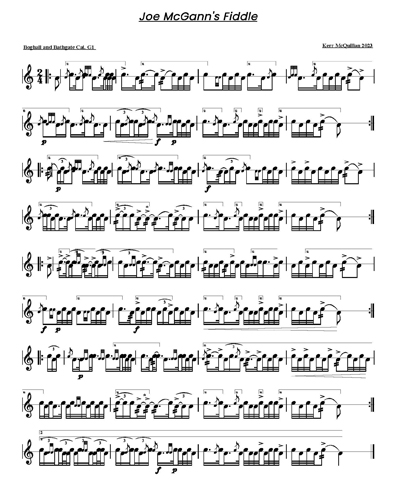
Kerr McQuillan: For me, when putting the Hornpipe & Jig together, it’s about a story, and you’ve got to think about the intentions and what you’re trying to do. It’s not so much the general tunes for me; it’s about what I’m trying to convey when I’m playing. Chris and I sit down months and months in advance and are like, Right, what are we trying to create here? And for us, it’s generally about engagement for the audience. What can people relate to? What can people understand? What can people enjoy? How can we create a feeling with everything we’re doing? Feeling is absolutely everything before I start looking at scores and tunes.
With “Joe McGann’s Fiddle,” it’s a traditional kind of World Solo Drumming hornpipe where you get on there and you kind of set the idiom and you just play by the book, dot-cut. Everyone can settle in and enjoy that. It’s kind of what’s expected.
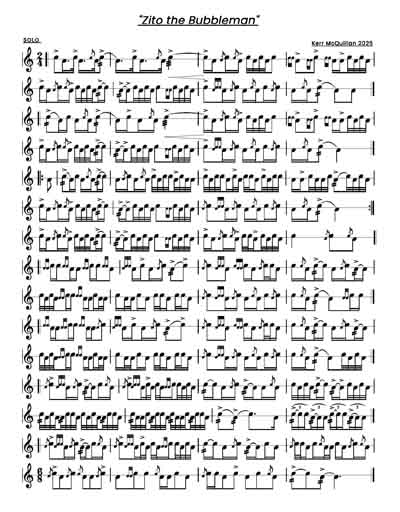
“Zito the Bubble Man” – I just absolutely love the tune, especially the third and fourth parts when it changes key and you can really start to go into detail on the nitty-gritty between pipes and drums. How can you link them together? How can you create a bit of contrast between both instruments, as well as tracking each other? And there’s a lot of intricate stuff in the third and fourth parts of that tune where things start to get going.
Then, the key change to “Last Tango in Harris” is seamless. It just works so well. Those tunes marry up very well together. And we did a couple of little, funky things in “Last Tango in Harris,” both drums and pipes. Little pauses here and there, just little bits to try to keep the audience on side – again, very intricate. Then the last tune, “Ray Anderson,” is quite spacious with the melody, but it’s a point for the audience to be like, Right, now we can just sit back and enjoy what’s going to end things here. It’s very much a story rather than just the tunes and drum scores.
pipes|drums: Many viewers/readers might know that you are a piper, too – a very good piper, Kerr. Does that help in your tune selection?
Kerr McQuillan: Absolutely. Chris and I would send recordings on the chanter back and forth to each other months in advance about wee things, what can we do here, what can we do there, and I think it just helps me understand because I can recognize all the notes and how that lines up with the rhythm; it just goes in as one together.
pipes|drums: So, you’ve gone up on stage. Are you feeling good at this point?
Kerr McQuillan: Yeah, I didn’t sleep a minute the night before. I did not sleep one minute. So, at this point I was pretty tired. I actually got a couple of bottles of Lucozade and just downed two bottles pretty quickly and then got going. All good.
pipes|drums: So here we go.
[Listening/watching recording.]
At this point, Kerr, are you feeling you’re off to the races, like you’ve got a really good start, in the zone?
Kerr McQuillan: Yeah, I think that tune is just really strong. Chris and I talked a lot about the upbeat in this tune. There are wee changes in the first part with the melody to help that instead of it being right on the downbeat. That gives it a little bit of life from the start as well. But it was really locked in at this point, so I think we were both quite happy with the start.
Chris Coates: I think we knew as well that we needed to start this tune off not too excited in terms of tempo. We knew we needed to put forward quite a composed hornpipe because we knew what we intended to do later in the set, increasing the intensity. I think we worked actually so much on the first bar of that tune the week leading up, just making sure we were pulsing the notes correctly, so that we knew we’d demonstrate a really sort of composed hornpipe and then sort of put the foot on the gas a wee bit later on in the performance.
pipes|drums: Chris, have to ask you, I mean, with pipers in a pipe band performance, getting away at the attack – it’s nerve-racking. A lot of pipers feel that once you’re away, it’s fine. Was that the same way here?
Chris Coates: Absolutely. There’s safety in numbers in a band, but you’re more exposed there in the sense that if something goes wrong in the intro there’s only one person to look at. When you hit it and then you just get going, that’s probably the most nerve-racking bit, to be honest. Once you get past the E, it’s really enjoyable.
pipes|drums: Excellent.
[Listening/watching recording.]
There we go, we’re through the first tune. Chris, we know you’re playing great. Kerr, are you feeling good about that first one out of the way?
Kerr McQuillan: Yeah, all good. The first one’s probably, in this set, is the most important of everything, to get that right, because we knew what comes next. It’s pretty intricate, and we were always playing it well, but this first one, to get it right and to keep you in the mix is really important. The last part kind of signifies that something new is coming, so in the repeat of the last part there are a couple of little variations that give you a wee hint that something’s coming next.
And the transitions between all the tunes are really important. You’ll see that between all four tunes here is a transition and there’s an end into everything. That really helps it move through to the next tune.
pipes|drums: Maybe touch on the tone of the drum as well. You’re happy with the Andante snare that you’ve got?
Kerr McQuillan: Absolutely. I put that on around eight weeks ago, and as soon as I put it on I was like, Right, this is the one. Don’t burst, don’t do anything stupid. It actually wasn’t touched basically since it was put on. I was really happy with the sound.
Chris Coates: On the drum, it might be worth saying that I designed the rap for the drum. It’s a custom rap that we had made, and really interesting. Kerr was asking, What do think we should do for drums in the band next year? And he sent a couple of ChatGPT AI-generated mockups. And then there was one that we really liked. I went away and used some of Adobe’s AI software to basically make this drum wrap for him, which incorporated the Andante logo and a comet meteor on the right side of centre. We were kind of praying that the skin and everything held because, if it didn’t, then we were going back to the orange drum if that didn’t hold.
pipes|drums: Excellent behind the scenes secret there. Let’s pick this up again. Here we go.
[Listening/watching recording.]
So, Kerr, there’s that key change you were talking about. What about the technical aspects of your scoring for that? Some different stuff is happening – really creative. Can you talk about that?
Kerr McQuillan: Yeah, going to the second time ending of the second part, we take a little pause before the key change comes. And that’s because it’s a round-style hornpipe, everything’s going evenly at this point. It was an opportunity to take a little bit of space to signify that the key change was coming because, again, what happens after the key change is more intricate. Just a little space at that point to signify that something different was coming.
Chris, you came up with that bit as we practiced as the weeks went on.
“There are so many bits where we had to be locked in together, it did feel like we were the only two people in the room for a lot of it because we were just kind of in the zone together. That was all that mattered, really.” – Chris Coates
Chris Coates: Yeah, it’s exactly what Kerr describes, to tee up the movement into a new kind of section. In terms of how we were performing that, Kerr, as you said, the drop-in is very intricate with the melody of the pipe. We did a lot of work just making sure that, even though we have a pause melodically when we hit the third part, we knew that was the bit ensemble-wise when we have to be completely together.
The funny bit about that performance is, because there are so many bits where we had to be locked in together, it did feel like we were the only two people in the room for a lot of it because we were just kind of in the zone together. That was all that mattered, really.
Kerr McQuillan: With the third part coming, we did a lot of work being really together, because the way the drumming goes is basically tracking everything that’s happening, the monotone of melody. It’s catching everything. It was a real opportunity to show off the ensemble and integration between the two of us, and I think we got that right. In the practices leading up, we were kind of struggling with it a little bit, and then it just clicked the week of the Solos when we managed to get it and then took it in there, which was brilliant.
pipes|drums: Let’s pick this up again.
[Listening/watching recording.]
Chris, I see you laughing.
Chris Coates: Yeah, pause it. There’s a bit there where we transition into runs, and it’s very intricate, but the fact that we did it well was so rewarding. Actually, Kerr came up with those runs, the diggity-diggity-diggity. Then, some people may or may not know that we changed the last phrase of “Zito the Bubbleman” to be the last phrase of the last time, of “Last Tango in Harris” as a hornpipe to set up that transition.
There were only one or two, not danger moments, but moments where I knew we needed to be proper on it here. And that was one of them. And when I heard it back, I was like, Thank you for getting that!
Kerr McQuillan: It was more of a drumming thing, and the initial score that I wrote, there was a little triplet thing I had in my head, and it never quite lined up with the melody. Then I said to Chris, What about we just play the drum score on the pipes, basically? Just play the runs. And he managed to make it work. And to pull off is cool because it’s really tricky. But yeah, locked in. We were just feeding off each other at this point.
pipes|drums: Was it like performing a quadruple axel, or whatever it’s called in figure skating? You’re waiting to hit that part?
Chris Coates: Yeah.
Kerr McQuillan: Exactly.
Stay tuned for Part 2 of pipes|drums’ exclusive conversation with Kerr McQuillan and Chris Coates.



NO COMMENTS YET