

The Medley Playbook: Shotts & Dykehead Caledonia
 We introduce an exclusive series of conversations with the musical leaders of the world’s top Grade 1 bands discussing the construction, orchestration, arrangement, and intentions behind their new medleys.
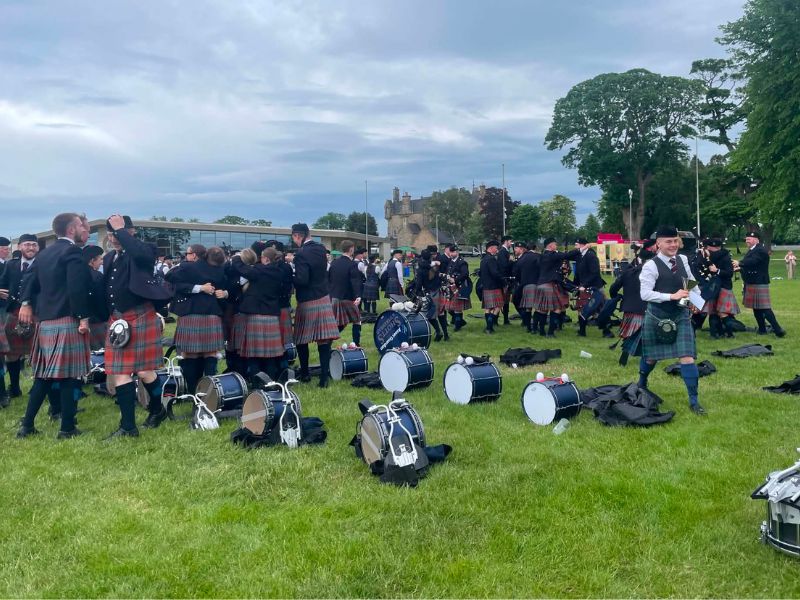
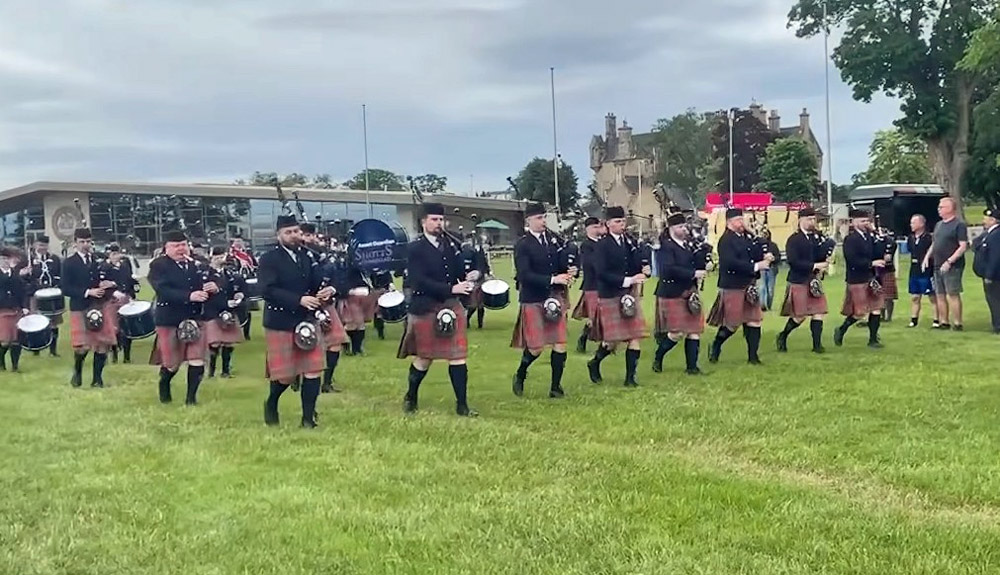
On Saturday, May 30th, Shotts & Dykehead Caledonia won the 2026 British Championship at Ingliston, on the west side of Edinburgh. It was the first championship victory under Pipe-Major Emmett Conway and Leading-Drummer David Henderson, and the first major the band won since gaining the 2015 World Championship title.

Conway was appointed pipe-major in 2018, following Ryan Canning in the role. A native of Northern Ireland and a former member of Field Marshal Montgomery under Pipe-Major Richard Parkes, he was the pipe-major of the Grade 1 New Zealand Police Pipe Band for four years before joining Shotts as the ninth pipe-major in the band’s storied history. Conway has brought his musical flair and creativity to Shotts, one of the most famous bands in history.
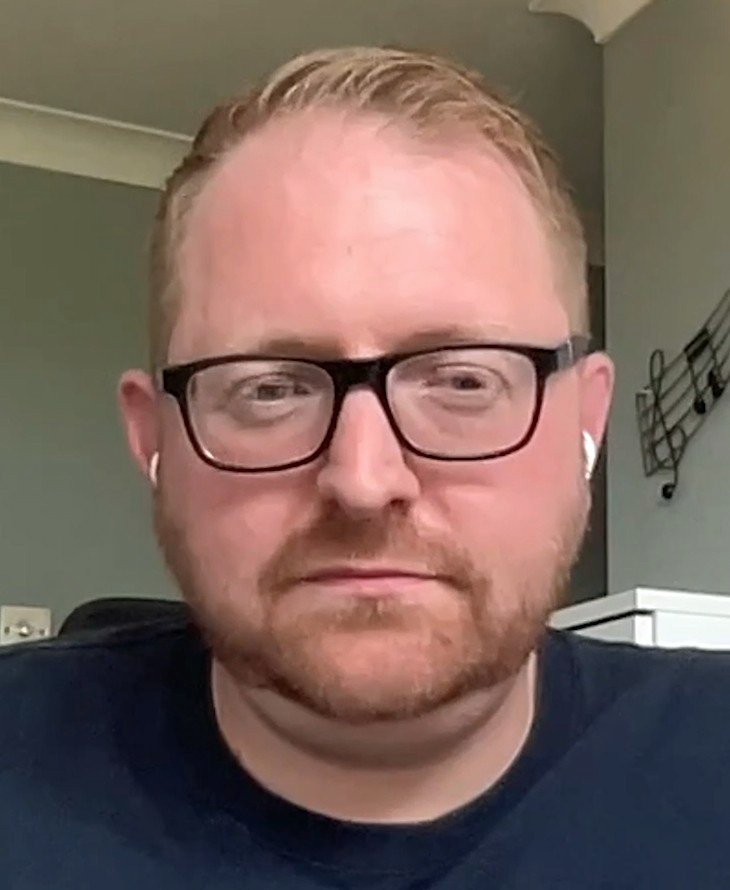
David Henderson joined Shotts & Dykehead in February 2025, with only three to prepare the music and his drum section for the competition season, and six months until the band’s Pre-Worlds “SOLAS” concert in August. Henderson came to Shotts with extensive Grade 1 experience, including as Leading-Drummer of Police Scotland & Federation, Spirit of Scotland (2016), and a long tenure with Shotts & Dykehead under legendary Leading-Drummer Jim Kilpatrick.
Just as the British Championship was the first major for Conway, winning the British Pipe Band Drumming Championship was a first for Henderson.
The band’s winning medley caught the favourable attention not only of all four judges, who each ranked the band first, but of the entire piping and drumming world. Their use of both new and familiar compositions, subtle arrangements and orchestration, and a careful attention to musical detail caught pipes|drums’ attention, too.
Here’s a list of the medley’s content:
“Ms. Pauline Ross” – hornpipe – composed by Ciaran Ross
“The Doune of lnvernochty” – four-part strathspey – traditional
“Rory Gallagher” – jig – composed by Gordon Duncan
“The Lark in the Morning” – jig – traditional
“Wee Charlie’s Air” – composed by Ciaran Ross
“Moonstar” – waltz – 4/4 march composed by Charlie Glendinning, arranged in waltz time by Emmett Conway, Graham Drummond, Ciaran Ross
“Dunrobin Castle” – waltz – traditional reel, arranged in waltz time by Emmett Conway, Graham Drummond, Ciaran Ross
“Alick Cameron, Champion Piper” – waltz – traditional reel, arranged in waltz time by Emmett Conway, Graham Drummond, Ciaran Ross
“Moonstar” (reprise) – waltz, 4/4 march – 4/4 march composed by Charlie Glendinning, arranged in waltz time by Emmett Conway, Graham Drummond, Ciaran Ross
For those who also like text, here’s a transcript of our conversation, with minor edits for clarity.
pipes|drums: We have something really special lined up. We’re going to look at the new medleys from Grade 1 bands, the top six finishers from last year’s World Championships. And we’re pleased to start with Shotts & Dykehead Caledonia, which got off to a roaring start last week at the British Championships by picking off the band’s first championship since 2015, since the band won the Worlds. And the first for Pipe-Major Emmett Conway and Leading-Drummer Davey Henderson. Congratulations, guys, on that. That’s a tremendous success for you.
Emmett Conway: Thank you very much.
Davey Henderson: Thanks very much.
pipes|drums: You won with a new medley, which we’re going to talk about today and go through it, have a listen to it and talk about the ins and outs of that medley and how it’s constructed musically. not so much the performance itself, but the structure, the content, the arrangement, the orchestration, and the thought processes that were involved.
Why don’t we start with that? Emmett, what is or was Shotts’ approach to constructing that new medley this year?
Emmett Conway: Well, the same as I suppose any medley. You sit down at the table with a few of the heads. I’ve certainly been on the piping side of things, Graham Drummond, my pipe-sergeant, Ciaran Ross, and Davey. We sat down and took on board how the medleys are going and what we could do better. We have to take a step back and go, Right, we’ve done good this year; how can we do better?
There were quite a few tunes we use in this medley that we probably had for a medley last year, but with Davey coming in in February or March, the priority last year was the World’s concert. [The band’s SOLAS show at the Glasgow Royal Concert Hall.] There are a few arrangements that we used in the Worlds concert that we use in the medley this year that we played at the British on Saturday.

We sat down and went through it all. We thought about what we want, and maybe what we don’t want, and we want to ensure that there were no gimmicks, and that what we were pulling off was going to be executed to the highest level.
There are a few wee things in there that we touched on that were nice touches. I thought it was quite smart. But one of the main things was that it was pulled off correctly. And so that’s the way it started.
pipes|drums: And the actual pulling of things together is a good point. You did that fantastic Pre-Worlds concert. And Davey, you came into the band with not a lot of time to prepare and pulled it off, and it was a sensation. It seemed to provide some content, some creativity that you injected into this year. What role did you play in creating the concert content and this new medley?
David Henderson: As Emmett touched on, we have a kind of music committee as such within the band, which consists of, obviously, Emmett, Graham, Ciaran, myself, David Ross, and then I draw on Steven Nelson as well within the drumming side.
You’re right, coming into the concert last year, obviously, there was a plethora of music there that we were listening to nonstop, trying to get some drum scores together in time. It became quite apparent to me that the “Moonstar” finisher we were playing at the concert would go down well as a finisher for a medley, or was well constructed as a finisher for a medley. We talked about it briefly and decided pretty early on that that was going to be part of what we were going to do this year in terms of medley construction.
Last year, when I came in, the band kept the same medleys, since the competition stuff was there, and we did that to the best of our ability at that time.
“We are all very involved in both sides of things. Emmett has things he chips in with the drumming, and the ensemble bass-section side, as well. And then there’s anything that myself or David Ross or Steven Nelson are hearing that might help ensemble-wise in the piping, we chip in with that. It’s very much an open playing field.” – David Henderson
And then the concert obviously took precedence at certain times. But we made the decision early on that this year would be two new medleys.
We are all very involved in both sides of things. Emmett has things he chips in on the drumming and the ensemble bass section side as well. And then there’s anything that myself or David Ross or Steven Nelson are hearing that might help ensemble-wise in the piping, we chip in with that. It’s very much an open playing field.
pipes|drums: It sounds really collaborative. You’re not just the pipe-major, Emmett, and leading-drummer, Davey, but quite a team of people putting together the arrangements.
Emmett Conway: Very much so, and when it comes down to the final say, myself and David, but it’s not a case of that. We sit down and work through it: Why do we think that’ll work? Why do we think that won’t work? What would people think? What would the audience think? What would judges think? We try to look at everything from every angle that we know, and we have six to seven minutes to pull this off.
David Henderson: Absolutely.
Emmett Conway: We can’t leave any stone unturned, we can’t come off thinking, we should have changed that break, or that break wasn’t working three weeks ago, and why did we risk that?
When we actually listened to the medley, we changed a few things. We played at Gourock three weeks ago with that medley, and the horrible day it was at Gourock: freezing cold and 78 degrees. There were things listening back in the recording that we were like, Well, that harmony doesn’t work, why do we play that? It was a case of, Well, let’s get it out and see if it works, and maybe we’ll see if it pulls together, and then we pull back and say, Well, no, it’s too dominant on the bottom hand, we need to brighten it up. And we did do that.
“We always say we can’t leave a judge scratching their head, going, ‘Did that work or didn’t that work?’ It has to work. It has to work. And you don’t want that confrontation on the sheet of a judge saying, ‘That didn’t work.’ You have to go back to the drawing board, and we thought it did.” – Emmett Conway
We always say we can’t leave a judge scratching their head, going, “Did that work or didn’t that work?” It has to work. It has to work. And you don’t want that confrontation on the sheet of a judge saying, “That didn’t work.” You have to go back to the drawing board, and we thought it did. It’s fine-tuning note for note, beat for beat, making sure the bass and tenors complement the embellishments of the piping, that the right notes are being hit, and that the notes harmonize as well. It’s not just a case of, “There are seven tunes, write your scores, David, write the bass and tenors, add yourselves in. Okay, let’s see how it goes.”
We had Gourock a few weeks ago, and we probably changed about 20 percent of the harmonies, lightened up some stuff, and changed the break from the strathspey to the jig. It wasn’t working in the hall for a couple of weeks, and we just thought we would go with it. Then we actually stretched out the finish as well. We originally stretched it out, and then we were timing the medley and we were running at seven minutes seven seconds, so we said, Right, let’s speed up that wee bit and then we were losing the effect and the emotion. We’re back into “Moonstar.” Listen to the projection, listen to the ensemble, listen to the tone, listen to the finish of the medley. We then drew that back, and by me chewing on the temples, we cut a few seconds off.
pipes|drums: That’s interesting. There has been talk for a while about the lack of attendance at minor competitions. And it seems like you made the most of playing at Gourock, a minor, and learned from it and adapted.
Emmett Conway: Yeah, that was the main reason why we went. With Gourock and Dollar, with two new medleys, we needed to get them out there. We needed to get feedback from the judges. We needed to look at the feedback and adjust, but use your own common sense. Everybody, every judge, every person has their own opinion. But you get the recordings from the three different sides of the band, and you get a recording from behind the drummers. You hear things differently than in the band hall. Apart from a couple of weeks, it’s been a wet spring, so you only got outside twice, and then the cold comes in and kind of spoils the practice. You absolutely need to utilize the minor competitions to go through the medleys and get the final touches that you think are going to be worthy of winning the Worlds, really.
pipes|drums: Before we go to the actual sound recording, last fall we visited with Pipe-Major Stuart Liddell, Leading-Drummer Steven McWhirter, and Pipe-Sergeant Ali Henderson from Inveraray & District, the reigning World Champions, about their “Dream Valley” medley. How much did that or has that had an effect on Shotts or other bands, for the musical aspects?
David Henderson: Obviously, with our ending that Emmett talked about, “Moonstar,” we actually had that in place before last year’s concert. That was in place quite early on for us. But what it did do was open the door and made that kind of ending or that kind of conclusion to a medley more acceptable. It opened the door for other people to try new things like that. In terms of ourselves, what we had was quite a bit before that, but it opened the door for others to try something similar and push the boundaries a little bit when it comes to the conclusion of medleys.
pipes|drums: We’ll listen to your performance from the British. You’ve pushed the boundaries a little bit more, too. We’ll go from tune to tune, and feel free to chime in with any comments you have. We’ll stop whenever you want.
pipes|drums: You’re in with a very original tune from Ciaran Ross, getting into the circle, with a solid, charismatic opener. But now you’re into “The Doune of Invernochty,” which is a very traditional, recognizable tune. Is that a conscious decision to allow the judges to wrap their heads around something familiar?
Emmett Conway: It is. Often, when it comes to medleys, strathspeys are overlooked. A lot of bands, not particularly Grade 1, but right down from Grade 1 to Grade 4, use either the same sort of strathspeys or they don’t take full advantage of strathspeys where you get the strong-weak-medium-weak, or strong-weak-strong-weak, depending on what way you play it. It’s so important that you nail that strathspey, and it’s one of those strathspeys where it’s very obvious where the strong beat is, and it’s very obvious to say when Davey writes the scores, it works together.
When bands put together medleys, they often overlook, for example, strathspeys and slow airs. I always think these are two big factors that can sometimes win you a competition or lose you one.
pipes|drums: We’ve admired Shotts’ ability to cut strathspeys under your direction, Emmett. It’s really well done and kind of instructional. Let’s continue.
pipes|drums: We had “The Bark in the Morning” there! [Laughter] Okay, backing up, “Rory Gallagher,” a Gordon Duncan tune. Was that a conscious decision to pay tribute to Gordon?
Emmett Conway: It wasn’t a conscious decision; I’m not going to say it was. Again, these are two jigs we played in the concert that worked, and one of the things that complements the two tunes is, when you go into “Rory Gallagher,” it’s all more top hand [sings part of the tune], and then when you go into “The Lark” it’s [sings part of the tune]. We’re always trying to get key changes and complementary tunes that the audience can tap their feet to, and know: I’ve heard that tune before, or I’ve heard that tune in a session, or I’ve heard that on a CD. It’s very important when we’re putting tunes together. Yes, we have some original compositions in it, but we need to engage the audience to ensure they understand what’s happening.
“It’s always a hot topic for us in the band hall. Do we play it or don’t we? If it’s not over-the-top and it’s pulled off well, well, why not? It has been done before. It’s a case of just doing it and putting it in the right places and making sure it’s tasteful, rather than just throwing it in, and ‘Whoa! Look! We can do this!’ No, it’s not about that; it’s about enhancing the medley and making sure that when we do these things, we’re pulling it off. – Emmett Conway
pipes|drums: Before we pick this up again . . . but I originally stopped it because of the half notes that you’ve included. It’s been done before, but it’s sticking your neck out. You never know how a judge is going to react.
Emmett Conway: Yeah, it’s been done before, and it’s always a hot topic for us in the band hall. Do we play it or don’t we? If it’s not over-the-top and it’s pulled off well, well, why not? It has been done before. It’s a case of just doing it and putting it in the right places and making sure it’s tasteful, rather than just throwing it in, and “Whoa! Look! We can do this!” No, it’s not about that; it’s about enhancing the medley and making sure that when we do these things, we’re pulling it off.
pipes|drums: And it is another opportunity. It has been given another stamp of approval by judges with your winning the British. It opens the door. It’s another one of those moments.
Emmett Conway: It was noted on the sheets as well that it worked. That was definitely something that was playing on my mind getting into the season. Do we try to pull this off and risk it? Or are the judges going to understand that we play an F sharp in in “Rory Gallagher” and then we play five F naturals that work. Solo pipers have done it before and it works, and I’ve heard it in sessions before and it works. Why shouldn’t it work in pipe bands? You have to take a step back and listen. If it’s pulled off, enjoy it, and credit the band for it. It worked for us, thankfully. Touch wood!
pipes|drums: All right, let’s keep going
pipes|drums: So, “Moonstar.” You’re hearkening back, as “Charlie Glendinning’s tune was very popular in the 1970s. Bands were playing it worldwide, and you’ve resurrected it in waltz time and connected it beautifully to the air. Was it a conscious decision to come up with that strong melody to take advantage of that and familiarity once again?
Emmett Conway: I touched on earlier the importance of a slow air. I’m not saying we get it right every time or we got it right. But I said to Ciaran, “I want you to write a slow air that pulls me in, that’s tugging at the heartstrings, that’s using the full scale of the chanter, that’s got suspense, that’s going where you think it’s going to go, then it takes a turn somewhere else and pulls you in again.”
And he takes a pen and paper and starts writing and, Yeah, that that will in the medley next year. Now, I want you to write me another one. He’s really good at it and he named it “Wee Charlie’s Air.”
Where “Moonstar” came out was actually a bit of a joke between Graham and Ciaran that when they blew up and played their drones and always try to play a different 4/4 or 2/4, and they’re always trying to outdo each other. Graham started playing that one day and then Ciaran struck up and started playing it as a reel. And then we kind of looked at each other as if, “Oh, that could maybe work in the concert or the medley,” and then it evolved into, “Well, we haven’t played a waltz in a medley in a few years, or certainly under myself. Can we make it into a waltz?” I try to challenge them, hoping they would succeed, and they sure did. They came back with that and what we started with and what we finished with were probably draft 10 or 12 and we had to cut parts off because at one stage were trying to interpret “Moonstar” into a slow air and it was just too much.
David Henderson: Yeah, we had loads of different interpretations on the go at one point.
pipes|drums: I was going to ask Davey, the air, the drumming accompaniment is quite sparse. Is that intentional as well?
David Henderson: Yeah, absolutely. A tune like that, although there are rhythmic hooks within the tune that we can lock into, it’s important to let the melody breathe and let the music come to the fore. It’s what we were saying about the tone and the quality of the instruments coming to the fore, and the slow air as well. It’s important to give it time and space.
But again, within that tune, there are certain rhythmic hooks that I heard straight away that lend themselves well to some subtle bass and tenor stuff going on there, and more of a backbeat riff sometimes rather than tracking the melody rhythm. So, it is quite sparse, but where it is, it comes across at points that lend themselves to a bit of rhythmic accompaniment.
pipes|drums: Definitely. Let’s pick this up.
pipes|drums: Big finish. We were talking about what’s been done before with the “Dream Valley” medley last year from Inveraray, with saving the best for last, even though it’s quite simple. It’s subjective whether people think that’s the best or not. But it’s just a strong statement to end on, as a reprise of “Moonstar” in that kind of genre. Was that intentional to hold back, and a little bit of, it might end now, but it keeps stretching out?
David Henderson: That tune at the concert last year and the kind of reel style at the end, it became quite apparent that that last phrase, although simplistic perhaps in terms of the kind of piping technique involved, that last phrase seems to lend itself to just a bit of more of “a breath,” as we usually describe it in the band, taking a breath on that last high-A from the pipes and the roll from us and just kind of relaxing into the end phrase rather than gung-ho to the end, as we have been doing up until now, really.
Again, that ending’s been through a few permutations. We’ve kind of changed things here and there to try to find the right point to have that kind of pullback on the end-phrase, making sure we’re not overdoing it, but being sympathetic to the melody at the same time. It just feels natural at that point in the tune. It felt as if it was a nice point to pull back and just relax to the end, is probably the best way to describe it.
pipes|drums: Emmett, anything to add about that finish?
Emmett Conway: No, as Davey said, it just felt like the more we played it, the slower we played it, and it felt like when we played it at Gourock, it was not as slow as we played it on Saturday, and you can actually hear a wee bit of integration in the piping, because people were ready to push. It was like, No, no, no, just pull back and just wait for it, just wait for my foot.
“Then you just fall into the conclusion, and you feel people going, That was quite nice. When I see people listen to it, they get that it was different, with more fuel in the tank to get every bit of this better for the next one.” – Emmett Conway
You can hear certainly in the recordings, when we hit that [sings part of the arrangement] that it’s ready. You’re, What?! What’s this? And then you just fall into the conclusion, and you feel people going, That was quite nice. When I see people listen to it, they get that it was different, with more fuel in the tank to get every bit of this better for the next one.
It’s a very enjoyable medley to play. Both of them are actually very different, but this one was really special on Saturday to get [the British Championship] with it.
pipes|drums: I’m sure it was. That indicates you’re still building on it, you’re still hearing things that you might tweak before the next medley competition.
Emmett Conway: One of the things that had a massive effect was the weather [at the British Championships]. It’s always the old saying: Really good in final tuning, but it was a long walk around, and you could hear the wind in the recording. I remember at one stage people’s tassels blowing, and you have to try to hold it together, and at that level, you do, but you always think, Well, if the weather stayed a wee bit better, we could have been even better. But it was still very good, it was superb where I was. Listening back to some of the recordings, you always hear wee things, but they will be fixed. And then again, there’s the stuff out of our control, like the weather.
pipes|drums: It’s been great talking to you about the musical side of that medley, and some of the thought processes that went into it, to get a behind-the-scenes look at what the very best bands in the world do. Congratulations once again on the success at the British and best of luck for the future. We’ve got the UK Championships coming up, then the European Championships, the Scottish Championships, and then the World Championships, where we’re guaranteed to hear the medley again.
Emmett Conway: And that’s it, and then back into the hard winter and do it all again! Thank you for the opportunity.
pipes|drums: Well, let’s enjoy the summer for now. All the best, we really appreciate it, and we’ll talk to you soon.
Our thanks to Emmette Conway and David Henderson of 2026 British Champions Shotts & Dykehead Caledonia for sharing insights on their winning medley.
Stay tuned to pipes|drums for the next installment of The Medley Playbook coming soon.


NO COMMENTS YET