

A solution to the problem of teachers judging pupils
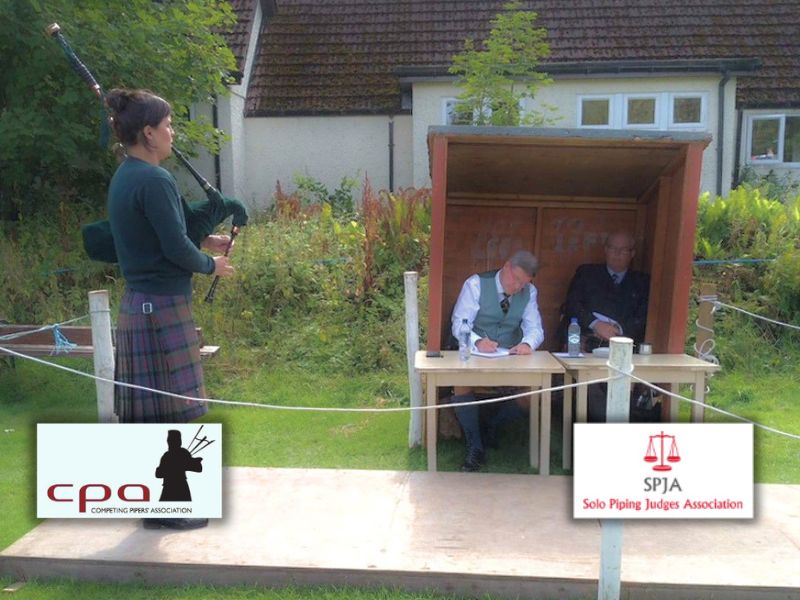
Editor’s preface: Solo piping competitors around the world who compete in “Senior” competitions in the UK are aware of the debate currently within members of the Solo Piping Judges’ Association and the Competing Pipers’ Association.
The SPJA has adopted a rule prohibiting its judge-members from judging a pupil in competition; the CPA has adopted a reciprocal rule prohibiting its competitor-members from being judged by their teachers.
Judges are not allowed to accept judging jobs in which they know a pupil is competing; competitors are not supposed to enter a competition in which they know their teacher is judging.
If they were unaware of a conflict and arrive at a competition only to find they would be in contravention of either rule, one or the other is expected to withdraw. If the event cannot run without the judge, and the pupil refuses to withdraw, the contest may continue, but the judge and competitor must inform their respective organizations of the incident.
Any prize awarded that involves a conflicted piper and judge will be disallowed and will not be considered when reviewing their application to compete at major gatherings, such as the Northern Meeting and the Argyllshire Gathering.
The CPA will not consider prizes awarded to pupils by their teacher when determining the member-piper’s grade level.
The system has been largely successful with competitions, pipers, and judges, but some problems have emerged, particularly with multi-judge “benches,” which are common in the UK and less frequent elsewhere.
We received the following plan from Colin MacLellan, a frequent contributor to pipes|drums and a famous competitor, judge and teacher.
While the plan is more specific to the Senior solo piping competitions in the UK, it is both noteworthy and applicable to the worldwide piping community.

A solution to the problem of teachers judging pupils
By Colin MacLellan
Wherever there are solo piping competitions, the age-old problem of teachers judging pupils has never really been solved.
I have worked on a plan to address these problems over the past few years because in the UK, we are facing a situation close to a crisis.
The plan can be applied to any region where panel judging of solo competitions exists.
In the UK, at least, strict reciprocal rules and policies by the Solo Piping Judges’ Association and Competing Pipers’ Association prohibit teachers from judging pupils and prevent pupils from being judged by their teachers.
Because of these rules, judges who are teachers are beginning to abandon teaching to judge.
Competitions are finding it increasingly difficult to get the quality of judging that they and competing pipers expect.
Perhaps most importantly, new expert judges who teach many competing pipers and will retire in the next few years will be unable to judge at all.
This judging proposal alleviates and solves these problems, and would allow all judges to judge all competitions, while still ensuring that judges do not, in fact, judge their own pupils.
In reality, the system is simple, but it should be carefully studied.
I invite all pipers and judges to consider the proposal and evaluate its merits and usefulness in addressing the present problems facing competitive piping.
Judging proposal
Judges’ guidance:
- A discussion shall take place immediately at the end of the competition in order to determine if major errors have been noted or have not been noticed. At that point, judges are free to adjust their rankings based on the outcome of the brief discussion.
- Judges shall rank each competitor in order of preference, 1, 2, 3, 4, etc., down to eight.
- The lowest score average aggregate among the three judges shall be ranked highest.
- If a judge has a conflict with a pupil playing, that judge shall not rank that player, and the average ranking of the other judges shall determine the player’s ranking.
- The completed ranking grid must be handed to the competition organizer at the conclusion of each competition. It will be retained by the competition organizer for a period of time as an accurate record of the competition result.
Points of interest:
- The grid to be filled in will be provided to the judges at competitions.
- The simple system allows teachers to judge competitions in which their pupils play without fear of bias or other perceptions.
- The system thus allows a significantly greater number of judges to be eligible to judge than is the case at present.
- The system allows for different opinions to be taken into consideration in a completely equitable way.
- The system completely negates the possibility of dominant voices on a judge’s bench exerting undue influence on the outcome of the competition in question.
- Most importantly, the system allows for a completely unbiased, proportional, and accurate blending of the three judges’ opinions and views. It will also end the very contentious controversies over teachers judging pupils.
Fictitious example competition
The three judges are Willie Ross, John MacDonald, and G.S. McLennan.
- Ross teaches Drummond
- MacDonald teaches McCallum
- McLennan teaches Johnston
They declare their interests in the pupils they teach to one another before the competition begins, and they do not assign ranks to their pupils when determining ranks 1-8.
Any player not in the top eight from any given judge is given a score of 10 from that judge.
| Fictitious Solo Competition | |||||
|---|---|---|---|---|---|
| Ross’s rankings | MacDonald’s rankings | McLennan’s rankings | |||
| Player | Rank | Player | Rank | Player | Rank |
| Beaumont | 1 | MacLeod | 1 | MacLeod | 1 |
| McCallum | 2 | Johnston | 2 | Speirs | 2 |
| MacLeod | 3 | Midgley | 3 | McCallum | 3 |
| Johnston | 4 | Drummond | 4 | Midgely | 4 |
| Midgely | 5 | Speirs | 5 | Sinclair | 5 |
| Urquhart | 6 | Beaumont | 6 | Beaumont | 6 |
| Speirs | 7 | Sinclair | 7 | Urquhart | 7 |
| Sinclair | 8 | Urquhart | 8 | Drummond | 8 |
| Drummond (not ranked) | McCallum (not ranked) | Johnston (not ranked) | |||
| Scoring | |||||||
|---|---|---|---|---|---|---|---|
| Player | Ross Rank | MacDonald Rank | McLennan Rank | Total Score | Number of Judges | Average (total score divided by number of judges) | Place |
| Beaumont | 1 | 6 | 6 | 13 | 3 | 4.33 | 5 |
| McCallum | 2 | N/A | 3 | 5 | 2 | 2.5 | 2 |
| MacLeod | 3 | 1 | 1 | 5 | 3 | 1.67 | 1 |
| Johnston | 4 | 2 | N/A | 6 | 2 | 3.0 | 3 |
| Midgley | 5 | 3 | 4 | 12 | 3 | 4.0 | 4 |
| Urquhart | 6 | 10 | 7 | 23 | 3 | 7.67 | |
| Speirs | 7 | 5 | 2 | 14 | 3 | 4.67 | |
| Sinclair | 8 | 7 | 5 | 20 | 3 | 6.67 | |
| Drummond | N/A | 4 | 8 | 12 | 2 | 6.0 | |
In the event of a tie, the judges should discuss and agree on the final placement between the tied players.
Frequently Asked Questions
- Why is this new plan needed? What’s wrong with what we currently have?
The plan is needed because the present restrictions on judges judging pupils constrain the availability of many judges. A return to little or no regulation would reintroduce significant concerns regarding conflicts of interest. This new plan will resolve these issues, allowing all judges to judge any events without real or perceived conflicts of interest and without restrictions on their teaching activities. - Won’t it be too complicated?
Judges will be provided with a simple blank grid in order to record their rankings. The final score is just the average of the rankings, divided by three, or, where there is a pupil playing, by two. The final scores then just need to be ranked to determine the result. It will be important to carefully check that all rankings have been recorded accurately. - Under this plan, is it now acceptable for me to judge any event in which my pupil may be playing, including the major competitions?
Yes. The intention is for this plan to provide a fair format for everyone to judge any competition. - Isn’t it preferable for judges to be able to discuss performances as a competition progresses?
This plan allows everyone to fairly judge all competitions and all pipers to play. It avoids dominant voices taking precedence. Discussion is allowed at the end of the competition in order to note major errors and omissions. - What if a player makes a major error and one or more judges don’t realize?
These points can be easily noted and discussed at the end of the competition to ensure that all judges are aware of major errors when determining their rankings. - Is this new system foolproof?
Yes. It has been carefully thought out over a long period of time and tested in numerous real-life and simulated competition scenarios. - Won’t people still think that it’s wrong for judges to be on a bench when they have pupils playing?
The plan would be well communicated to pipers, competition organizers, and piping media prior to use. Organizations like the UK’s Solo Piping Judges Association cannot control what people think, but this plan provides a satisfactory platform for alleviating the problems which are currently faced.
Colin MacLellan is one of the world’s most accomplished pipers. In addition to a decades-long competitive solo career during which he won, among many prizes, the Highland Society of London’s Gold Medals and the Silver Chanter, he was the pipe-major of Grade 1 Lothian & Borders Police and Dunvegan, and Grade 2 Glengarry and was a member of the 78th Fraser Highlanders and Spirit of Scotland. His many contributions to piping include serving as president of the CPA, co-founding and chairing the SPJA, resurrecting and leading the Eagle Pipers’ Society, and teaching hundreds of successful pipers worldwide. He lives in Edinburgh.




NO COMMENTS YET