

The Medley Playbook: Police Scotland Fife
 “Chappin at the door” is a Scots expression that can mean being on the brink of great success, and, by every measure, the Grade 1 Police Scotland Fife is indeed chappin at the door of competitive glory.
With the band’s roots intertwined in the Kingdom of Fife’s strong tradition of piping and drumming excellence, including direct ties with the two-time World Champions Dysart & Dundonald, and decades in Grade 1 under the Fife Constabulary name, Police Scotland Fife inches ever closer to the pinnacle of pipe band excellence.
Already considered one of the elite Grade 1 super bands, the group is making an even stronger name for itself as one of the world’s premier concert performers, regularly playing to sold-out halls across the UK. The band has consistently featured in the top six at virtually every RSPBA major championship for more than a decade, and since 2024, when they won the British Pipe Band Drumming Championship, the volume of the chappin on the door has increased markedly.
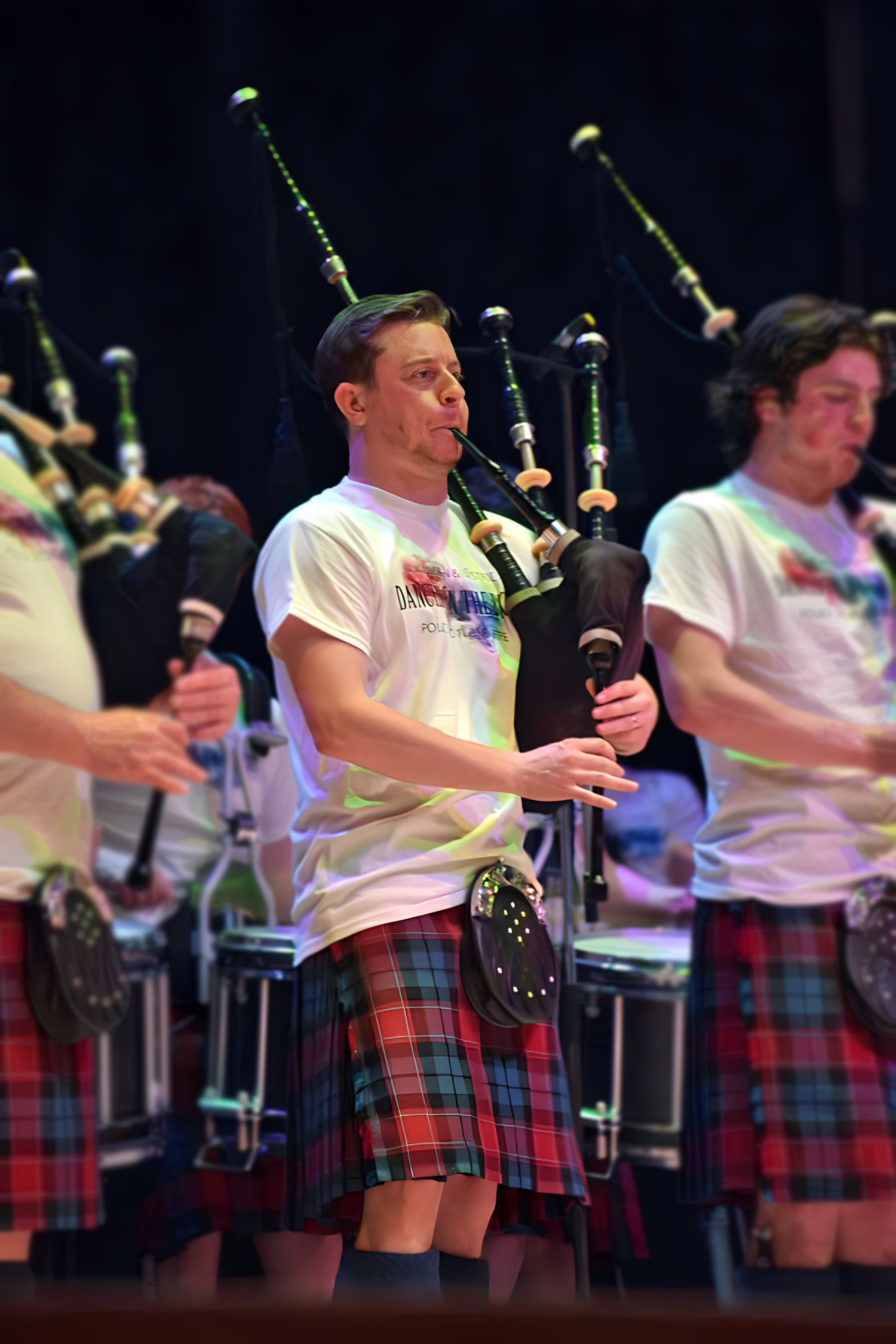
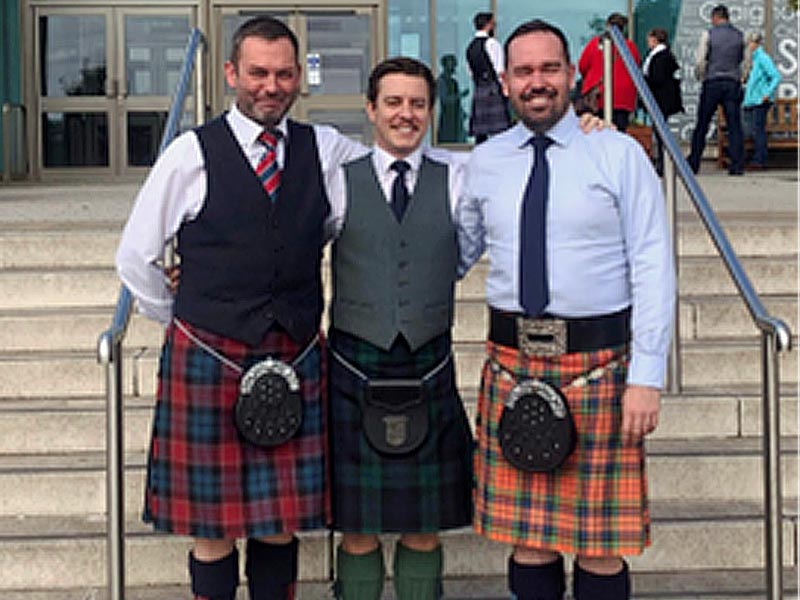
David Wilton became Police Scotland Fife’s pipe-major in 2021, taking the reins from Douglas Murray, who had led the band for 11 years. Like Murray and the band’s previous pipe-majors Andrew Mathieson (2009-’10) and James Murray (2007-’09), Wilton brought with him world-class solo piping success. In addition, he is a seven-time World Champion Highland Dancer (Adult: 2007, ’08, ’09, ’11; Juvenile: 2004; Junior: 2005, ’06), and the band has benefitted from his competitive and artistic experience, especially when it comes to strathspey playing.
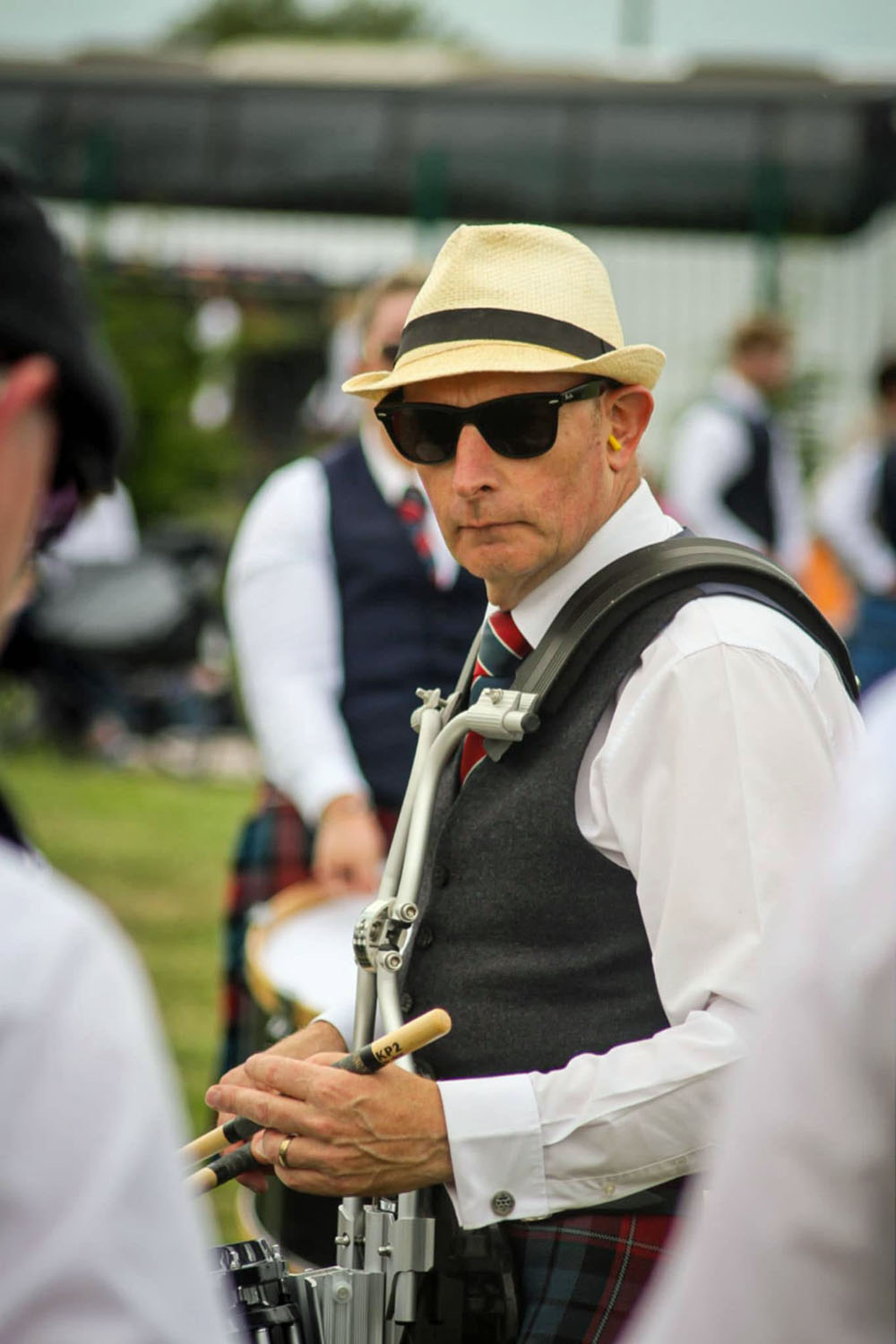
Leading-Drummer Mick O’Neill and his entire drum section joined Police Scotland Fife shortly before the Grade 1 Clan Gregor folded in 2008. O’Neill took over from Lee Innes (now a well-regarded RSPBA judge), and has brought even more stability to the band’s corps. O’Neill is one of the most-liked pipe band members around, and his straw trilby is as much his trademark as his corps’ inimitable sympathetic ensemble style.
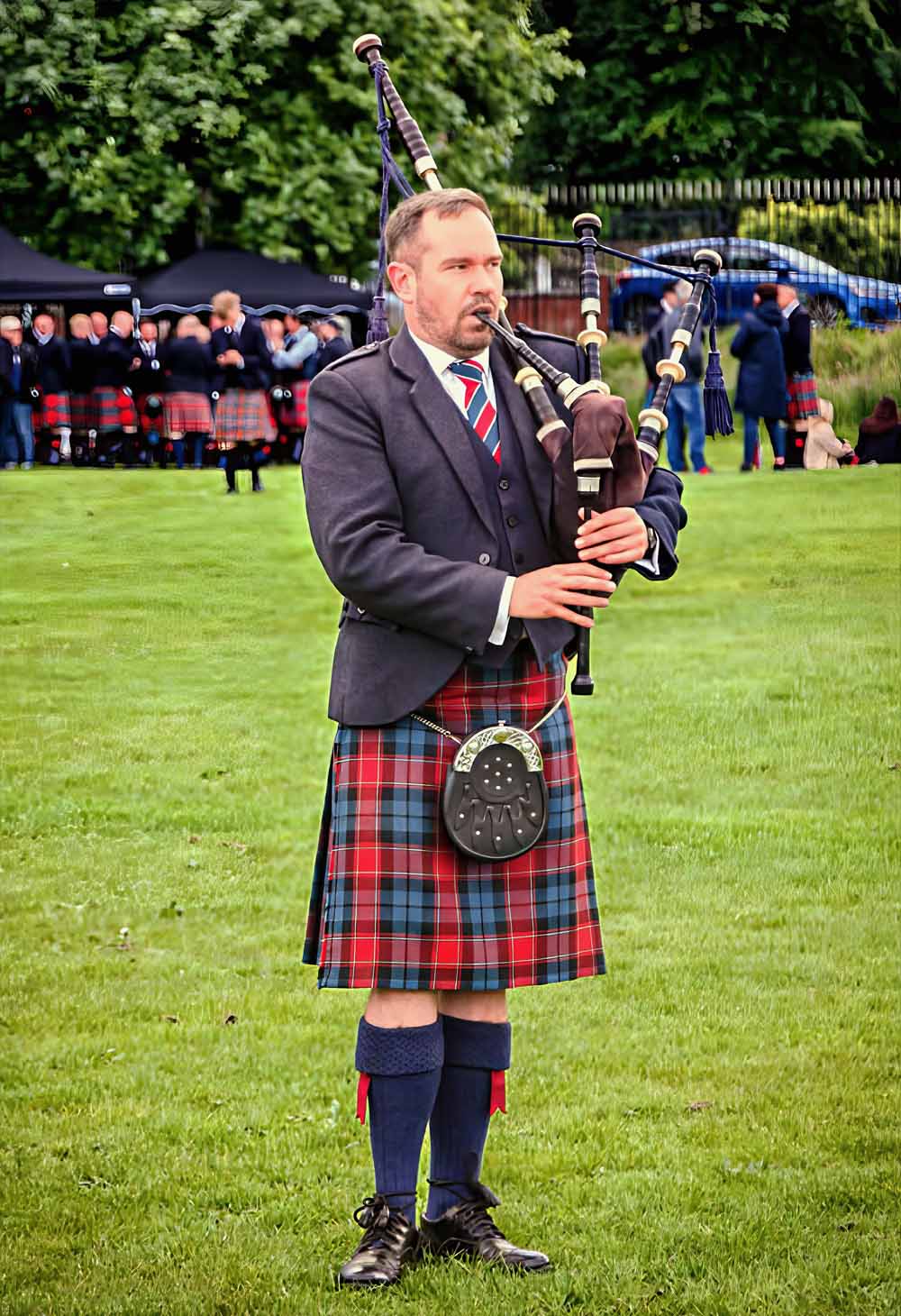
Continuing the band’s strong tradition of top solo pipers as leaders, Pipe-Sergeant Greig Canning joined Police Scotland Fife in 2023, coming back to a Fife region band after playing with Grade 1 Inveraray & District for more than a decade and, before that, serving as Dysart & Dundonald’s last pipe-major from 2010 to 2014. His background as a reedmaker with his own Castle Bagpipes is a certain asset to the band.
Interestingly, each leader is a full-time teacher of piping or drumming. David Wilton runs the piping and drumming teaching program at the High School of Dundee, Mick O’Neill is the longtime drumming instructor at George Watson’s College in Edinburgh, and Greig Canning teaches at Lochgelly High School in Fife. Each of those programs consistently generates dozens of well-taught musicians, already well practiced in competitive pipe banding.
While most top bands are aligned with strong teaching programs, Police Scotland Fife may well outpace any band on earth. Wilton reckons that, due not only to the work of the three leaders, and also several other pipers and drummers within the ranks, there are currently more than 1,000 young players receiving almost daily tuition from Police Scotland Fife members.
Suffice it to say, there is no shortage of young talent consistently vying for a spot in the band, thus safeguarding a strong future in both competition and onstage performance.
Police Scotland Fife debuted a new 2026 medley in May at the British Championships in Edinburgh. The band was tied third in piping, fourth in ensemble, and finished fourth overall, seriously chappin at the door of competitive glory.
Here’s a list of the medley’s content:
“Lullaby for Mel” (air) – Ross Ainsley
“The Cat and the Dog” (9/8 jig) – traditional
“£50 Cash Back” (jig) – Fraser Shaw, John Summerville & Kevin O’Neill
“My Laggan Love” (air) – traditional, arranged David Wilton
“Haud the Lass Til I Run at Her” (strathspey) – traditional
“Captain Horne” (strathspey) – traditional
“The Kilt is My Delight” (strathspey and reel) – traditional
“Knees Up In Hanoi” (hornpipe) – Calum MacCrimmon
“Aye, Right” (hornpipe) – Angus Grant
“Lullaby for Mel” (air) – Ross Ainsley, arranged by David Wilton
As one famous piper purportedly said, “Technology is just one cock-up after another,” so there are a few very minor audio issues in our exclusive conversation with Pipe-Major David Wilton, Leading-Drummer Mick O’Neill and Pipe-Sergeant Greig Canning, as they take us through the fascinating and continued musical evolution of the creation of a truly inspiring new medley.
For those who also like text, here’s a transcript of our conversation, edited for written clarity.
pipes|drums: We continue the Medley Playbook series with Police Scotland Fife, a band that is on the ascent and doing some very creative musical things. We’re pleased to have Pipe-Major David Wilton with us, Leading-Drummer Mick O’Neill, and Pipe-Sergeant Greig Canning. Thanks, guys. Really appreciate you taking the time.
Let’s talk about Police Scotland Fife and everything that goes into creating this new medley that you’ve got for 2026.
David Wilton: Yeah, it all started at the very end of last season, at the end of the Worlds. We usually have a debrief about a week later, just to run down the season. What do we like? What do we not like? What do we want to do for next year? What are our goals? Did we achieve our goals set previously? Where are the gaps? What do we need to do?
During those conversations, we like to ask the question, “What type of medley do you guys want to be playing for the next season? Do you want a big-idea medley? Do you want a theme running through it? Do we want to go down that route? Do we want to bring back some old stuff? Do we want to just chuck some really great tunes together and make some exciting music that way?”
That’s sort of where it started.
The general feel was they wanted a big-idea medley. So that always is music to my ears, but also a bit of, “Okay, I have no big ideas right now.”
I was like, “Okay, I’m going to have to go soul-searching now.”
So off we go into a dark hole, trying to figure out some sort of plan. We had maybe a couple of things that we’d been discussing throughout the season with “Lullaby for Mel” and whether we’d use “Lullaby for Mel” in the medley somewhere.
I quite liked the idea that you’re taking this beautiful melodic piece and maybe not just doing what you would expect, putting it in the middle as a slow air. Maybe let’s just open with it. Let’s open the whole medley with it. There were these ideas being touted around.
“We had discussed the idea that we might look through some of the archives of Dysart & Dundonald and look at some of the heritage of the band and the lineage. Although we are not directly linked with Dysart as a spin-off band, we are very steeped in that area. Fife music is very dear to all of our hearts.” – Pipe-Major David Wilton
We also had discussed the idea that we might look through some of the archives of Dysart & Dundonald and look at some of the heritage of the band and the lineage. Although we are not directly linked with Dysart as a spin-off band, we are very steeped in that area. Fife music is very dear to all of our hearts. We were trying to think: do we modernize that? Do we try and look down those routes?
These were all the questions that we were asking the band. I think, generally, where we came out was we’ll try and go down both routes and see what happens. As we were looking for the Dysart connection, Greig said, “What about ‘Laggan Love’? Why don’t we go there?”
It was a bit of a scary move because we were like, “Well, this is seriously iconic. How could we possibly touch this without either making it a cheap replica or a complete carbon copy that maybe doesn’t get the essence of it because you weren’t there for the process?”
There was a lot of that in our minds when we were approaching these things. I mean, we had many, many conversations about all of it, but I think generally we kind of pick a few ideas and try to build around that. We don’t look at it as, “I want to play all of these tunes and make them into a medley.” A lot of the time we pick a couple of things. I always like to have a good slow air, knowing that I’ve got something to piece it all together in the middle and we can develop from there. If I’ve got a slow air and an opener, then I’m good.
Sometimes you need the finisher. We’ve done things in the past where we’ve gone with a finisher that we know we want to play, and then we work backwards from that. Generally, I like to have the beginning, middle and end roughly sorted, and then the tunes in the middle sort of come out of the keys that we play in. We make sure we’re not playing the same key for too long. Maybe we’ll look to change the key after a second tune, or right away. It depends on how long the opener is. We’ve gone through that process a number of times with all of our medleys since I’ve taken the band on.
I’m not sure what happened prior to that with Dougie [former pipe-major Douglas Murray], but that’s been our approach, and it seems to create medleys that we find interesting, we quite enjoy playing, and I think that’s the big message at the end of it all.
We’ve got to play our music how we want to play. If they like it, they like it. If they don’t, they don’t. As long as we’re happy. It’s all very self-indulgent, I guess, but not at any point are we trying to ostracize the listener. We’re always trying to make sure the listener’s connected in. If that doesn’t happen, we pretty much scrap the idea, go away and try again. That’s it, really.
pipes|drums: I want to get back to the Dysart connection, the Fife connection, in a little bit. Mick, as we’ve asked the other bands, what about your role in the musical creation? Obviously, drumming is musical, but in the melodic creation, do you come to the table with ideas of your own that you really want to see in a new medley?
Mick O’Neill: I’m welcome to do so, obviously. In this particular medley, it was David and Greig that worked on the melodic theme and then, intermittently, would present parts of it to me to see what I thought I could do in terms of the ensemble effects and things like that. So, in this particular medley, I’ve not had any input in the melodic creation.
pipes|drums: One thing that, when we get to it, we’ll talk about a little bit is “Lullaby for Mel” by Ross Ainslie. It’s an air. So, coming in with an air, as we’ll listen to, that’s a bit of a risk. Maybe go to you, Greig. What was the discussion around starting a new medley with basically an air?
Greig Canning: Well, I think first things first, we love the tune. Both myself and David were talking about it and playing it and doing stuff with it last season, in the middle of the season, where we were going, “This has got legs. This has got something about it. We like this.”
Similar things were happening with the tune “Knees Up In Hanoi,” which was obviously made famous by Breabach, which we can talk about as well. But in terms of “Lullaby for Mel,” we just loved the melody, and we thought, “Could we do this?”
We thought we’re strong enough tonally now that we could carry that off and have lots of impact. I think we’re at a place where we could deliver this and do it justice.
A lot of good music has lots of space in it, and it just felt like we could show off tone, work with Mick on the ensemble, make the drum score really effective, and make it engaging and impactful, not like an air, almost. Take something that is an air and just flip it and make it ours.
pipes|drums: Yeah, making it yours is a theme that’s come up before; it’s enjoying what you play. It can make a huge difference to a band as a whole.
Greig Canning: Yeah, for sure. With the idea of putting “Lullaby for Mel” in, obviously it’s there at the start. It ties things together at the end, and it kind of interweaves with “Aye, Right,” the last tune. But we also talked about not playing “Laggan Love” and playing “Lullaby for Mel” as an air and showing it as the opener.
We didn’t go down that route. We went with what we’ve got. But these were the kinds of conversations that were happening at the time.
pipes|drums: It is hard for me to articulate this, as it often is, but is the musical side of things rising in importance for pipe bands at the top level, especially? The overall musical package, as opposed to 30 years ago, bands could have played very simple content and, if they played it perfectly, they’d do well. Now it’s a different story. David, any thoughts around that?
David Wilton: I guess you’re probably right. There’s definitely a trend toward people being a little bit more creative, exploring what the bagpipes can do. It’s difficult, though, because, at the end of the day, bagpipes blend already.
When you’re adding in harmonies, it can become quite muddy, and it’s really difficult to get a defining line coming through with the same texture of sound layered on top in a few different ways or with different notes.
I think we’re all trying to create chordal effects that maybe change the mood of things without losing the melodic line. That’s possibly a lot different from maybe 30 years ago.
I still think good tunes are good. I think that really matters most. There’s no point flogging a dead horse on a tune because you like the harmony line. I think the melodic line has got to come through strongly.
That’s where we went with “Lullaby for Mel.” It’s such a strong musical statement that it speaks for itself. You just add a little adjustment of a chord here or there and try to capture the right feel. Make sure you’re not getting the wrong chord in the wrong place. Don’t make it too heavy, so the melodic line is still coming through. These changes happen throughout the year. You realize that’s too strong, or that needs to be lightened up there. Those are conversations we continue to have throughout the year.
David Wilton: But I think the development of medleys is that we’re all keen to play something that just makes it, I don’t know, maybe too complex. I’m not sure. I think we try very carefully to tread a line between too complex and self-indulgent, but then not just going down a plain and simple, “Here’s a good tune with a little bit of harmony coming in.” It’s difficult.
When you’re doing the recording, we can talk about it, but the break between “Lullaby for Mel” and the jig, we don’t introduce the jig right away. We actually do a chord that surrounds the key change. So, we make the key change, then we start introducing the tune.
Maybe we haven’t quite nailed the harmony balance on that yet, but we’re playing about with different versions. There was a tweak at the weekend, just adding more people in on the melodic line to hear it a little bit clearer.
Again, because I think if the listener doesn’t understand straight away what you’re doing, then there’s a little bit of, “That’s not right.” Because it’s still competitive music and you’re still being assessed right there and then, your first impression is still the most important impression. Even if people hear your medley five, six, seven or eight times, they might get into it a little bit more each time they hear it and hear another little aspect that they didn’t notice. I think we strive for that.
But the first listen has to be very, very clear. If it’s not, then we’ve not done our job properly. These are the conversations that we have constantly. Are we doing that right? Is that coming out how we want it to?
We know what we’re trying to do. But does the listener know what we’re trying to do?
I think the development of medleys is very clear to see. There’s more emphasis on the overall ensemble, orchestral-type thing, as opposed to just good tunes played really accurately, which is still a very important element.
pipes|drums: Let’s go to the recording.
pipes|drums: Let’s pause it there. That’s “Lullaby for Mel,” of course, what we talked about. You’re giving it almost a military feel. Mick, what was your thinking with the percussion accompaniment?
Mick O’Neill: Well, initially, what we were looking for, as all bands are looking for, was that initial impact to grab the listener. When we first started with “Lullaby for Mel,” we had an extended E, and there was a bit of a drum riff before we hit the tune. It’s come out much differently from where we started, as often happens.
Basically, we wanted that crescendo roll up to the first beat of the tune, then a diminuendo back down to grab the listener straight away in terms of the dynamics that were on offer from the band. Then, just to help the whole flow of the tune, we tried to keep the beat constant and regular, so it was supporting the melody.
With so much space in that melodic line, it gave us the scope sometimes to play in the space and then, at other times, follow the melodic line. We try to do both things, play in the space at times and not play over the space at other times.
David, Greig and I spoke a lot about that while we were putting the score together. “Let’s not play over there.” “Let’s not fill in there.” “Let’s play with the melody here.” “Let’s go over there.” Just so we were creating the right feel and ensemble.
For example, there are spots where the snare corps comes out, and the bass section fills in little patterns that are effective with the tune as well. It was about getting those parts of the drum score to complement the melodic line in the way we wanted. That was where my thoughts were.
pipes|drums: The bass section almost foreshadows that very clever bridge into the slip jig “The Cat and the Dog.” Very, very effective. Why don’t we continue?
pipes|drums: We’re going now from “The Cat and the Dog” into “Fifty Pounds Cashback,” a jig. Now we’re into a traditional strathspey.
But let’s go back to the Dysart elements. Greig, you talked about Dysart & Dundonald, and I believe you’re the last pipe-major of that very famous band and “My Laggan Love,” which Bob Shepherd made very famous. Talk about the thought process with that. And, Mick, the drumming elements of Dysart & Dundonald, I can hear them in that.
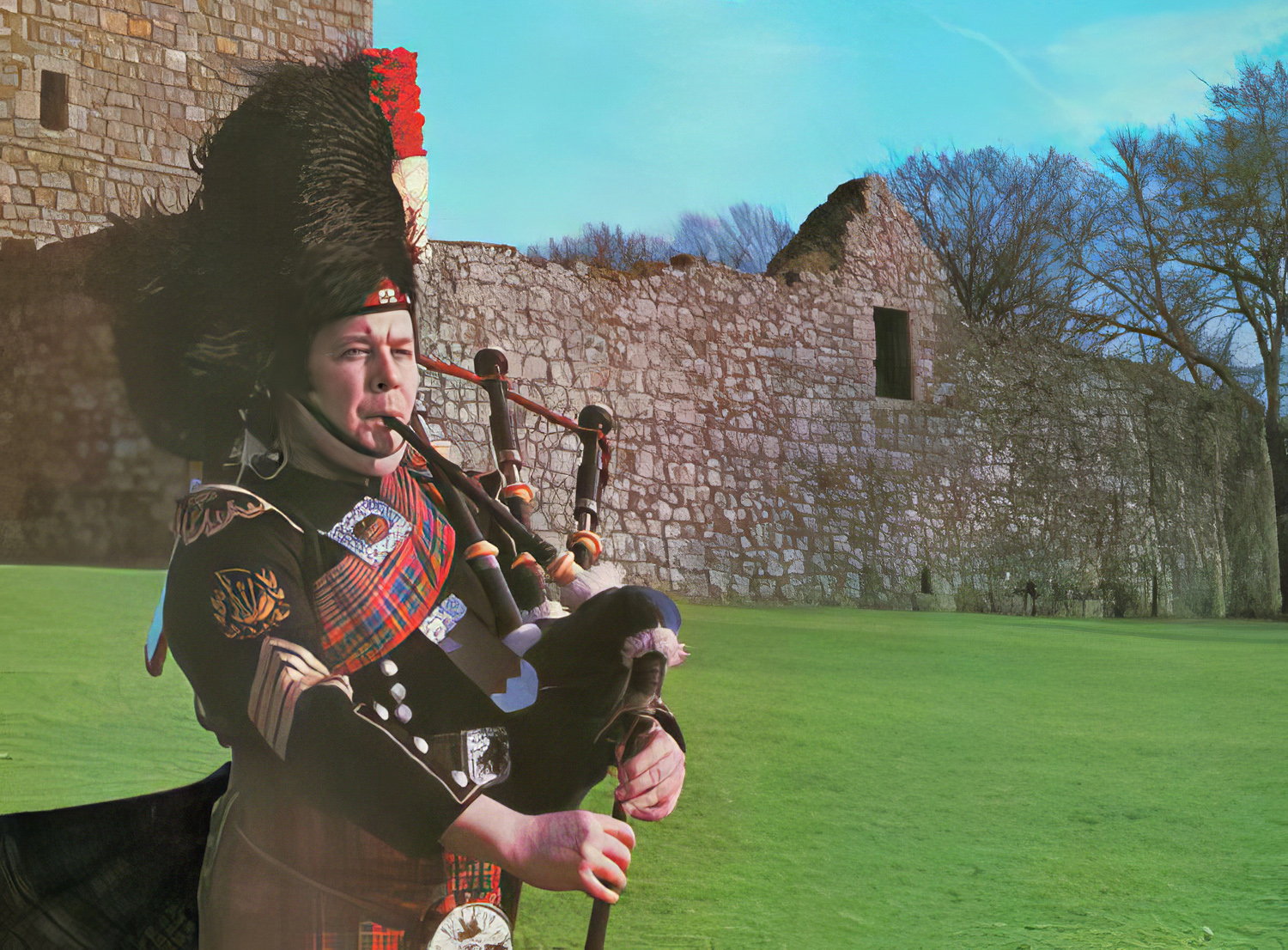
Greig Canning: It’s one of the most iconic slow airs that has ever been in pipe band medleys. There was a thought running around our heads that we wanted to do something with this, but we didn’t want to make it a carbon copy. We did want to nod our heads to a remnant of the last one, or a little bit of the drum score, and there are hints of that there.
We’re also quite heavily influenced by the Victoria Police medley, “The Terror Time.” There’s a lot of space in that too, and it’s quite free. We referred to that quite a lot: what elements of that did we like, and how could we bring them into this without just taking that tune and saying, “Let’s do ‘The Terror Time’ instead”
“We wanted to use ‘Laggan Love’ and make it ours, and make it say what we wanted it to say. We worked really, really closely. There were a lot of conversations about what we could do here, what we could do there. Should we put that little Dysart touch in this bit, or should we put it over here? We went through about 50 iterations until we thought, ‘That’s the one we like.'” – Pipe-Sergeant Greig Canning
We wanted to use “Laggan Love” and make it ours, and make it say what we wanted it to say. I feel like we’ve done a great job with that, if I do say so myself. We worked really, really closely. There were a lot of conversations about what we could do here, what we could do there. Should we put that little Dysart touch in this bit, or should we put it over here? We went through about 50 iterations until we thought, “That’s the one we like.”
Again, it boils down to what David says: What’s going to be the most fun for us to play is probably going to come across the best to the listener and to the judge.
We’re kind of backing ourselves and our own taste. David and I talk most days about these things.
We’re usually quite well aligned in terms of our tastes and our influences. “Have you heard that tune?” “Have you heard this guy play that?” We talk quite a lot and riff off each other. I think we’ve got quite similar sensibilities. Once we get started, we just can’t stop riffing on things. The end product’s there for everybody to hear.
pipes|drums: Mick, let’s talk about the late, great James King from Dysart & Dundonald, the leading-drummer of that great band in its greatest years. How much influence did you take from Jim King’s scoring of “My Laggan Love”?
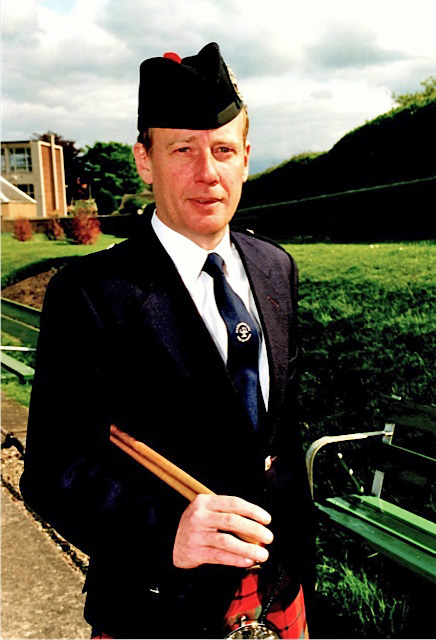
Mick O’Neill: Well, I think Greig touched on it briefly there. At first, I went with a completely blank canvas and just wrote something right off the top of my head and presented it to David and Greig. As Greig quite rightly said, version fifty-two or fifty-three was eventually what we settled on. It moved a lot. It moved an awful lot. But essentially what we were trying to achieve was a tribute to that great band and letting everyone know that that’s exactly what it was.
That’s why we have those hints of Jim’s rhythmic patterns in it, but also those very emotive rolls while putting a touch of what we do on it as well. It’s a very emotional tune, so you’ve got to make sure the emotion is conveyed to the listener in the right way. The drums obviously can have a very dramatic effect on that dynamically, particularly when you’ve got so much space there in that melodic line.
We tried to take every opportunity to do that while not compromising the history of the tune and, as David and Greig have touched on, it’s iconic. It’s one of the most iconic slow airs that’s ever been played in pipe bands. We were very keen to retain its integrity as we moved forward with it. Hopefully we’ve done that – in version 52!
pipes|drums: It’s a great balance. It’s a melodic, sad tune, but it’s also an incredibly dramatic piece of music, complemented, of course, by the percussion.
Okay, so let’s pick up at the strathspeys.
pipes|drums: So, very, very clever stuff here. Going for the very traditional “The Last Time I Ran Away,” “Captain Horne,” and “The Kilt Is My Delight,” with a really clever transition using strathspey and then into reel time with “The Kilt Is My Delight.” So, is this the intentionally traditional, “get your head around it,” familiar side of the medley?
David Wilton: No, not intentionally. But we definitely pride ourselves on strathspeys. We definitely don’t like the strathspey to be the filler. Being from a Highland dancing background, I also did a dissertation on strathspeys, the origins and where they all came from. It’s something I really geek out about. Sadly, the band have to get dragged along with that!
I don’t necessarily feel like it’s just two tunes and off we go into the reels. I do want to create something there.
“The way we approach strathspey playing as well is not just dot-cut and cut-cut as much as you can, and create as much space as possible. There’s definitely a pulsing and flow that we try to create there that’s not so easy to play. There’s not a practice that goes by where we’re not analyzing a little run here, a little run there. We’re trying to get the right shape to the tunes. Every tune carries its different weight. We’re not putting this blanket strong-weak-medium-weak on every single tune that we approach. Sometimes we’re emphasizing – don’t shoot me! – beat four.”
The way we approach strathspey playing as well is not just dot-cut and cut-cut as much as you can, and create as much space as possible. There’s definitely a pulsing and flow that we try to create there that’s not so easy to play. There’s not a practice that goes by where we’re not analyzing a little run here, a little run there. “That’s not good enough here,” or “That’s not good enough there.” We’re just trying to get the right shape to the tunes. Every tune carries its different weight. We’re not putting this blanket strong-weak-medium-weak on every single tune that we approach. Sometimes we’re emphasizing – don’t shoot me! – beat four. Sometimes we can play to beat four. Sometimes we won’t do that. Sometimes we’ll play to beat two. Sometimes we’re on the weak side. If it’s traditionally strong-weak, medium-weak, that’s what we do sometimes. It depends on the tune. It really comes down to what makes this sound right for this melodic line.
We’ve got two very contrasting strathspeys there, and I think you can hear that. One of them’s a little bit more of a driving strathspey, but that takes us out into the next one, so hopefully that changes the idiom and perks your ears up. We don’t present it without the harmony; we fade it in. We’re hoping you’re figuring out what’s going on there. Mick also is low, low, low in the drums, then smashes in on one of the really dot-cut phrases.
The B to low-G: Mick’s going big there. That was a big decision we made, to keep it low, low, low for ages. We wanted to create tension.
Usually, the strathspeys are not where you would do that. We’re trying to create some level of tension there, and then it sort of fizzles out into the melodic line, just clean. No harmonies there. Nothing coming in. Then we start playing, and that’s where we’re building the next layer of everything. When we cut to “Captain Horne,” that’s where we maybe go for the more traditional strong-weak, medium-weak. We try to pull out those pulsed notes and create some snap because this is a really iconic Highland dancing tune.
If you’re going to play for Highland dancers, you need to know this tune. So we always tend to have a really traditional Highland dancing strathspey within the medley. Then when we went into “The Kilt Is My Delight,” we’re obviously so in love with strathspeys that we decided to start the third strathspey before breaking into the reel from there. We were just like, “Do you think we could do this? Is it overkill?”
But it’s worked out really well. We’ve had a lot of compliments on the break into the reel. Keeping the same melody just helps. The contribution that Mick has with the drums, the bass and tenor little inputs, there are so many areas of interest that it’s hard to hear them all the first time.
When you have it in the headphones, you can hear all the individual drums coming through, and you can really hear everything that’s going on there. It’s not just the melody with a drum score underneath it. I don’t think we’re trying to make that traditional.
But we do love traditional tunes. They’re just great tunes. I think we probably look to traditional tunes more once we’re out of the strathspeys and slow airs and we’ve got the opener and closer sorted. We’re looking for some good tunes that will just be good to play and make sure we deliver them really, really well.
Mick O’Neill: I think, in a sense as well, what we created dynamically there coming out of the slow air, if we look back at bands over the years, they would have a very big, strong start from the drum corps going into the strathspey to emphasize that change of idiom from the very slow melodic theme. Then we’re into the dance idiom, and straight away the drummers are very strong. Whereas we are actually very, very quiet until beat three and four of the second bar of the tune, and then we’re away. Then we build all the way into line two of the first, or the last switch. It was something David, Greig and I talked about and tried with the band. We tried to see how much we could extend that dynamic to make the impact come later. As David was saying, the harmony is fading out there, then the melody comes back in, and the drums are there to emphasize that part of it happening.
pipes|drums: Once again, very effective. And in “Captain Horne,” those little turns of phrase, the creative elements and runs that you throw in there, just can’t help but bring a smile to my face. It’s nice with a traditional tune.
Greig Canning: Those little turns and twists get a really deliberate, conscious effort from us. David and I are sitting in David’s kitchen, and we’ve got very similar sensibilities. As I’ve said before, while bar one and bar five on the paper are matching, we don’t want them to match. We want to add a wee twist or make it still predictable for the listener, but with a hint of something else. Just add a little seasoning to it.
We’ve got very, very similar tastes and sensibilities there. The rule is, though, you don’t do it for doing its sake. It’s got to service the melody. It’s got to service the listener.
pipes|drums: All right. Let’s resume the recording and take this on to the end.
pipes|drums: All right, so we finished off there with “The Kilt Is My Delight” in reel time, “Knees Up In Hanoi,” “Aye, Right,” and then a reprise of “Lullaby for Mel.” One thing that occurs to me is this medley has got a lot of low-G in it, the dangerous low-G, and you guys are pulling it off. It’s really very effective from start to finish.
David Wilton: Well, just get that in tune, you know! Let’s try our very best to get that in tune! We knew as soon as we started with “Lullaby for Mel,” we knew somehow we were going to have to intertwine it somewhere. It was going to have to come back somehow. At times I’ll look at the key and go, “Right, now I need a reel in D-major.” I like to try to piece two tunes together, I guess. So we were just looking. It was like, “Right, Greig, tunes, reels in D. Reels in D. Let’s go for it and try and figure some out that feel like a nice little finisher.”
“Aye, Right” cropped up. I had been looking at “Aye, Right” for years and just never really found the right place for it. The tune itself, we’ve knocked off the first part. The first part is in B-minor, which is where “Knees Up In Hanoi” is. We know B minor, relative minor to D. We want to go back to D. We’re going to finish on D. That’s why “Knees Up” is there. It gives us a little B minor transitional tune that’s going to help us resolve into D. If we get to that key change nicely, then we’re up and running.
With Mick giving it the drum-kit riffs in “Knees Up” and adding that rhythmic, percussive support to the tune, it really allows us to release right out of the end of that tune. So that whole “Knees Up” tune is really just setting us up for “Aye, Right” in the end. “Aye, Right,” as a tune, what can you do with all those birls and the rhythmic support that the tune gives? It’s just an exciting tune. It’s nice. It’s always been great, no matter what you do. So we chopped off the first part in B-minor and just went straight into the second part. We figured out a way to do that smoothly. Then we added “Lullaby for Mel” over the top. Throughout “Mel’s,” we take “Aye, Right” out of that reprise to begin with. Then we add little snippets of the “Aye, Right” tune back in there again with the birls before bringing “Aye, Right” back right at the end.
I don’t think we’ve reinvented the wheel there. We’re not the only band to have done stuff like that.
“I think sometimes we may be naïve to think that we’re original. This certainly doesn’t feel bang-on original, but it feels like us. That’s what we’re trying to do. Just create exciting music. If it’s exciting to us and not to someone else, then that’s okay. No problems there. I don’t think we’re too precious about it. People can have the conversation, and nobody needs to go away crying. It’s all good.” – David Wilton
I don’t think it’s really possible these days to be fully original. Everything’s an amalgamation of ideas. We’re always listening to our competitors. We’re always listening to bands. It’s all a big melting pot. You’re just trying to put your own wee stamp on things.
I think sometimes we may be naïve to think that we’re original. This certainly doesn’t feel bang-on original, but it feels like us. That’s what we’re trying to do. Just create exciting music. If it’s exciting to us and not to someone else, then that’s okay. No problems there. I don’t think we’re too precious about it. People can have the conversation, and nobody needs to go away crying. It’s all good.
We took it to Mick, and he was like, “Great. This is great. We can do stuff with this.” We hadn’t really given him much up to that point. We had an opener that was pretty vague, and then we had a slow air that hadn’t been written. Then we had this concept of “Aye, Right” amalgamating with “Lullaby for Mel.”
We’ve not really figured out “Mel’s,” so how are we going to figure out the end? But you give him the jigs and strathspeys, well, he knows what to do there. It just took ages to piece together. We had a concert outside Cookstown where we had to have a medley for, and we were like, “We need to get this done.” Put the pressure on a little bit.
We came up with a version, and then we changed a couple of things right after that because we knew we didn’t want them. I think, actually, what we did was strategically delete some of the middle-section stuff. Mick, was it? We just took away a lot.
Mick O’Neill: Obviously, there was the opportunity to bring “Lullaby for Mel” back. We tried to keep the structure of the drum score similar, so we had a bit of musical form there. Some of the bass and tenor work that’s in there is in the opener as well. We tried to keep the musical formation true to itself. We’re building up to an end, so there’s got to be that feeling of creating a little bit of excitement while also recognizing, as I said earlier, the amount of space that’s in that melody and not compromising it. We did play about with bass and tenor stuff.
Actually, the snare line emptied out a few things as well, just to make it feel like it was building to a natural conclusion when we went back into “Aye, Right” for the final passage of the medley. I actually found that great fun to write. I was writing that score on the shores of Loch Fyne over the New Year. David had sent me a recording of it. So the “Aye, Right” score and the “Lullaby for Mel” ending came from there while I was over there on holiday. It was a great place to write music, to be fair!
pipes|drums: The reprise itself isn’t a new idea. It goes back to the 1970s, I think, with Shotts & Dykehead bookending medleys. But it seemed like Inveraray took things to a different level thematically with the “Dream Valley” medley last year. We’ve talked about this with the other bands. How much do you think that medley, that performance, that acceptance of that thematic kind of approach, has influenced you guys this year?
Greig Canning: I mean, I think we just keep going back to the fact that we make music that we enjoy and that is for us. So there might be something subconscious in there, but we didn’t at all go out there trying to make a medley because of somebody else. I’m sure I speak for all of us when I say we went out there trying to make a medley that we were proud of and that we would enjoy playing. Just to that end, my favourite bit of the medley is literally the drum-kit riff into “Knees Up In Hanoi.” I smile every time we play that. It wouldn’t feel the same without that backing, that drum-kit backbeat fill.
Interestingly, this year Boghall are actually playing a tune that we are as well, and I think possibly Inveraray were at one point. We’ve all gone about playing the same tune in very, very different ways. The end result is totally different. We’ve made music to please us. We sound like us. If people like that, then great. We’re trusting the guys who are leading the charge with that in the band. We’re not taking our cues from anywhere else. We’re just doing what we like.
pipes|drums: Well, that’s really well put. I think it is a very, very original medley at the same time. Listening to that, I can almost see the wheels turning with all of you at times. You’re hearing different things. Are there still going to be changes to this medley between now and the World Pipe Band Championships?
David Wilton: Yeah, probably. Probably is the case. We’ve just changed some stuff from the old medley, dynamically, quite a lot. We’re always tweaking. I think when you develop as a band, and I think it’s fair to say that we have been in a development phase of what Fife is producing now, it takes time to find the identity that you want. Then it takes time to gain confidence in your own identity. I think this medley, this year especially, probably sums us up the most. We’re more confident in what we know and what we like now.
There are so many elements of pipe bands that need sorted. You get into the nitty-gritty trying to do that, but it all just comes down to great delivery. I think there’s a lot about this medley that we would not have tackled four years ago, five years ago. I think we just wouldn’t have been confident enough to do it. That’s just part of everyone’s development as a band.
There are a lot of quality bands. The standard’s incredible. Everyone probably thinks their own era is the best it’s ever been, but I’ve listened to bands literally since I was born, and I can’t remember a time when you had this strength and depth of pipe band music, quality, delivery, musicianship. It’s quite amazing. It’s very frustrating too. But also amazing.
You feel like you’ve created a band that’s good enough to win, and then it’s like, “No, but there’s another seven, eight, nine, 10 bands that are good enough to win as well.” I don’t think there’s ever really been that.
I remember a time when you had three really great bands that could go for it. If you could get yourself to those guys’ standard, you were doing good. I feel like everybody’s at that high standard now. It comes down to basics. If you can deliver your basics properly, that’s where it’s going to come down to getting the nod on the result. Again, it could come down now to personal taste in music. You could see some wild fluctuations in results because one judge likes this and another judge likes that. But every band’s delivering their true identity. I think that’s great.
It’s difficult to be in the pack with all the bands jostling for position. Everybody’s just keen to stay relevant. We’re trying to build our band, be relevant, and then stay relevant. The standard just keeps going up, and we’re just trying to do the same.
So, I mean, there are always gears to do that with, and I think that’s the great thing about pipe band music right now. It’s developing into something that we’re not sure where it could go in a few more years.
I think certainly with the “Dream Valley” medley, it maybe gave people a little bit more confidence to just do what they’ve been wanting to do. If there was any influence that the “Dream Valley” medley had, it could be just, “Let’s just go for it.” Don’t be fearful to finish on a slow air because it’s not exciting enough. Just do something that you feel still makes you excited.
I’m certain, we know the Inveraray guys well, that last year’s medley was very exciting for them to play. They were right up for it. I think that’s true of our medley this year. The whole band’s been right up for putting this together. We took a risk. We went for “Lullaby for Mel” going in. Why? It’s not a hornpipe. It’s not a march. It’s a lullaby. It could be a bit confusing. “You can’t start a medley with a lullaby!”
But if you approach it in a certain way, you’re still getting that melodic line coming through. It’s the most important thing. Great support from the drum corps. The big decision that made that work so well was the diminuendo roll back down again. Right up, and straight back down, to settle everybody down. So we have that impact, and then we’re just going, “Okay, calm down. Just have a listen to what we’re going to deliver.” Then we build from there.
“I was going to say exactly the same thing, David. Obviously, that was a fairly iconic moment in pipe bands. We all spoke about last year’s performance by Inveraray. But you’re not going to out-Inveraray Inveraray. There’s no point in trying. Or out-Boghall Boghall. We’ve got to be Fife. That’s what we’ve got to be because that’s what we’ll be good at. We’ll be good at delivering our music.” – Leading-Drummer Mick O’Neill
Potentially, had Inveraray not done “Dream Valley,” maybe we wouldn’t have been ballsy enough to do it. I don’t know. Who knows? They did that medley before we finished ours. I think it’s difficult to imagine that you’re not being influenced by everybody around you. It’s just the way it is. I think we’re too connected.
Mick O’Neill: Yeah, I was going to say exactly the same thing, David. Obviously, that was a fairly iconic moment in pipe bands. We all spoke about last year’s performance by Inveraray. But you’re not going to out-Inveraray Inveraray. There’s no point in trying. Or out-Boghall Boghall. We’ve got to be Fife. That’s what we’ve got to be because that’s what we’ll be good at. We’ll be good at delivering our music.
Not that the other bands are not delivering brilliant music, as David touched on earlier, about how great the standard is. It’s phenomenal. It’s actually a privilege to be walking into that circle amongst those bands. But, yeah, we just want to be true to ourselves and keep the listeners engaged as much as we possibly can with our music.
pipes|drums: It’s been great talking to all three of you about the new medley and the inner workings of Police Scotland Fife. You’ve got a strong following worldwide. People like what you’re doing, and it’s terrific to see the band continuing every year to rise up and literally knock on the door of the World Pipe Band Championship.
Good luck to you for the rest of the season. We’ll look forward to hearing more from Police Scotland Fife. Really appreciate the time.
All: Thank you for having us. It’s been a pleasure.
pipes|drums: Police Scotland Fife, the leaders of one of the world’s elite Grade 1 bands, who’ll be vying for the World Pipe Band Championships in August.
Here’s the entire Police Scotland Fife 2026 medley for your listening pleasure:
And here’s the first half of the medley in draft mode, taken from a band practice last winter.
Our thanks to David Wilton, Mick O’Neill, and Greig Canning for being so generous with their time and for sharing insights into the music development of Police Scotland Fife’s new 2026 medley.
Stay tuned for more from pipes|drums.
Corrections were made on July 25, 2026: An earlier version of this article inaccurately listed “Lullaby for Mel” by Ross Ainslie as “Mel’s Lullaby,” which was true to the transcript of the video interview. Tune title accuracy is important, so all references to the piece were corrected.





NO COMMENTS YET