

It’s a wrap: Colin MacLellan on the importance of the Castle Recordings
 We started the exclusive series of Castle Recordings made by Captain John A. MacLellan MBE in the 1960s in March 2024, and 151 tunes and 18 installments later, it’s fitting to wrap the series with a brief recorded conversation with Colin MacLellan.
Colin came to us with the idea of publicly and freely making his father’s historically important recordings of piobaireachds available on pipes and drums. We are forever grateful to him for that.
Using a reel-to-reel Ferrograph tape recorder, MacLellan prioritized what he considered to be the most essential tunes in his expansive repertoire. His interpretations are very much his own, but with the firm grounding he received from countless hours of instruction from Pipe-Major Willie Ross, 2nd Battalion Scots Guards.
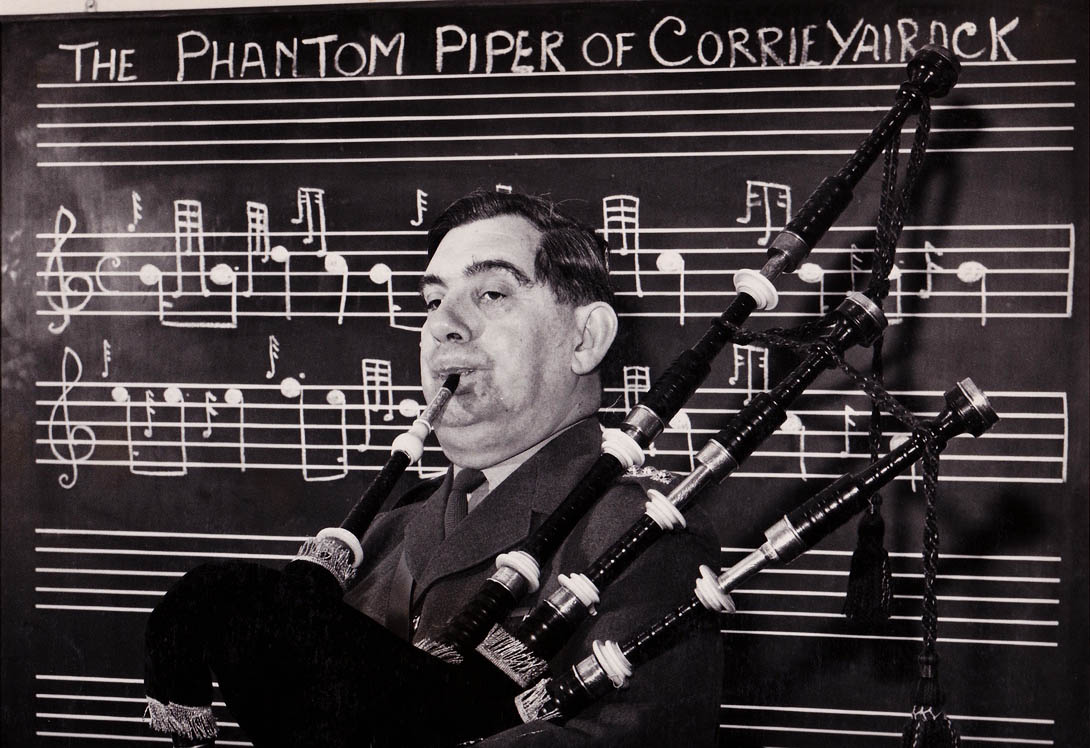
Before running the Army School from 1959 to 1974, teaching and training dozens of regimental pipers in the famed Pipe-Majors’ Course at the Castle, MacLellan made his mark as one of history’s greatest solo competition pipers. At the Northern Meeting, he won the Clasp twice and the Silver Star Former Winners MSR four times. He won the Bratach Gorm and the Former Winners MSR five times in London. At the Argyllshire Gathering, he captured two Senior/Open Piobaireachd and four Former Winners MSR titles.
In 1958, MacLellan was the first and, so far, only piper to gain the Grand Slam of solo piping by winning the Inverness Clasp and Silver Star and the Senior Piobaireachd and Former Winners MSR at Oban.
He published six music and instructional collections and founded and edited the International Piper magazine for 10 years. Since he died in 1991, MacLellan’s piobaireachd compositions have taken their rightful place alongside the greatest works of ceol mor and are now heard regularly in competitions and recitals worldwide.
To put a bow on the series gift-wrapped for pipes|drums readers, here’s our discussion on the series with Colin MacLellan.
Here’s a transcript of the discussion, with editing for written clarity.
pipes |drums: We have Colin McClellan with us to wrap up the end of the Castle Recordings. We’ve done 151 piobaireachds recorded by Captain John A. MacLellan. It’s been a terrific series. We thought we’d talk to Colin, who procured all the tapes and put them together to ensure the recordings get to us. Colin, thanks a lot for getting together.
Colin MacLellan: You’re more than welcome. It’s been a fascinating presentation of the tunes and a great place to have them lodged and available to whoever wants to listen to them.
pipes|drums: Yeah, it’s a fantastic library of recordings from the 1960s. Maybe we can talk about the importance of the recordings. Why are they important to piping and piping posterity?
Colin MacLellan: One of the things I feel about these recordings is that in those days, people didn’t have the vast repertoires of tunes that sometimes modern players have. In those days, you played in the competitions and you basically learned your set tunes for Oban and Inverness. Nowadays, there’s so many different competitions with so many requirements that people build up great big repertoires.this business of recording which was essentially the entire Piobaireachds Society collection up until that time was quite extraordinary feat for somebody to record 120, 130, 140 Piobaireachds. I think it was really, really important because they were made for the Army School of Piping, of which my father was the first chief instructor, and they were made as part of to build and construct a teaching curriculum and be part of that. And it was how he felt the tunes went then. It’s a snapshot in time. Later on, he changed his mind on a of things and I heard him play a lot of these tunes slightly differently, sometimes quite a bit differently, and I was the beneficiary, amongst other pupils, of his who heard and understood the development of the tunes.
He was definitely one of the most innovative and open-minded people that I’ve ever met, in terms of being creative in producing outstanding interpretations of piobaireachd.
pipes|drums: And so you’re saying that these are essentially a snapshot in time of how he was playing those tunes within a space of two or three, four years. And he would have been a proponent himself, changing his mind on musical interpretation?
Colin MacLellan: Well, he was definitely one of the most innovative and open-minded people that I’ve ever met, in terms of being creative in producing outstanding interpretations of piobaireachd. It’s really interesting because the late John McFadden once said, he said there are two or three stages in a piper’s piobaireachd learning: One, you learn to play, obviously, and then you start learning to play piobaireachd, and you learn piobaireachds, and then you start to compete.
What you’re doing is you learn a tune and then you perfect the tune to play in the competition. And he maintained that it was only afterwards that you studied the tune and understood it after you finished competing, because the whole competing business was just taking the tune, learning it and perfecting it technically and bagpipe-wise and all that kind of thing. And it was only after the competing phase was over that people got the opportunity and the time to actually study the tunes, as it were. Since I started judging a lot and understanding what the tunes are all about, I can really appreciate the whole development of understanding the music.
pipes|drums: It’s almost like your best playing comes after your competing days are over.
Colin MacLellan: Sometimes that might be the case. Of course, if you can keep your technical ability up, you certainly are a better player the older you get. I believe that. I think it’s very important and the tapes are important in that. They are a reference rather than a sort of thing to be merely copied because we have in this day and age, we have so much access now to recorded music, fortunately, because it’s a great advantage, but a bit of a double-edged sword in that people will tend just to go and copy somebody really, really good. It’s either my father, Pipe-Major MacLeod, Nicol and Brown or any of the people who had access to the recordings. You can copy these tapes and be reasonably assured that what you’re playing is very, very good, especially for the purpose of competitions. The other problem is that it leads to people not going for actual tuition nearly as much as they used to.
They’re learning the tunes, memorizing them, but not studying them. I think that’s actually a little bit of a disadvantage of all the proliferations of recordings being available.
Back to the business of understanding the tunes. They’re doing exactly what John MacFadyen said: They’re learning the tunes, memorizing them, but not studying them. I think that’s actually a little bit of a disadvantage of all the proliferations of recordings being available.
pipes|drums: It seems to us, the technology itself, even though we might look back on reel-to-reel recorders in the quaint way now, at the time, was pretty cutting-edge, still cutting-edge. And do you think your father was an early adopter of technology for teaching purposes? We know Brown and Nicol were great champions of recording lessons and things. Do you think your dad was? Was this a response, maybe, to Brown and Nicol?
Colin MacLellan: I’m not sure whether it was a response at the time; it wasn’t easy to record. I think the equipment that my father had to acquire, probably as a private citizen, might have been quite hard to acquire for a private citizen. He had these two great big, very expensive, very heavy Grundig recording machines, the same kind that the BBC used and the reel-to-reel tapes.
Making the recordings wasn’t easy. I say, he had the facilities and the funding of the Army School of Piping. The funding wouldn’t have been great, but he would have used whatever funds were available wisely. And that’s one of the ways he did it. Later on, with the invention of the much cheaper cassette recorder, I’m not 100 % sure about that, but possibly other teachers started using the recordings a lot more when that device became freely available both for the teachers and students. In the beginning, it was difficult to record.
My father’s sort of a mentor and teacher was Pipe-Major Ross. I think it’s unfortunate that there are virtually no recordings of Ross playing piobaireachd. I think it’s a massive loss to the piping world because. He was an absolutely fantastic piobaireachd player. There are lots of recordings of his light music, which is terrific listening. He’s an absolutely marvelous player, so his piobaireachd would have no doubt been to the same standard, but there is nothing. I think there’s one piobaireachd somewhere of Pipe-Major Ross playing a piobaireachd, and that’s it. There’s no such thing as, say, “The Willie Ross Style,” and so we can only go by his pupils, the style they played in – my father, people like John Burgess and others who were taught by Ross for an idea of how he actually played. It’s really interesting and a loss to the whole progression of teaching that his piobaireachds are not available.
pipes|drums: Considering the prominence of your father’s compositions in the last 10 or 20 years, they’ve risen to the fore. “Farewell to the Queen’s Ferry,” certainly “The Phantom Piper,” “The Edinburgh Piobaireachd,” and others are becoming almost standard in top-level competitions and even in the amateur rings too. Do you think this series will contribute more to the legacy of your father and his compositions?
Colin MacLellan: No doubt it will. The thing about piping is, quite often, success is measured in prizes won, and people get very, very influential by how many of this or that they’ve won. My father won his share, or more than his share of prizes. But having the recordings freely available gives people an idea of just what kind of piobaireachd player he was. He was a very bold, very exciting, very interesting piobaireachd player. Leading on to his compositions, they’ve become much better known through public performances at the John MacLellan Memorial Dinner Recital. Indeed, it’s been fantastic in the last 10 years to see how many of these big prizes are being won with my father’s tunes.
I hasten to think that almost by any other composer living or dead now, these tunes are major compositions, and people are not only submitting the tunes for large, important competitions when they’re set tunes, but, more importantly, they’re putting them in as their own free choice.
The tunes you mentioned, “The Queen’s Ferry,” “The Edinburgh Piobaireachd,” there are four or five very big major tunes and there are some other smaller ones. Later on in his life, he started making slightly smaller tunes. The whole thing is very interesting, and these recordings will help show everybody the big picture between what kind of piobaireachd player he was and what kind of composer he was.
I often wonder what would happen if . . . Pipe-Major [Donald] MacLeod, my father, or even as recent as John Burgess, came and played on the stage today. How would they be received? My guess is that they would say, “It’s just too fast.” Which I think would be a real shame, because that means we’re not accepting a broad range of playing styles. We should be accepting a wide range of tempos in playing.
pipes|drums: Will it prompt pipers to give piobaireachd a little more “go” than the dirgy sort of style that we’ve heard so much in the past?
Colin MacLellan: Well, I hope so, because I think there is a trend, and people have been observing this for many years now, in piobaireachd playing, and even more so in light music, of tempos slowing down to a funereal pace in some cases.
And I think piping and competitions standardized this idea of tempo and style. I often wonder what would happen if one of these great players of yesteryear, Pipe-Major [Donald] MacLeod, my father, or even as recent as John Burgess, came and played on the stage today. How would they be received? My guess is that they would say, “It’s just too fast.” Which I think would be a real shame, because that means we’re not accepting a broad range of playing styles. We should be accepting a wide range of tempos in playing.
In the past, players have played at a slower tempo. One of those players that I heard was, and he was a beautiful, march, strathspey and reel players – two people. They’re both from Argyll, funnily enough: Pipe-Major John MacKenzie was a beautiful, beautiful, march, strathspey and reel player. He played down at about, at the time I heard him in the 1970s, 66 beats to a minute in a march, which now is about the standard. But it was very, very conservative then. And the other really marvellous player I heard was Pipe-Major Ronald McCallum, who played in much the same style as John MacKenzie. I think there should be room for lots of different tempo variations in today’s competitive playing.
pipes|drums: Anything to add about the Castle Recordings as we say goodbye to the series, even though the series will live on forever in the pipes|drums archive?
Colin MacLellan: I’d just like to say that it’s been such a great pleasure working with you and pipes|drums in putting them out. I want them to be a service, a learning tool, and listening for people’s entertainment in the future. And I think they’re a very valuable source of material for a wide range of uses. It’s been a great pleasure for me to have been able to put them out to the wider public.
pipes|drums: Well, we want to thank you for thinking of pipes|drums. It’s an honour to be able to represent, to archive these important recordings and we hope – we know – that readers, listeners, viewers everywhere around the world will appreciate them. Thanks to you, Colin, for putting all of it together.
Colin MacLellan: My complete pleasure. Thank you.


NO COMMENTS YET